Typhoid FeverCauses, Symptoms, Diagnosis & Treatment
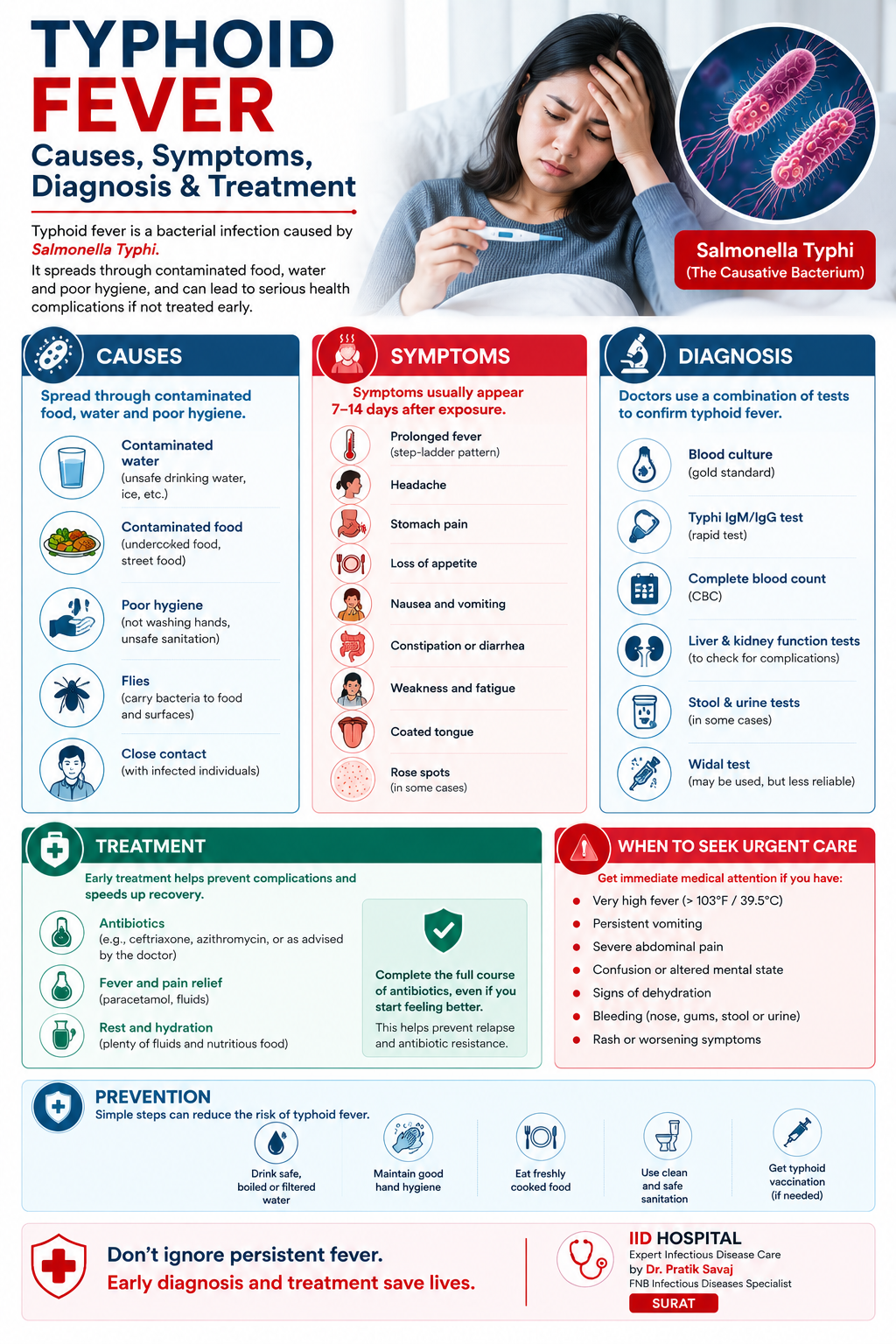
Typhoid fever is caused by Salmonella typhi, spread through contaminated food and water. It presents with a classic step-ladder fever that rises over days, abdominal symptoms, and relative bradycardia. Blood culture — not the Widal test — is the correct diagnostic test. Drug-resistant typhoid including XDR strains are increasingly common in Surat and Gujarat, making specialist-guided antibiotic selection essential.
What Is Typhoid Fever?
Typhoid fever — also called enteric fever — is caused by the gram-negative bacterium Salmonella enterica serovar Typhi (Salmonella typhi). The closely related species Salmonella paratyphi causes paratyphoid fever — clinically similar but generally milder. Both are transmitted exclusively through contaminated food and water — the faecal-oral route.
After ingestion, Salmonella typhi penetrates the gut wall, multiplies in the mesenteric lymph nodes, and then enters the bloodstream causing bacteraemia — which is responsible for the fever and systemic symptoms. The bacteria then colonise the gallbladder, Peyer’s patches (lymphoid tissue in the small intestine), and reticuloendothelial system.
Typhoid is a disease of inadequate water and sanitation infrastructure. It flourishes wherever drinking water can be contaminated with faecal material — through open defecation near water sources, flooding, broken sewage lines, or contaminated ice. In Surat, typhoid peaks during and after monsoon when flooding and water contamination increase.
Typhoid is Transmitted Only Through Contaminated Food and Water
Typhoid cannot spread through the air, casual contact, or being near a typhoid patient. It requires ingesting Salmonella typhi — from contaminated drinking water, ice, street food prepared with contaminated water, unwashed raw vegetables irrigated with contaminated water, or food handled by a typhoid carrier. Identifying the contamination source is important to prevent spread to household contacts.
The Step-Ladder Fever — Typhoid Symptoms Week by Week
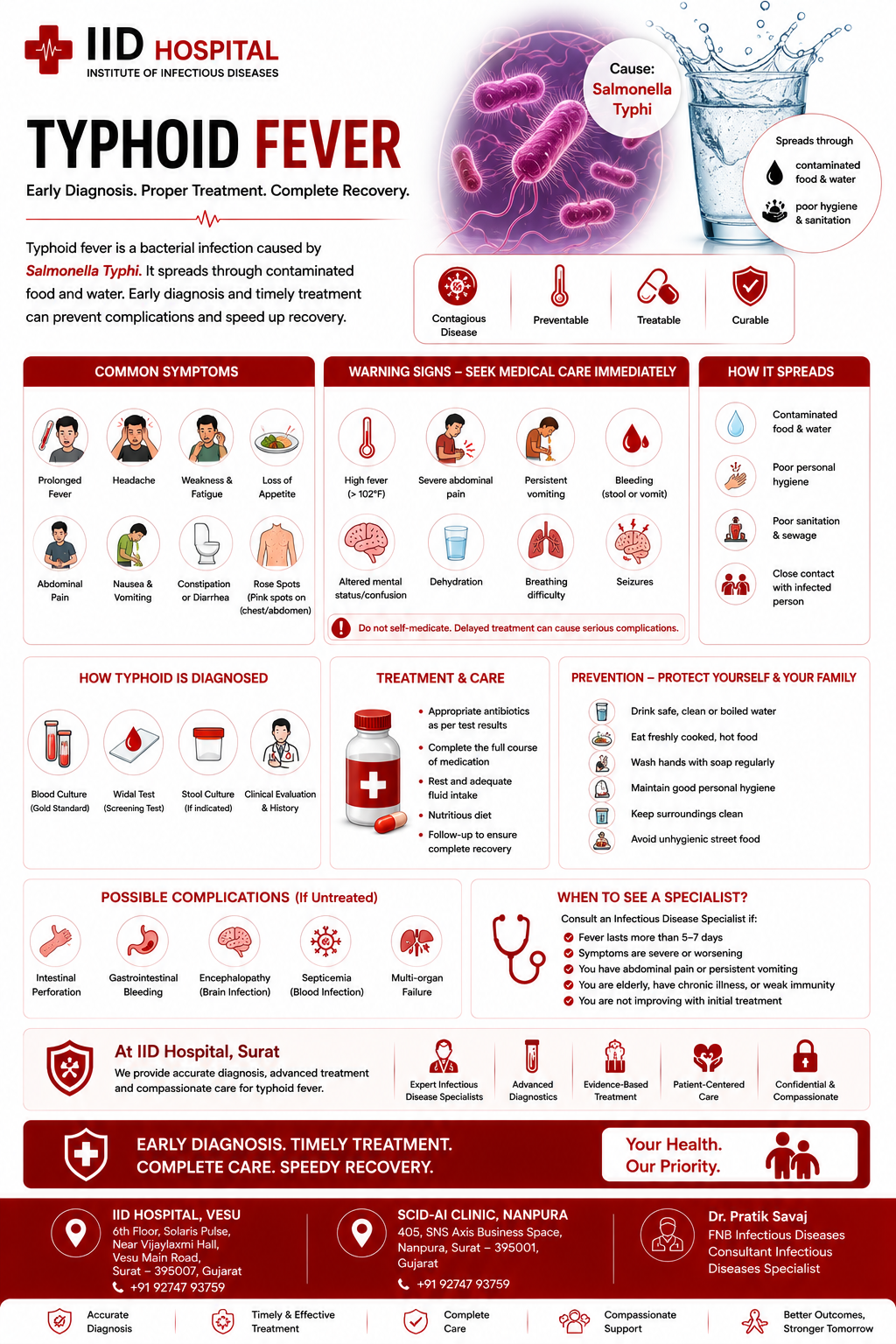
Unlike dengue’s sudden onset or malaria’s cyclical pattern, typhoid fever rises gradually in a step-ladder pattern — each day slightly higher than the last. This characteristic pattern and the week-by-week progression of symptoms makes typhoid clinically distinct.
Schematic representation of untreated typhoid fever — actual course varies. Antibiotic treatment resolves fever within 3–7 days.
Recognising Typhoid — The Classic Clinical Signs
Beyond fever, typhoid produces a constellation of signs that an experienced clinician can recognise. These findings — particularly the combination of rose spots, relative bradycardia, and a coated tongue — are so characteristic that they significantly raise clinical suspicion for typhoid before any test result is available.

Step-Ladder Fever Pattern
Fever rises progressively each day — 38°C on day 1, 39°C by day 3, 40°C+ by day 5–7. This gradual step-wise rise is characteristic of typhoid and distinct from the sudden-onset high fever of dengue or the cyclical fever of malaria.
Relative Bradycardia (Faget’s Sign)
In most infections, fever causes a corresponding rise in heart rate (tachycardia). In typhoid, the heart rate is inappropriately low for the degree of fever — for example, a temperature of 40°C with a pulse of only 70–80 bpm. This dissociation is Faget’s sign — highly suggestive of typhoid fever.
Rose Spots
Rose spots are small (2–4 mm), faint, pink, blanching macules that appear on the lower chest and upper abdomen during week 2, in crops of 10–20. They are caused by bacterial emboli in skin capillaries. They fade in 2–3 days and are seen in about 30% of patients — harder to see on darker skin.
Coated Tongue
A heavily coated tongue — white or yellowish coating with red tip and edges — is a classic typhoid sign. The coating is thickest in the second week and gradually clears as the patient recovers. Combined with abdominal pain and step-ladder fever, it strongly suggests typhoid.
Hepatosplenomegaly
Enlargement of the liver and spleen is present in approximately 60–80% of typhoid patients during week 2. The liver and spleen are enlarged due to bacterial infiltration and immune cell proliferation. Both are usually soft and mildly tender. Significant splenomegaly increases the risk of rupture.
Typhoid Psychosis
In severe typhoid (typically week 2–3), patients may develop marked confusion, agitation, or delirium — historically called “typhomania”. This occurs due to toxaemia affecting the brain. It is more common in high-fever states and with inadequate hydration. Usually resolves with effective antibiotic treatment.
Complications to Watch For in Week 3
The most feared typhoid complication is intestinal perforation — ulceration through the Peyer’s patches causes a hole in the bowel wall, leaking intestinal contents into the peritoneal cavity. This presents as sudden severe abdominal pain and rigidity — a surgical emergency with high mortality. Any typhoid patient who develops sudden worsening of abdominal pain must be assessed for perforation immediately.
The Widal Test — Why It Should Not Guide Treatment
The Widal test measures antibody titres against Salmonella typhi antigens. It was developed in 1896 and remains widely used in India — because it is cheap, fast, and widely available. But it should not be the basis for treating typhoid, and acting on a positive Widal without blood culture leads to overdiagnosis and inappropriate antibiotic use.
Extremely poor specificity in India. Prior typhoid vaccination, other Salmonella species, malaria, dengue, liver disease, autoimmune conditions, and even healthy adults living in endemic areas can produce “positive” Widal titres. In Surat, a significant proportion of healthy individuals have Widal titres that would be called “positive” elsewhere.
Antibodies take 7–10 days to appear — so Widal is negative in the first week when typhoid is most treatable and blood culture positivity is highest.
No internationally agreed cut-off titre that reliably distinguishes active infection from background positivity in endemic populations.
Cannot assess antibiotic sensitivity. Even if a Widal were reliable for diagnosis, it provides no information about which antibiotic the organism is sensitive to — critical in the era of MDR and XDR typhoid.
Blood Culture — The Correct Diagnostic Test
Blood culture is the gold standard for typhoid diagnosis and the only test that allows antibiotic sensitivity testing (AST). A positive blood culture confirms the diagnosis definitively. It also identifies the organism (Salmonella typhi vs paratyphi) and tells you exactly which antibiotics it is sensitive to — essential when MDR and XDR strains are circulating in Surat.
Highest sensitivity in week 1 (80–90%) — exactly when clinical suspicion is first raised and Widal is still negative. Blood should be cultured at the first visit.
Antibiotic Sensitivity Testing (AST) on the cultured organism guides exact antibiotic selection. This is non-negotiable when XDR typhoid is circulating locally — the wrong antibiotic will fail.
TYPHIDOT (IgM/IgG rapid test) is a better alternative to Widal for rapid serology — more specific, more sensitive, and available as a rapid test. Can be positive from day 4–6. But blood culture plus AST is still the definitive approach.
Stool and urine culture add sensitivity in week 2–3 when blood culture positivity begins to decline. Bone marrow culture has the highest overall sensitivity but is invasive — used for antibiotic-pretreated or culture-negative cases.
MDR and XDR Typhoid — A Growing Crisis in Gujarat
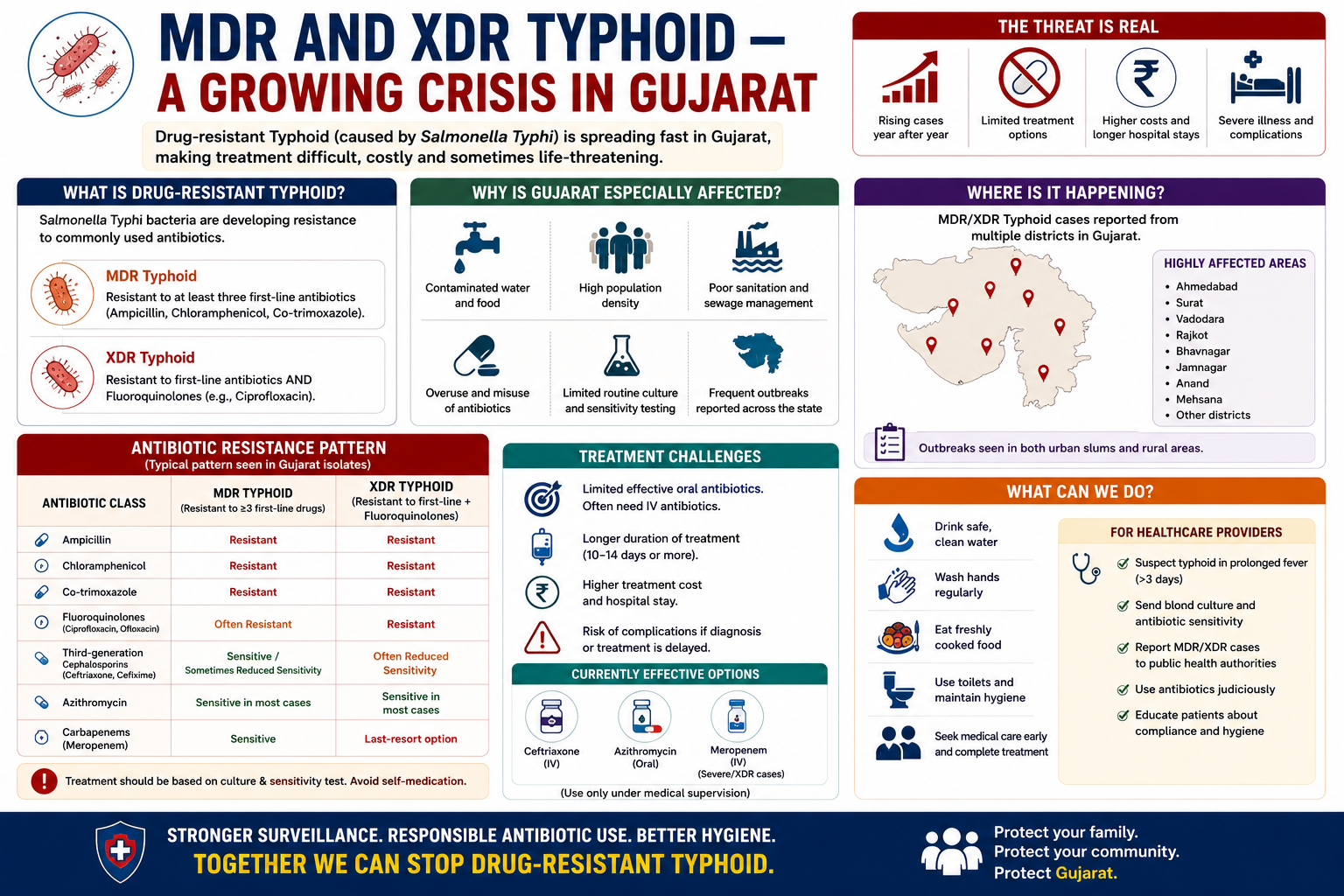
Drug-resistant typhoid is a major and worsening problem in Surat and Gujarat. The widespread, often empirical use of antibiotics for fever without culture-guided diagnosis has driven rapid emergence of resistance. Fluoroquinolone-resistant typhoid (resistant to ciprofloxacin — the most commonly prescribed antibiotic for typhoid) is now common throughout India.
In the last decade, XDR (Extensively Drug-Resistant) typhoid — resistant to fluoroquinolones, third-generation cephalosporins, and traditional first-line drugs — has emerged. This leaves only azithromycin and carbapenems (last-resort hospital IV drugs) as treatment options. Without AST to guide therapy, treating XDR typhoid empirically leads to treatment failure, prolonged illness, and complications.
| Resistance Type | Drugs Resistant To | Treatment Options Remaining | Prevalence in Surat/Gujarat |
|---|---|---|---|
| Drug-Sensitive (DS) | Sensitive to all first-line drugs | Ciprofloxacin, Ceftriaxone, Azithromycin, Chloramphenicol, Ampicillin | Decreasing — less common now |
| MDR Typhoid | Chloramphenicol, Ampicillin, Cotrimoxazole | Ciprofloxacin, Ceftriaxone, Azithromycin | Common |
| Fluoroquinolone-Resistant | Ciprofloxacin, Ofloxacin (reduced sensitivity or full resistance) | Ceftriaxone (IV), Azithromycin, Carbapenems | Very common in Gujarat |
| XDR Typhoid | All first-line + fluoroquinolones + third-generation cephalosporins | Azithromycin only (oral) or Meropenem (IV) | Emerging — increasing cases |
Why Blood Culture + AST Is Non-Negotiable in Surat
Prescribing ciprofloxacin for typhoid empirically in Surat — without a blood culture and AST — risks treating fluoroquinolone-resistant or XDR typhoid with a drug that will not work. Treatment failure means week 3 complications. Every typhoid case managed at IID Hospital has blood culture sent on day 1, and antibiotic selection is guided by the sensitivity result.
Complications of Typhoid — Why Early Treatment Matters
Most typhoid complications occur in week 3 of untreated or inadequately treated illness. They are largely preventable with early, appropriate antibiotic therapy. In patients already on treatment, watch for these signs even during apparent clinical improvement.
Occurs in 1–3% of typhoid patients, typically in week 3. Ulceration of the Peyer’s patches (lymphoid tissue in the small bowel) leads to perforation of the bowel wall. Presents as sudden severe abdominal pain, rigidity, absent bowel sounds, and rapid deterioration. Requires immediate surgical intervention (laparotomy and bowel repair) plus IV antibiotics covering bowel flora. Mortality 10–30% even with surgery. Any typhoid patient who develops sudden abdominal pain must be evaluated for perforation immediately.
Bleeding from ulcerated Peyer’s patches into the intestinal lumen. Presents as passage of dark or bright red blood in stool, sometimes with a sudden drop in blood pressure. Usually self-limiting if mild — but massive haemorrhage requires blood transfusion and may require surgical intervention. Haemorrhage often precedes perforation. Any bloody stool in a typhoid patient is a warning sign requiring urgent assessment.
Altered consciousness, confusion, or delirium (“typhoid psychosis”) occurring due to toxaemia affecting the brain. More common in severe illness with high fever and inadequate hydration. Not a true meningitis — CSF is usually normal. Responds to effective antibiotic treatment and fever control. Dexamethasone may be used in severe cases with altered consciousness to reduce mortality.
Approximately 1–4% of patients become chronic carriers — harbouring Salmonella typhi in the gallbladder for more than one year without symptoms. Chronic carriers shed the bacteria in stool intermittently and are an important source of ongoing typhoid transmission in the community. Chronic carriage is more common in women, elderly patients, and those with gallbladder disease. Treatment requires prolonged antibiotic therapy and sometimes cholecystectomy.
How Typhoid Is Treated — Antibiotic Selection and Duration
Send Blood Culture on Day 1
Before starting antibioticsBlood culture must be collected before any antibiotic is given — antibiotics significantly reduce blood culture positivity even after a single dose. This is the most important step and the most commonly skipped one. Blood culture + antibiotic sensitivity testing (AST) is the foundation of correct typhoid management in an era of drug resistance. At IID Hospital, blood culture is collected at the first visit for every suspected typhoid case.
Empirical Treatment While Awaiting Culture
Guided by local resistance patternsWhile awaiting blood culture results (typically 3–5 days), empirical treatment must account for local resistance patterns. In Surat where fluoroquinolone resistance is common: Ceftriaxone 2g IV once daily is the preferred empirical choice for moderate–severe illness. Azithromycin (500–1000 mg/day for 7 days) for mild outpatient cases. Avoid ciprofloxacin empirically in Surat given local fluoroquinolone resistance rates.
De-Escalate or Step Up Based on AST
Culture-guided precisionOnce blood culture results and AST are available, antibiotic therapy is adjusted to the most targeted, narrowest-spectrum effective drug. If sensitive to ciprofloxacin — switch to oral ciprofloxacin. If MDR — continue ceftriaxone or azithromycin. If XDR — escalate to meropenem (IV) or high-dose azithromycin. This culture-guided approach is what distinguishes specialist-level typhoid management from empirical general practice.
Treatment Duration
Complete the full courseTyphoid treatment must be completed for the full prescribed duration: Ciprofloxacin: 10–14 days. Ceftriaxone IV: 10–14 days. Azithromycin: 7 days. Stopping early leads to relapse (5–10% rate even with full course). Continue treatment for at least 5 days after fever resolves — not until fever breaks. Fever typically resolves in 3–7 days with effective antibiotics.
Supportive Care
Equal importance to antibioticsAdequate hydration (3–4 litres/day oral or IV), paracetamol for fever, soft easily digestible diet (no high-fibre foods), bed rest. Avoid NSAIDs — they can mask fever and mask early signs of complications. Monitor temperature twice daily and report any sudden worsening of abdominal pain immediately. Dexamethasone IV is indicated in severe typhoid with altered consciousness — reduces mortality significantly in this subgroup.

Never Do This in Typhoid
Free Typhoid Treatment in India
All typhoid medicines including ceftriaxone and azithromycin are available at government hospitals. Blood culture and sensitivity testing is available at district hospitals under NRHM. However, in Surat where XDR typhoid is emerging, specialist-guided treatment with local resistance pattern data gives significantly better outcomes than empirical treatment.
Preventing Typhoid — Food, Water, and Vaccination
Typhoid is entirely preventable. Every case of typhoid represents a failure of food safety or water sanitation. Prevention works at three levels — personal food and water hygiene, vaccination, and broader community sanitation improvements.
Food & Water Safety
Drink Only Safe Water
Boil water for 1 full minute before drinking or use water purified with a certified filter. Municipal tap water in Surat is treated but can be contaminated through old pipes or monsoon flooding. During monsoon, assume tap water is unsafe unless boiled or filtered.
Avoid Street Food and Outside Ice
Street food, roadside juices, pani puri, and outside food in Surat are prepared with water of uncertain quality. Ice added to drinks outside the home is a common transmission route. During typhoid outbreaks in Surat, avoid all outside food and drinks.
Handwashing After Using the Toilet
Typhoid spreads through the faecal-oral route. Thorough handwashing with soap and water after using the toilet and before handling food is one of the most effective individual prevention measures. Handwashing with water alone is insufficient — soap must be used.
Wash Fruits and Vegetables
Raw vegetables and fruits can be contaminated through irrigation with contaminated water. Wash thoroughly under running water. Peel fruits before eating. Avoid raw salads outside the home during typhoid outbreak seasons.
Vaccination & High-Risk Groups
Typhoid Conjugate Vaccine (TCV)
Typbar-TCV is WHO-prequalified and provides longer-lasting immunity than the older Vi polysaccharide vaccine. Given from age 6 months. Recommended for: household contacts of confirmed typhoid patients, travellers to high-risk areas, and communities in typhoid-endemic regions. Not 100% effective — food and water hygiene must continue.
Food Handlers and Healthcare Workers
Food handlers, restaurant staff, street food vendors, and healthcare workers are at higher risk and are important vectors of typhoid transmission to others. Annual typhoid vaccine and regular stool culture testing for chronic carriage are recommended for this group.
Household Contacts of Typhoid Patients
Household contacts of a confirmed typhoid patient are at high risk. Prophylactic vaccination of all household contacts is recommended. Shared food preparation areas should be cleaned thoroughly. Contacts should watch for fever for 2–3 weeks after the index case’s illness onset and seek assessment if they develop fever.
Community WASH Improvements
Safe water supply, sanitation infrastructure, and community hygiene education are the only long-term solutions to typhoid. Individual prevention reduces personal risk but cannot eliminate typhoid without addressing the underlying WASH (Water, Sanitation and Hygiene) infrastructure in Surat’s high-density areas.
Typhoid cases annually in India — one of the world’s highest burdens
India accounts for a disproportionate share of the global typhoid burden, driven by inadequate water and sanitation infrastructure in densely populated urban areas. Surat is one of India’s highest-risk cities for typhoid — combining high population density, migrant worker populations from high-burden states, monsoon flooding that contaminates water supplies, and widespread street food consumption.
What makes typhoid in Surat uniquely challenging is the rapid emergence of drug resistance. The widespread empirical use of ciprofloxacin for any undifferentiated fever — without blood culture — has driven fluoroquinolone resistance rates in Salmonella typhi to very high levels. XDR typhoid, previously rare, is now appearing with increasing frequency in patients presenting to IID Hospital after failing community treatment.
Monsoon Alert — When to Test in Surat
Any fever during or after monsoon in Surat that has lasted 3–5 days without a clear source should have blood culture sent for typhoid. The classic step-ladder fever pattern + abdominal symptoms + monsoon timing is a high-specificity clinical picture. Blood culture on day 1 of specialist assessment before any antibiotic is given.

What Patients Say About Dr. Pratik Savaj
I had 12 days of fever before anyone found the cause. Dr. Savaj cultured my blood, confirmed S. Typhi, and started the correct antibiotic the same day. My fever resolved within 72 hours. Three other doctors had missed it entirely.
I had XDR typhoid — resistant to fluoroquinolones and the usual antibiotics. Dr. Savaj chose azithromycin based on the sensitivity report and my fever cleared. Without his specialist knowledge of resistance patterns I would have deteriorated.
I relapsed with typhoid three weeks after completing a course elsewhere. Dr. Savaj identified the relapse immediately, explained why it happens, completed a proper extended course, and I have been well since. His explanation of the biology was remarkable.
My son developed typhoid with intestinal bleeding. Dr. Savaj managed the complication expertly with IV ceftriaxone and strict monitoring, avoiding surgery. His clinical judgement on when to observe versus intervene was exactly right.
Dr. Savaj vaccinated my entire family before our trip to a high-risk area. He explained the difference between the injectable and oral vaccines clearly and which was more appropriate for us. Two months later a colleague who wasn't vaccinated got typhoid — we did not.
The Widal test elsewhere was positive but Dr. Savaj explained it was unreliable and ordered blood culture instead. Culture confirmed typhoid. He treated me correctly from the start and I recovered fully within a week. The right test made all the difference.
Frequently Asked Questions
About Typhoid Fever
Answered by Dr. Pratik Savaj, FNB Infectious Diseases — IID Hospital, Vesu, Surat.