
— and needs specialist investigation
Persistent FeverWhat It Means and What to Do
A fever that has lasted more than 2–3 weeks without a clear diagnosis is not “just viral.” It is a signal that the underlying cause has not yet been identified — and that systematic specialist investigation is needed. In India, the most common causes are tuberculosis, hidden infections, lymphoma, and autoimmune conditions. Each requires a different diagnostic pathway.
self-limits
assessment
FUO workup
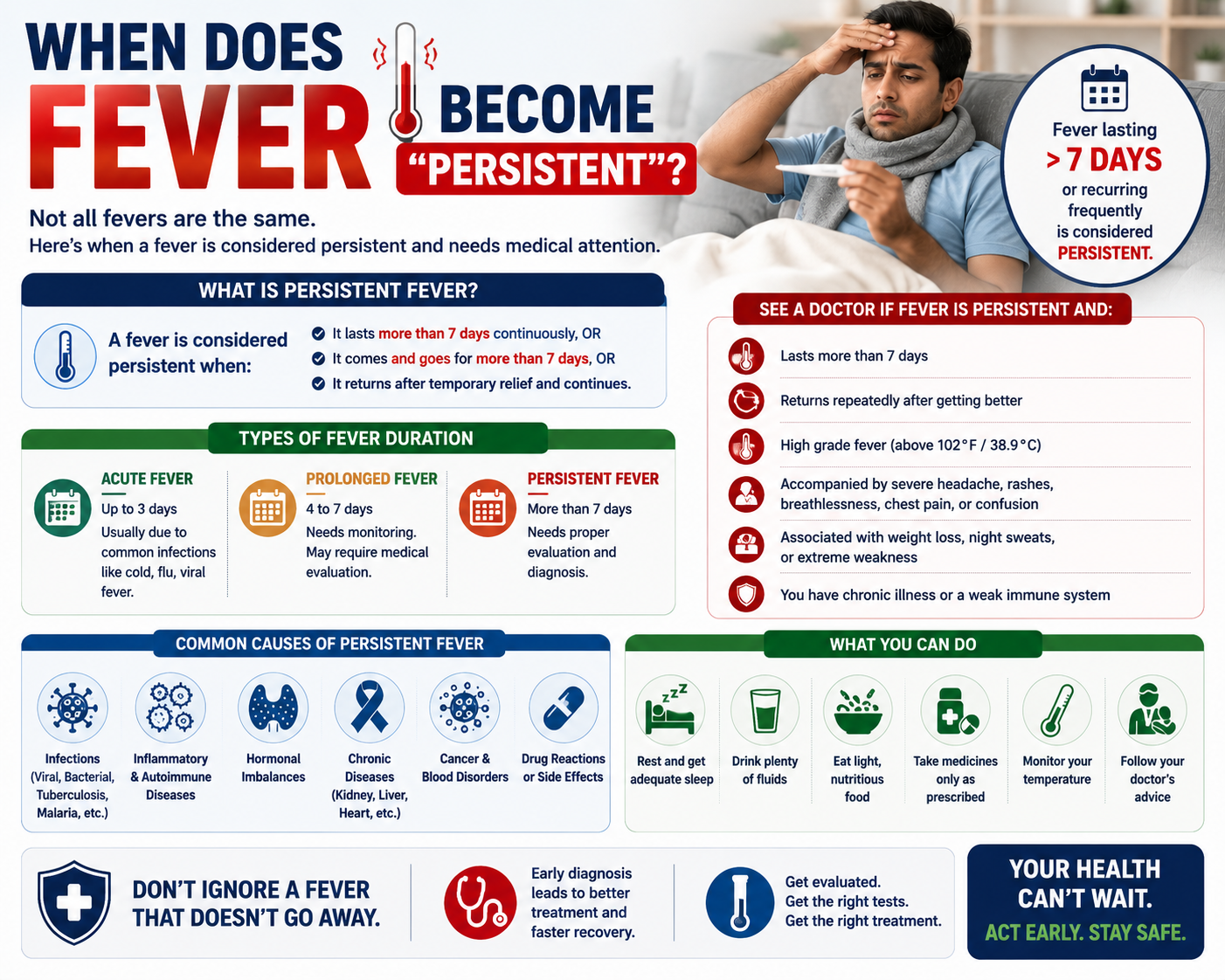
When Does Fever Become “Persistent”?
Fever becomes persistent — and clinically significant in a different way — when it lasts beyond the expected duration for a self-limiting viral illness. Most viral fevers resolve within 3–7 days. Fever persisting beyond 7–10 days without a clear diagnosis warrants assessment. Fever beyond 3 weeks is the formal threshold for Fever of Unknown Origin (FUO) investigation.
The key clinical distinction is not just duration — it is the absence of a diagnosis. A confirmed dengue patient with fever on day 6 has “persistent fever” in duration but a known cause. The clinically urgent situation is fever of equal duration where the underlying cause remains unidentified after basic investigation — because that is where dangerous but treatable conditions are hiding.
In India, persistent unexplained fever has a different differential than in Western countries. Tuberculosis (particularly extrapulmonary TB with a normal chest X-ray) is the most common cause. Other common Indian causes include: enteric fever presenting atypically, infective endocarditis, liver and intra-abdominal abscesses, visceral leishmaniasis (kala-azar), and brucellosis. These must be excluded before pursuing rarer diagnoses.
The Most Common Mistake
Treating persistent fever with repeated courses of antibiotics without a diagnosis. Each antibiotic course sterilises blood cultures, delays diagnosis, selects for drug resistance, and allows the underlying condition to progress. Blood culture before the first antibiotic dose is the single most important action in persistent fever investigation.
Questions to answer at assessment
The Three Categories of Fever of Unknown Origin
Persistent fever falls into three broad diagnostic categories. The percentages below reflect the distribution in India — where infectious causes are more common than in Western FUO series, largely due to the TB burden and endemic tropical infections.
Infectious Causes
Most common in India — TB leads
Malignant Causes
Often present as fever before other symptoms
Inflammatory & Autoimmune
Immune system attacking own tissues
5–15% of FUO Remains Undiagnosed
Even after comprehensive specialist investigation, a proportion of persistent fever cases yield no diagnosis. Many of these resolve spontaneously. In these cases, watchful waiting and periodic reassessment is preferable to empirical treatment — which risks treating the wrong condition and potentially masking the true diagnosis when it eventually declares itself.
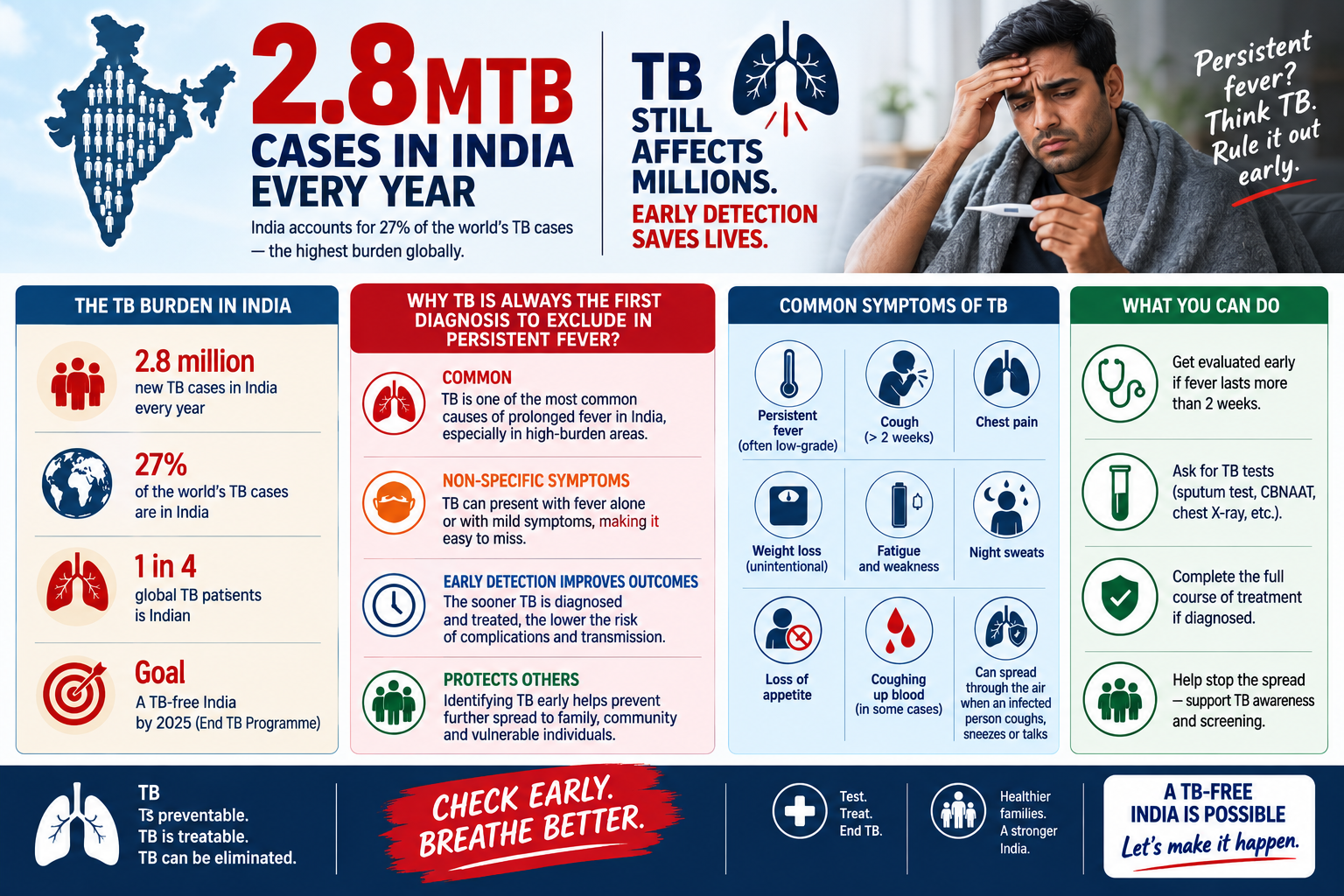
Tuberculosis is the most common cause of persistent fever in India and is frequently missed because it presents in ways doctors don’t expect. The classic picture — cough + haemoptysis + weight loss + abnormal chest X-ray — is pulmonary TB, which is the minority of missed TB cases. Extrapulmonary TB presents with persistent fever and a normal chest X-ray.
TB can affect lymph nodes (firm, painless swelling in neck or armpit), spine (back pain with neurological symptoms), abdomen (pain, ascites, altered bowel habit), meninges (headache, neck stiffness), kidneys (sterile pyuria — white cells in urine with no bacteria), pericardium (fever with pericardial effusion), and virtually any other organ. In all these forms, the chest X-ray may be completely normal.
How IID Hospital Excludes TB in Persistent Fever
TB Treatment Should Never Be Started Without a Diagnosis
Empirical TB treatment without microbiological confirmation is practiced when clinical suspicion is overwhelming and diagnosis is not feasible. But every effort must be made to obtain a diagnostic specimen first — because drug-resistant TB (MDR/XDR) requires completely different treatment, and a positive culture with DST allows correct drug selection. Dr. Savaj always attempts microbiological confirmation before initiating TB treatment.
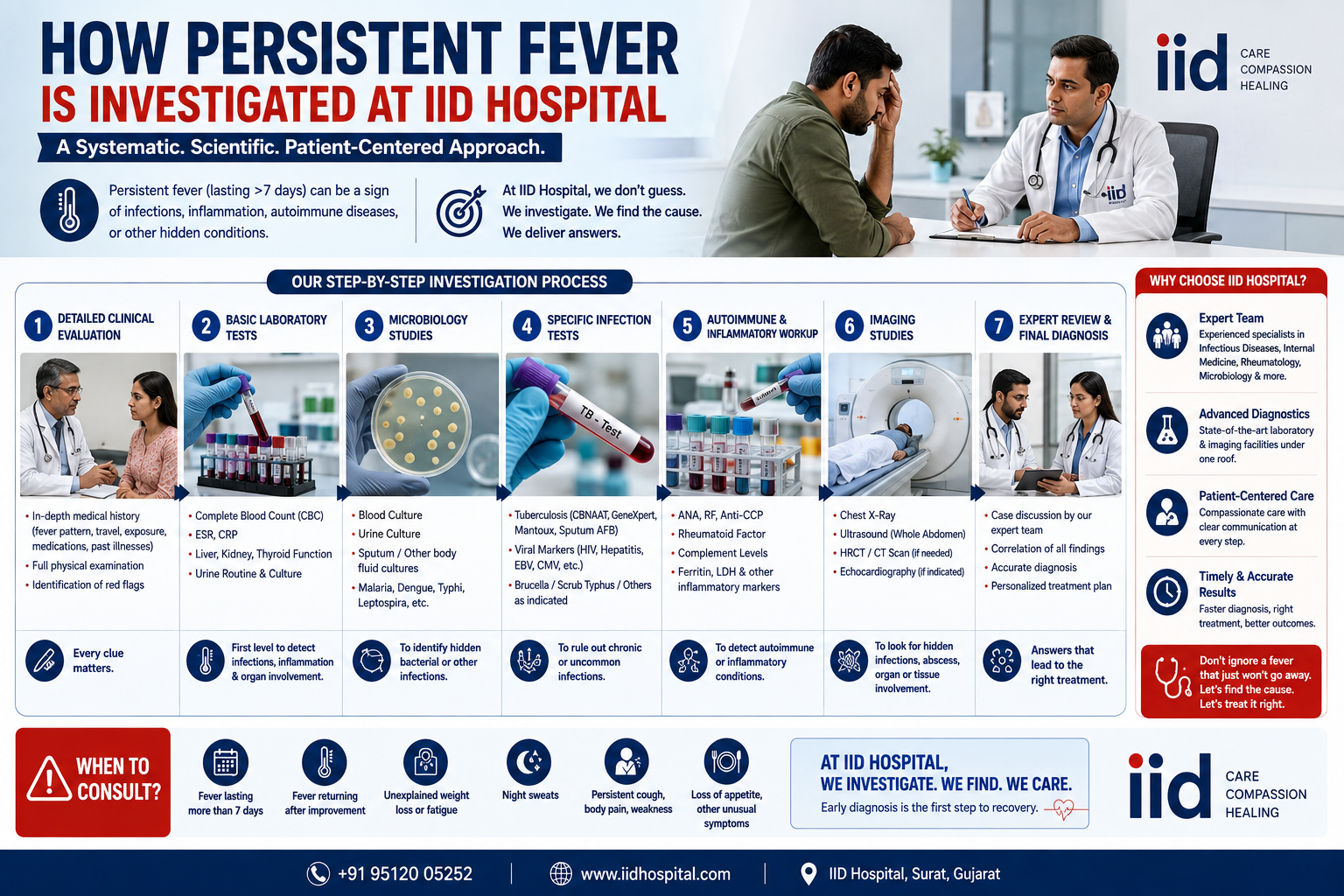
How Persistent Fever Is Investigated at IID Hospital
Investigation follows a structured, sequential protocol — not random test ordering. Tests are selected based on clinical probability and are done in phases, with each phase guiding what comes next.
First-Line Tests — Day 1 of Assessment
Before any antibioticSecond-Line — Based on First-Line Results & Clinical Picture
Days 3–7Third-Line — When Diagnosis Remains Elusive
Week 2–3 if neededBring All Previous Reports
Previous blood tests, imaging reports, culture results, and antibiotic prescriptions are invaluable — they tell Dr. Savaj what has already been excluded and prevent repetition. Do not take new antibiotics before your appointment if at all possible — this reduces blood culture yield.
What Raises Immediate Red Flags
When Persistent Fever Becomes a Medical Emergency
Persistent fever is usually not an emergency — but certain accompanying signs transform it into one. These red flags require emergency assessment immediately, not a scheduled clinic appointment.
WhatsApp Dr. Savaj UrgentlyConfusion or altered consciousness
Meningitis, cerebral malaria, encephalitis, or typhoid encephalopathy — all require emergency assessment.
Neck stiffness + severe headache
Meningitis until proven otherwise. Do not delay for scheduled investigation.
Sudden severe abdominal pain
Typhoid perforation or intra-abdominal abscess rupture. Surgical emergency.
Breathlessness at rest
Pericardial effusion (TB pericarditis), pleural effusion, pneumonia — cardiac tamponade risk.
Bleeding from any site with fever
Possible endocarditis with embolic phenomena, or haematological malignancy with thrombocytopenia.
Rapidly worsening jaundice
Severe leptospirosis (Weil’s disease), liver abscess rupture, or fulminant hepatitis — potential liver failure.
Cold extremities + rapid pulse
Septic shock — requires emergency antibiotics and ICU. Do not wait.
Fever in severely immunocompromised patient
HIV with CD4 <50, chemotherapy-induced neutropenia, post-transplant: any fever is an emergency.
Why Persistent Fever Needs an Infectious Disease Specialist
Most patients with persistent fever have already seen one or more general physicians before reaching IID Hospital. They have been given antibiotics — sometimes multiple courses — without a diagnosis. The fever persists. The reason this happens is not a failure of the general physician — it is that persistent unexplained fever is specifically what infectious disease specialists are trained for.
Systematic Protocol, Not Random Testing
Dr. Savaj applies a structured, sequential FUO investigation protocol built on clinical probability — not ordering everything at once. Each phase of investigation is guided by the results of the previous phase. This finds the diagnosis faster and avoids wasting resources on low-probability tests before high-probability ones are excluded.
Extrapulmonary TB Recognition
TB with a normal chest X-ray is the most commonly missed diagnosis in Indian persistent fever. Dr. Savaj has specific training from P.D. Hinduja Hospital — one of India’s principal TB centres — in diagnosing extrapulmonary TB. He knows exactly which specimens to send, in what order, and how to interpret the results.
No Empirical Antibiotics Without a Plan
Every antibiotic course given without a diagnosis reduces the chance of finding the diagnosis. At IID Hospital, antibiotics are used when there is clinical urgency requiring treatment before culture results are available — not as a default response to persistent fever. Blood culture is always sent first.
Cross-Speciality Awareness
Persistent fever can be infectious, malignant, or autoimmune. An infectious disease specialist trained in all three categories — and who knows when to refer to haematology, rheumatology, or oncology — is uniquely positioned to navigate the full differential diagnosis systematically rather than managing only one category.

What Patients Say About Dr. Pratik Savaj
I had 18 days of fever and had already seen three doctors. Dr. Savaj asked about my travel history, ordered a targeted set of tests including blood culture and dengue NS1, and diagnosed typhoid within 48 hours. The right diagnosis the first time — not more antibiotics guessed.
My fever lasted 6 weeks. Dr. Savaj did a structured workup — including bone marrow biopsy — and found disseminated tuberculosis. He was the first doctor to consider TB as the cause. Treatment resolved the fever completely within 3 weeks.
I had fever every 3 weeks for 4 months. Dr. Savaj identified a pattern consistent with tertian malaria and confirmed P. vivax. He also explained why previous treatment had failed and completed a proper radical cure. No recurrence in 8 months.
My daughter had fever for 3 weeks and was admitted to hospital twice without a diagnosis. Dr. Savaj took a detailed history, noticed neck stiffness we had attributed to sleeping posture, and diagnosed cryptococcal meningitis. Specialist-level thinking saved her.
I am HIV-positive and developed fever lasting 2 months. Dr. Savaj investigated opportunistic infections simultaneously — found CMV viraemia — and adjusted my ART. He manages both my HIV and any fever episodes in one integrated appointment.
After returning from Rajasthan I developed fever and joint pain. Multiple doctors said it was viral. Dr. Savaj diagnosed chikungunya with post-viral arthritis and gave me a structured recovery plan. He also ruled out malaria and dengue properly.
Frequently Asked Questions
About Persistent Fever
Answered by Dr. Pratik Savaj, FNB Infectious Diseases — IID Hospital, Vesu, Surat.