HIV SpecialistSurat — Confidential, Expert, Compassionate
IID Hospital provides complete HIV care under one roof — HIV testing, ART initiation and management, PEP (within 72 hours), PrEP, HIV-TB co-infection management, and PMTCT. No referral needed. No judgement. Every consultation is legally confidential under the HIV and AIDS (Prevention and Control) Act, 2017.
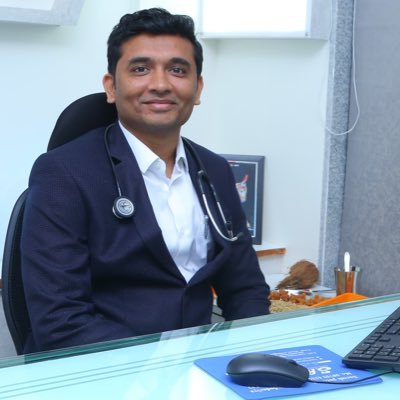
What Is HIV — and How Is It Different From AIDS?
HIV (Human Immunodeficiency Virus) is a virus that attacks the immune system — specifically CD4 T-cells, the white blood cells that coordinate immune defence against infections and cancers. Over time, without treatment, HIV progressively destroys these cells, leaving the body unable to fight ordinary infections.
AIDS (Acquired Immunodeficiency Syndrome) is not a virus — it is the most advanced stage of HIV infection, defined as a CD4 count below 200 cells/mm³ or the presence of an AIDS-defining illness (tuberculosis, Pneumocystis pneumonia, CMV retinitis, Kaposi’s sarcoma, and others). AIDS is what happens when HIV infection is left untreated for years.
The critical point: with modern antiretroviral therapy (ART), people with HIV never need to reach the AIDS stage. ART suppresses HIV to undetectable levels, allowing the immune system to recover, CD4 count to normalise, and the person to live a near-normal lifespan. HIV today is a manageable chronic condition — not a death sentence.
HIV
The virus itself. A person can live with HIV for years with a fully functioning immune system when on effective ART. Being HIV-positive does not mean having AIDS.
AIDS
The advanced stage of untreated HIV infection. CD4 below 200 or AIDS-defining illness. Preventable with ART. Reversible in many cases with early treatment.
With Modern ART
How HIV Spreads — and How It Does Not
HIV is present in blood, semen, vaginal fluids, rectal fluids, and breast milk. Transmission requires one of these fluids from an HIV-positive person with a detectable viral load to enter the body of another person. Understanding transmission routes is essential for prevention — and for eliminating the stigma that prevents people from seeking care.
How HIV IS Transmitted
Unprotected sexual contact
Vaginal, anal, or oral sex without a condom with a partner who has a detectable viral load. Anal sex carries the highest per-act risk.
Blood-to-blood exposure
Sharing needles or syringes, needlestick injuries in healthcare workers, unscreened blood transfusions, and unsterilised tattooing or piercing equipment.
Mother to child (perinatal)
During childbirth or breastfeeding if the mother has a detectable viral load. Preventable with PMTCT: ART during pregnancy + infant prophylaxis within 24 hours of birth.
How HIV Is NOT Transmitted
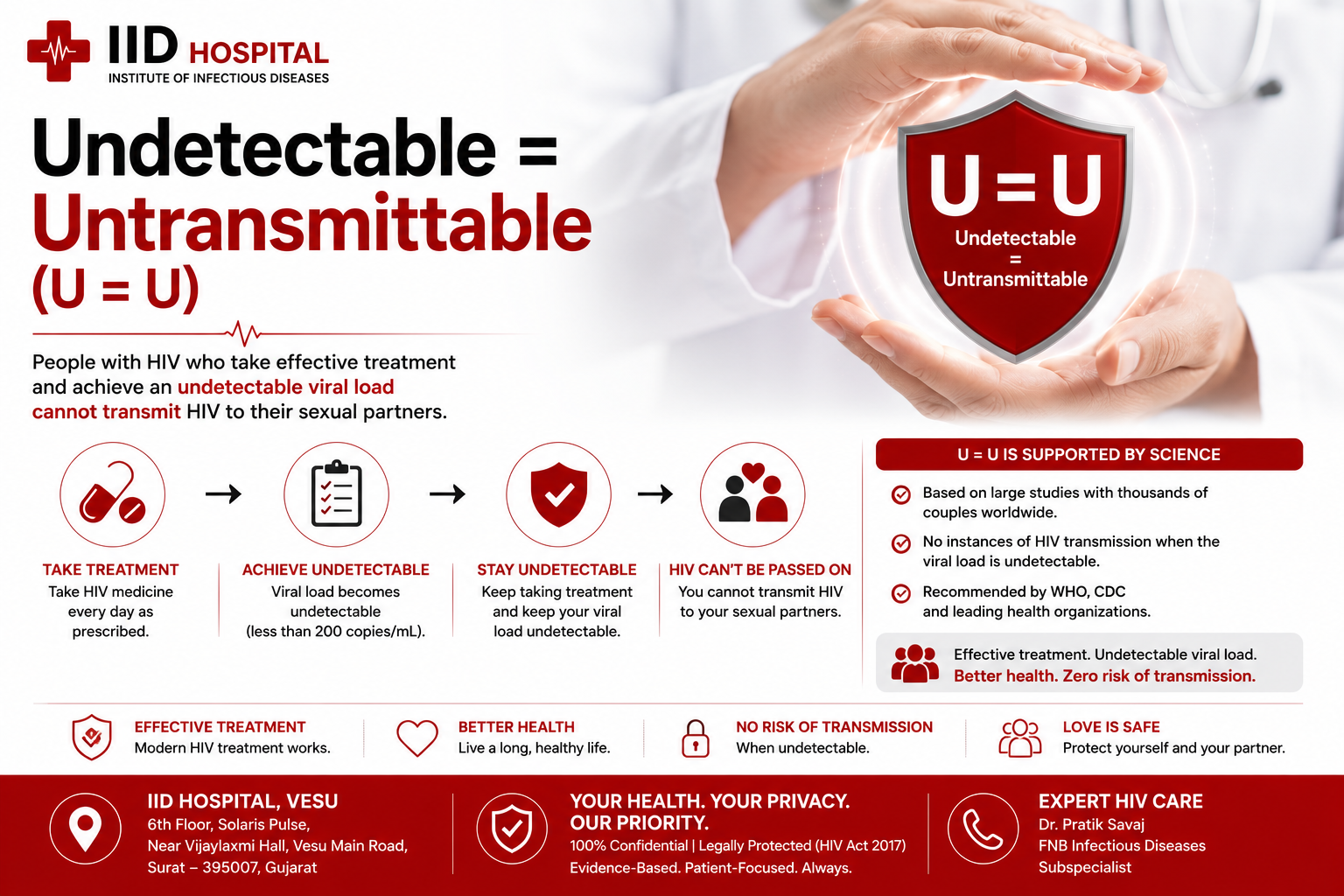
U=U principle: A person on effective ART with an undetectable viral load cannot transmit HIV sexually — even without a condom.
HIV Symptoms Across the Three Stages
HIV infection progresses through three distinct stages — each with different symptoms, different immune status, and different clinical priorities. Most people with chronic HIV infection have no symptoms at all, which is why testing is the only way to know your status.
Stage 1
Acute HIV Infection
Often called “acute retroviral syndrome” — occurs in 50–80% of newly infected people. Resembles a severe flu or mononucleosis.
Viral load is extremely high — most infectious window. Most people don’t know they are infected at this stage.
Stage 2
Chronic HIV Infection
Often completely symptom-free. HIV continues replicating, slowly destroying CD4 cells. Without treatment, CD4 falls by 50–100 cells/year.
This is why HIV testing is the only way to know your status. Feeling healthy does not mean HIV-negative.
Stage 3
AIDS — Preventable with ART
AIDS occurs when CD4 drops below 200 or an AIDS-defining illness develops. Entirely preventable with ART.
With ART: CD4 recovers, AIDS-defining illnesses resolve, and life expectancy returns to near-normal.
The Key Message: Most People with HIV Have No Symptoms
The absence of symptoms does not mean the absence of HIV. The only way to know your HIV status is to get tested. At IID Hospital, HIV testing is available on request — confidential, non-judgemental, and with expert pre and post-test counselling by Dr. Savaj.
Complete HIV Care — All Under One Roof
From first HIV test to long-term ART management, IID Hospital provides every component of HIV care with specialist-level expertise and full legal confidentiality.
HIV Testing & Counselling
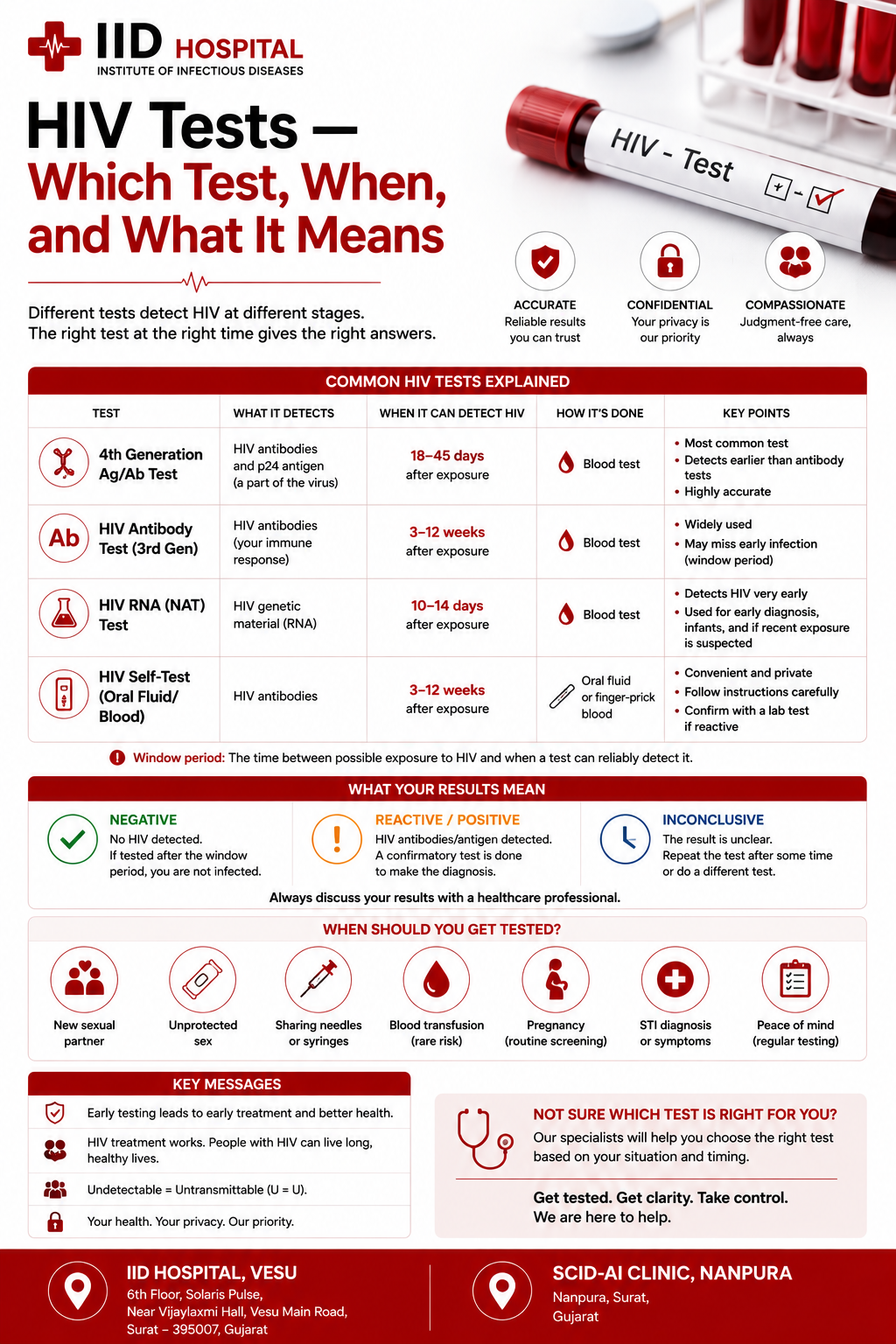
4th-generation antigen/antibody testing with pre and post-test counselling. Accurate from 18–45 days post-exposure. RNA PCR for early detection from day 10–14. Results discussed in a confidential, supportive environment. No referral needed.
Same-day results availableART Initiation & Management
Antiretroviral therapy initiation with modern, well-tolerated first-line regimens. Viral load and CD4 monitoring. ART side effect management. Regimen switches. Drug interaction assessment. Goal: viral suppression to undetectable.
Goal: Undetectable viral loadPEP — Post-Exposure Prophylaxis
Must start within 72 hours of exposure — the sooner the better. 28-day ART course that prevents HIV infection after high-risk exposure. Available for sexual exposure, needlestick injuries, and sexual assault. Call immediately: +91 92747 93759.
72-hour emergency windowPrEP — Pre-Exposure Prophylaxis
Daily tenofovir-based medication that reduces HIV acquisition risk by more than 99% when taken consistently. For HIV-negative individuals with ongoing high-risk exposure. Includes baseline testing, 3-monthly follow-up, and monitoring.
99%+ protective when taken dailyHIV-TB Co-Infection
HIV doubles TB risk and TB is the leading cause of HIV-related death. Integrated management of HIV-TB co-infection including timing of ART initiation, IRIS management, drug interactions (rifampicin + efavirenz/dolutegravir), and DOTS coordination.
Specialist co-infection protocolPMTCT & Pregnancy
Prevention of mother-to-child transmission. ART during pregnancy, neonatal prophylaxis within 24 hours of birth, infant testing schedule, and breastfeeding guidance. Risk of transmission to baby reduced to below 1% with proper management.
Transmission risk below 1%U=U stands for Undetectable = Untransmittable. It means that a person living with HIV who is on effective antiretroviral therapy and has maintained an undetectable viral load — below 200 copies/mL — for at least 6 months cannot sexually transmit HIV to their partner.
This is not a theory. It is the conclusion of three large, rigorous clinical studies — PARTNER, PARTNER2, and Opposites Attract — that together documented over 100,000 condom-free sexual acts between HIV-positive people on effective ART and their HIV-negative partners, with zero HIV transmissions.
What U=U means for relationships
HIV-positive individuals on effective ART can have sexual relationships without fear of transmitting HIV. Serodiscordant couples (one positive, one negative) can be intimate safely. U=U transforms both the medical and human reality of living with HIV.
What U=U means for treatment
U=U applies only when viral load is consistently undetectable — which requires taking ART every day, without missed doses. This is why viral load monitoring and adherence support are core components of Dr. Savaj’s HIV management protocol.
What U=U means for you
If you are HIV-positive and not yet on treatment — or on treatment without confirmed viral suppression — this is a reason to start or optimise ART today. Not just for your own health. For your partner. For your future.
Post-Exposure Prophylaxis — 72-Hour Window
Call immediately. Do not wait for a scheduled appointment. PEP must start within 72 hours of HIV exposure — efficacy is highest when started within 2 hours and declines significantly after 24 hours.
Pre-Exposure Prophylaxis — 99% Protection
A daily medication taken before potential HIV exposure that reduces the risk of acquiring HIV by more than 99% when taken consistently. For HIV-negative individuals with ongoing high-risk exposure.
HIV Tests — Which Test, When, and What It Means
The right HIV test depends on how much time has passed since exposure. Using the wrong test at the wrong time produces false-negative results — which is why specialist guidance on testing timing matters.
When to Test
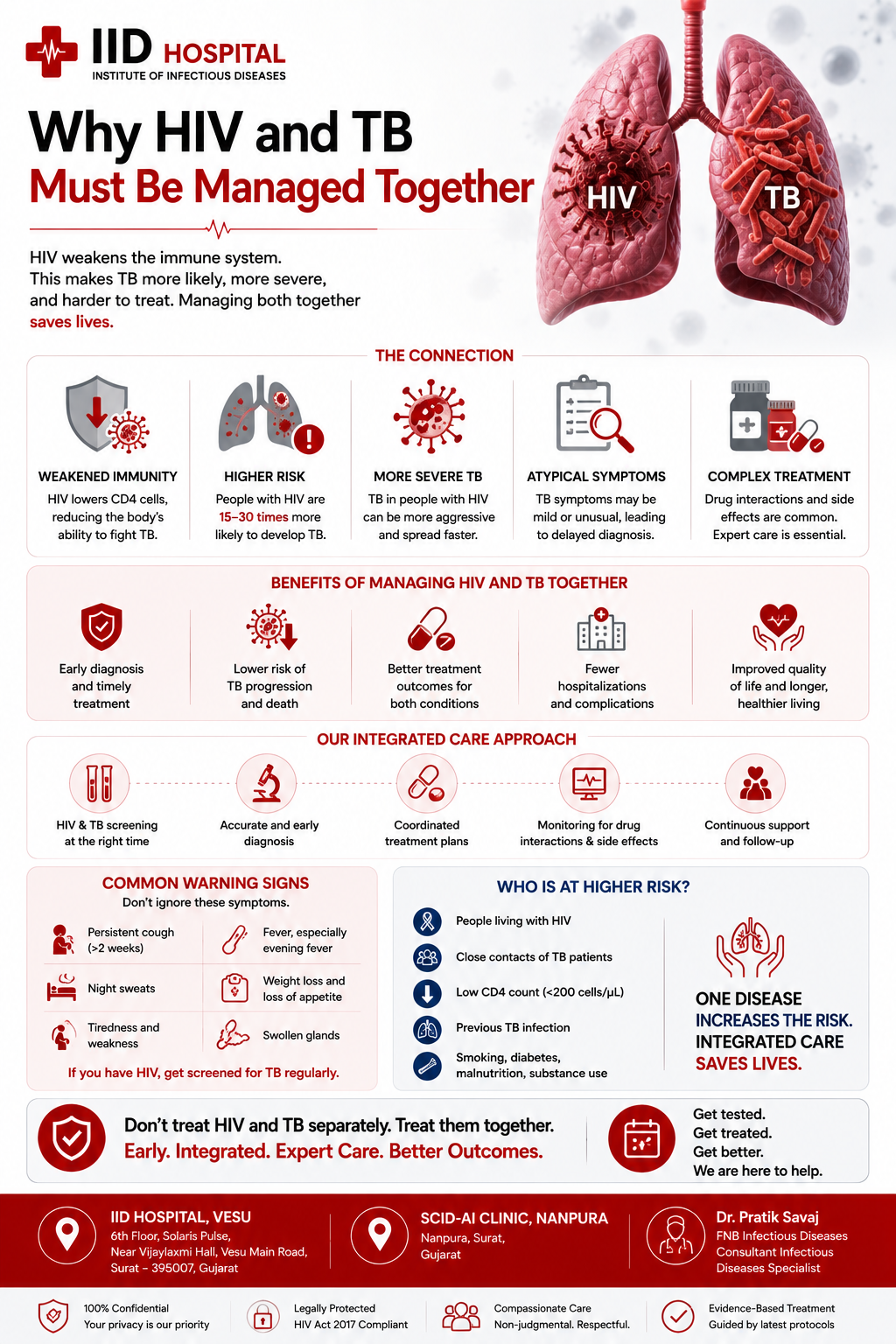
Why HIV and TB Must Be Managed Together
HIV and TB are deeply intertwined. HIV suppresses the immune system — specifically the CD4 T-cells that normally contain TB bacteria. This makes people with HIV 20 times more likely to develop active TB from latent infection. TB, in turn, accelerates HIV disease progression by activating the immune system and increasing HIV viral replication.
At IID Hospital, every HIV patient is screened for TB and every TB patient is tested for HIV — because managing one without the other produces inferior outcomes.
Your HIV Status Is Legally Protected — HIV Act 2017
Many people delay HIV testing or treatment out of fear that their status will be disclosed — to their employer, their family, or their community. This fear is the single biggest barrier to HIV care in India. Understanding your legal rights removes this barrier.
The HIV and AIDS (Prevention and Control) Act, 2017 is one of the most progressive HIV laws in Asia. It creates specific, enforceable legal rights for people living with HIV in India — backed by criminal penalties for healthcare providers who violate them.
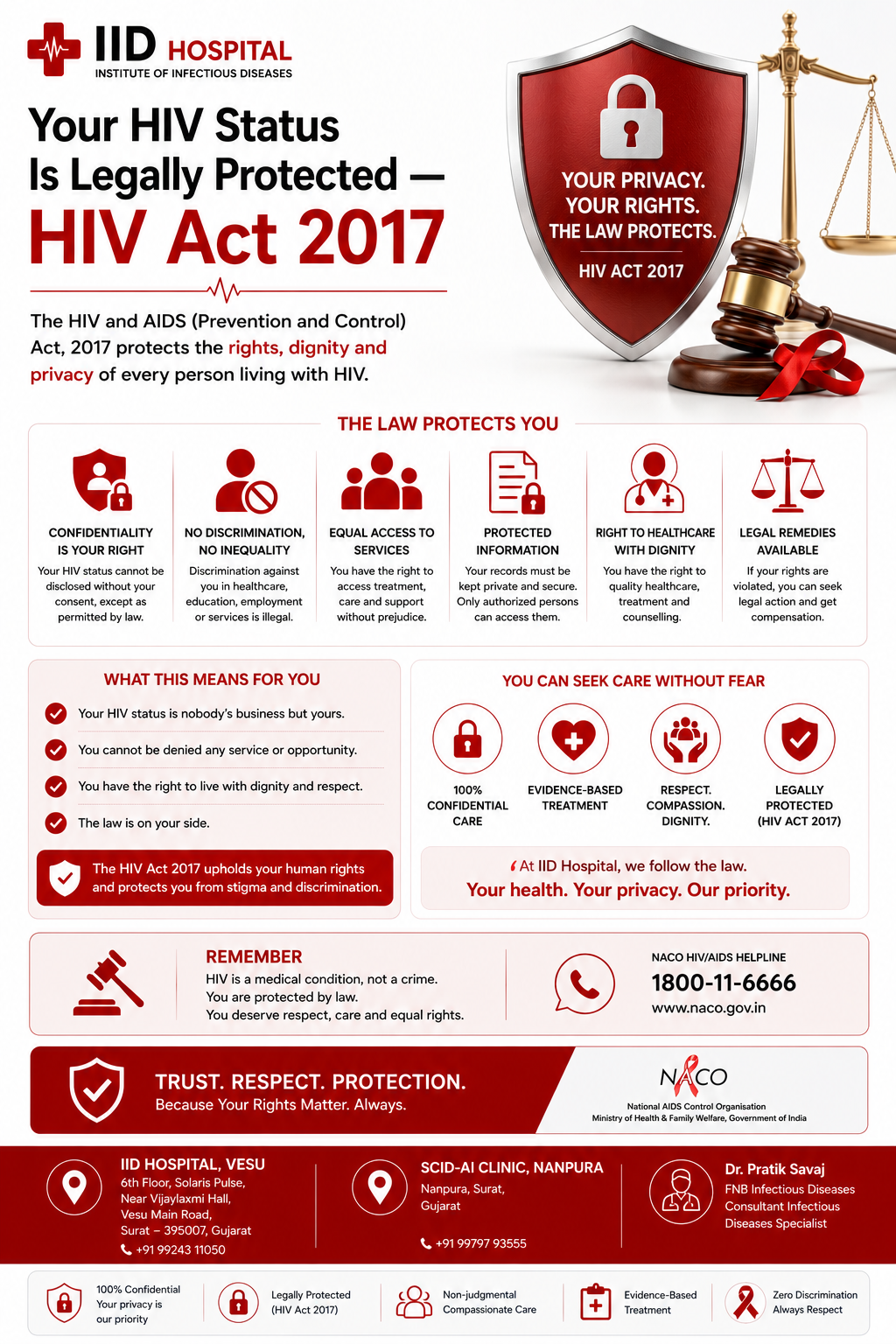
Right to Confidentiality
Your HIV status cannot be disclosed to any person — employer, family member, insurer, court, or institution — without your explicit written consent. Healthcare providers who disclose your HIV status without consent commit a criminal offence under the HIV Act 2017, punishable by imprisonment up to 2 years and fine. At IID Hospital, this right is absolute and taken seriously.
Right to Non-Discrimination
The HIV Act 2017 prohibits discrimination against people living with HIV in employment, education, healthcare, housing, and public services. Terminating someone’s employment because of their HIV status is illegal. Refusing healthcare to an HIV-positive person is illegal. Denying housing is illegal. These are enforceable legal rights, not suggestions.
Right to Healthcare
Every person living with HIV has the right to healthcare services — including ART — without discrimination. Antiretroviral therapy is available free of charge through government ART centres in India. No healthcare provider can refuse treatment on the basis of HIV status. This right applies in both public and private healthcare settings.
Your Employer Cannot Know
Your employer has no right to know your HIV status — and you have no legal obligation to disclose it. Pre-employment HIV testing as a condition of employment is illegal under the HIV Act 2017. If your employer demands HIV testing or discriminates on the basis of HIV status, this is a criminal violation of your rights. Dr. Savaj can provide documentation of medical consultations without disclosing your HIV status.
What Patients Say About Dr. Pratik Savaj
I was terrified when I tested positive. Dr. Savaj spent a full hour with me — explaining what HIV means today, what ART does, what U=U is, what my life will look like. I left feeling like a person with a manageable condition and a doctor who genuinely cares.
I needed PEP after an exposure. WhatsApp’d at 10 PM. Dr. Savaj responded within 30 minutes, explained everything, and I had the prescription the next morning — well within the 72-hour window. His responsiveness genuinely may have saved me from HIV.
I am on ART and have been undetectable for 2 years. Dr. Savaj manages every aspect — my viral load, my CD4, my side effects, my drug interactions. I have complete confidence that someone with real specialist training is watching over my health.
My husband is HIV-positive and I am negative. Dr. Savaj explained U=U, started my husband on ART, and now his viral load is undetectable. We no longer live in fear. Dr. Savaj gave our marriage back to us.
Starting PrEP through Dr. Savaj was the best decision I made. He explained everything clearly. I’ve been on PrEP for 8 months with no side effects and complete confidence. The entire process was handled with total discretion.
I was diagnosed with HIV and TB simultaneously. The dual diagnosis was overwhelming. Dr. Savaj managed both with precision — coordinating the treatment sequence and drug interactions. Six months later my TB is cured and my HIV viral load is undetectable.
Questions Patients Ask
Before Their First Appointment
Answered directly by Dr. Pratik Savaj, FNB Infectious Diseases — IID Hospital, Vesu, Surat. All consultations are completely confidential.