
Why VaccinationMatters for Adults
Most Indian adults received childhood vaccines and assumed their protection is lifelong. It is not. Many childhood vaccines wear off. Adults need specific vaccines for diseases that have no effective treatment once complications develop. Hepatitis B-related liver cancer, pneumococcal pneumonia in diabetics, and influenza hospitalisation in the elderly are all preventable with vaccines available today.
What Most Indian Adults Are Missing
Vaccines Prevent What Treatment Cannot Reverse
Vaccination is not an alternative to treatment — it is a completely different category of medicine. When you contract a vaccine-preventable disease, treatment can manage symptoms and complications. But it cannot reverse what has already occurred. Hepatitis B-related liver cirrhosis cannot be undone. The hearing loss from pneumococcal meningitis is permanent. The neurological damage from tetanus takes months to recover from. The death from influenza in an elderly diabetic is irreversible.
In India, adult vaccination is severely under-prioritised. The national immunisation programme focuses on children — and rightly so — but adults carry significant vaccine-preventable disease burden that is largely invisible because it manifests as complications of common diseases (liver cancer in HBV carriers, pneumonia in the elderly, influenza hospitalisations in diabetics) rather than as dramatic outbreaks.
Dr. Savaj’s Approach at IID Hospital
Every patient who comes to IID Hospital receives a vaccination review — not just those who come specifically for vaccines. Vaccination history is part of every infectious disease consultation. For high-risk patients (diabetics, HIV-positive individuals, those over 65, healthcare workers), a personalised vaccine schedule is provided at the first visit.
Prevention Before Exposure
Vaccines work only before infection. Once hepatitis B has established chronic infection, the vaccine cannot clear the virus. Once influenza has caused pneumonia, the vaccine cannot prevent the hospitalisation. The time to vaccinate is when you are well — not when you are sick.
Protection Wanes — Boosters Are Not Optional
Tetanus protection wanes after 10 years. Typhoid Vi protection lasts 3 years. Influenza strains change annually. The childhood vaccines that protected you 30 years ago may no longer be providing adequate protection today. Not knowing this is the commonest reason adults miss necessary boosters.
High-Risk Groups Need Extra Protection
Diabetics, HIV-positive individuals, the elderly, pregnant women, and healthcare workers are at higher risk from vaccine-preventable infections and at higher risk of serious complications when they occur. Standard adult vaccines plus high-risk specific vaccines (pneumococcal, annual influenza, hepatitis B) are recommended for these groups by all major guidelines.
Key Vaccines for Adults in India
Each vaccine below is recommended for Indian adults based on disease burden, available evidence, and Indian guidelines. Dr. Savaj determines which apply to you based on your age, health conditions, occupation, and vaccination history.
Influenza (Flu Vaccine)
All adults — especially 50+, diabetics, pregnancy, healthcare workers
What It Prevents
Seasonal influenza — fever, body ache, pneumonia, hospitalisation, death. Annual reformulation targets circulating strains. Protects against severe disease, hospitalisation, and death even in years of imperfect strain match.
Why It Matters in India
Influenza causes significant adult mortality in India, particularly in diabetics and the elderly, but is almost never recognised as the cause of death (attributed to 'fever'). Annual vaccination is the single most impactful adult vaccine in terms of lives saved per year.
Hepatitis B (HBV)
All unvaccinated adults; healthcare workers; sexual contacts of HBsAg+
What It Prevents
Hepatitis B infection, liver cirrhosis, and hepatocellular carcinoma (liver cancer). Over 95% effective. Check anti-HBs titre after completion to confirm immunity.
Why It Matters in India
India has 3–4% chronic HBV prevalence — approximately 40 million people. HBV is the leading cause of liver cirrhosis and liver cancer in India. Most carriers are unaware. Unvaccinated adults face ongoing risk from blood exposure, sexual transmission, and shared razors/equipment.
Hepatitis A (HAV)
All adults without prior immunity; travellers; food handlers
What It Prevents
Hepatitis A — liver inflammation, jaundice, fatigue lasting weeks to months. Rarely fatal in healthy adults but causes significant illness and lost income. No chronic disease but very debilitating acute illness.
Why It Matters in India
Surat has periodic hepatitis A outbreaks, particularly during monsoon when water supply is compromised. Food handlers, those who eat at restaurants frequently, and anyone without prior immunity should be vaccinated.
Typhoid Vi Polysaccharide
All adults in Surat and endemic cities; travellers
What It Prevents
Typhoid fever caused by Salmonella typhi. Prevents hospitalisation, intestinal perforation, and complications. Does not prevent all cases — safe food and water practices remain essential.
Why It Matters in India
Surat is an endemic area for typhoid, with XDR typhoid (resistant to fluoroquinolones and third-generation cephalosporins) increasingly common. Vaccination reduces disease severity even when it does not prevent all infection. Repeat every 3 years.
Pneumococcal (PCV13 + PPSV23)
65+; diabetics; chronic lung/heart/kidney/liver disease; HIV-positive; post-splenectomy
What It Prevents
Pneumococcal pneumonia, meningitis, and bacteraemia caused by Streptococcus pneumoniae. Reduces pneumonia hospitalisation in high-risk adults by 60–80%.
Why It Matters in India
Diabetics are 3–5× more likely to develop invasive pneumococcal disease. HIV-positive individuals are at very high risk. Pneumococcal disease in these groups is frequently fatal. Despite clear guidelines, very few Indian adults with diabetes or HIV receive pneumococcal vaccination.
Td / Tdap Booster
All adults without recent booster
What It Prevents
Tetanus (lockjaw), diphtheria, and pertussis (whooping cough). Tetanus protection wanes by 10 years after last dose. Pertussis (Tdap) especially important for adults around newborns.
Why It Matters in India
Tetanus is entirely preventable but still causes significant mortality in India, particularly from wounds sustained in occupational or agricultural settings. Most adults have not had a tetanus booster since childhood and are unaware their protection has waned.
Who Needs Which Vaccines — By Risk Group
Vaccination recommendations vary by age, health condition, and occupation. The groups below have specific vaccine needs beyond the standard adult schedule.
People with Diabetes
HIV-Positive Individuals
Adults Over 65
Healthcare Workers
Pregnant Women
Adults Without Vaccination Records
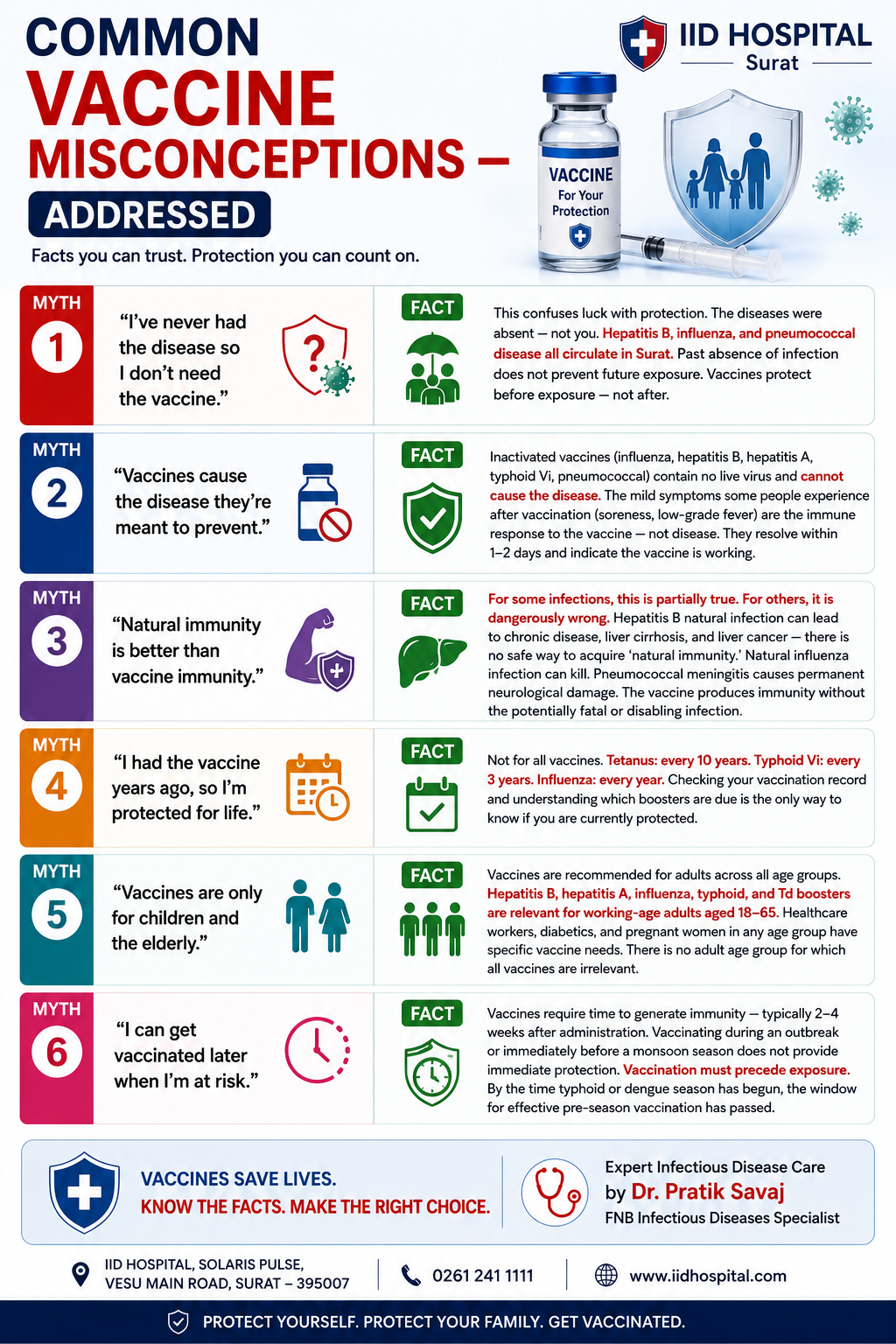
Common Vaccine Misconceptions — Addressed
“I've never had the disease so I don't need the vaccine.”
This confuses luck with protection. The diseases were absent — not you. Hepatitis B, influenza, and pneumococcal disease all circulate in Surat. Past absence of infection does not prevent future exposure. Vaccines protect before exposure — not after.
“Vaccines cause the disease they're meant to prevent.”
Inactivated vaccines (influenza, hepatitis B, hepatitis A, typhoid Vi, pneumococcal) contain no live virus and cannot cause the disease. The mild symptoms some people experience after vaccination (soreness, low-grade fever) are the immune response to the vaccine — not disease. They resolve within 1–2 days and indicate the vaccine is working.
“Natural immunity is better than vaccine immunity.”
For some infections, this is partially true. For others, it is dangerously wrong. Hepatitis B natural infection can lead to chronic disease, liver cirrhosis, and liver cancer — there is no safe way to acquire ‘natural immunity.’ Natural influenza infection can kill. Pneumococcal meningitis causes permanent neurological damage. The vaccine produces immunity without the potentially fatal or disabling infection.
“I had the vaccine years ago, so I'm protected for life.”
Not for all vaccines. Tetanus: every 10 years. Typhoid Vi: every 3 years. Influenza: every year. Checking your vaccination record and understanding which boosters are due is the only way to know if you are currently protected.
“Vaccines are only for children and the elderly.”
Vaccines are recommended for adults across all age groups. Hepatitis B, hepatitis A, influenza, typhoid, and Td boosters are relevant for working-age adults aged 18–65. Healthcare workers, diabetics, and pregnant women in any age group have specific vaccine needs. There is no adult age group for which all vaccines are irrelevant.
“I can get vaccinated later when I'm at risk.”
Vaccines require time to generate immunity — typically 2–4 weeks after administration. Vaccinating during an outbreak or immediately before a monsoon season does not provide immediate protection. Vaccination must precede exposure. By the time typhoid or dengue season has begun, the window for effective pre-season vaccination has passed.
How to Get Your Adult Vaccination Schedule
Book a Vaccine Consultation at IID Hospital
Call +91 92747 93759 or use the WhatsApp button. A vaccine consultation is a 15–20 minute appointment. Bring any vaccination records you have — immunisation booklet, old medical records, or notes from your doctor. If you have no records, that is fine — Dr. Savaj will work from your history and targeted serology.
Dr. Savaj Reviews Your Vaccine History and Risk Factors
Age, medical conditions (diabetes, HIV, chronic disease), occupation (healthcare worker, food handler), travel plans, pregnancy status, and household contacts (newborn, elderly, immunocompromised). The personalised schedule is based on your specific risk profile — not a generic list.
Targeted Serology Where Appropriate
For hepatitis B: anti-HBs titre to check existing immunity before vaccinating. For hepatitis A: anti-HAV IgG. For varicella: IgG if no clear disease or vaccine history. This avoids unnecessary vaccination where immunity already exists and identifies gaps precisely.
Vaccination and Schedule Document
Vaccines are administered at IID Hospital or at a pharmacy. You receive a written vaccination schedule showing which vaccines were given, when the next dose is due, and when boosters are required. Keep this document — it is your vaccination record going forward.
Annual Review
An annual vaccine review ensures that influenza vaccination is current, typhoid timing is tracked (every 3 years), and any new vaccines or guidelines are incorporated. High-risk patients (diabetics, HIV-positive) have vaccine status reviewed at every visit.

What to Bring
No Records? No Problem.
Most Indian adults do not have complete vaccination records. Dr. Savaj will use your history and targeted blood tests to determine what you need. Not having records is never a reason to skip a vaccine consultation.
What Patients Say About Dr. Pratik Savaj
I needed yellow fever vaccination and an ICVP certificate before travelling to Kenya. Dr. Savaj assessed my fitness, administered it at the approved centre, and provided the stamped certificate in time. Professional throughout.
I had no idea which adult vaccines I needed. Dr. Savaj reviewed my history, identified gaps in hepatitis B and Td coverage, and gave me a clear catch-up plan. No GP had ever done this for me.
As a diabetic with COPD, I was unsure about flu and pneumococcal vaccination. Dr. Savaj explained exactly which vaccines I needed, timing, and frequency. His knowledge of high-risk vaccination was exceptional.
Our family needed hepatitis A, typhoid, and rabies pre-exposure vaccination before Southeast Asia. Dr. Savaj assessed each member individually and gave detailed malaria chemoprophylaxis advice. Outstanding.
I asked why the flu vaccine needs repeating annually. Dr. Savaj explained antigenic drift and annual reformulation clearly — something I had never understood. He makes complex immunology genuinely accessible.
Unvaccinated for hepatitis B at 42. Dr. Savaj checked my antibody status, completed the three-dose course, and retested to confirm seroconversion. Comprehensive vaccination done correctly for the first time.
Frequently Asked Questions About Vaccines
Answered by Dr. Pratik Savaj, FNB Infectious Diseases — IID Hospital, Vesu, Surat.