SCID-AI · 405 SNS Axis Business Space, Nanpura, Surat
Mon–Sat: 11–1 PM & 4–6 PM
Malaria prevention travelers SCID-AI Surat  Travel Medicine · SCID-AI Blog
72 hours Malaria can progress to cerebral disease
within 72 hours of symptom onset — never delay testing
 Travel Medicine · SCID-AI Blog

Malaria Prevention for Travelers — The Right Prophylaxis for Your Destination

Dr. Pratik Savaj
Dr. Pratik SavajFNB Infectious Diseases · SCID-AI, Surat
Malaria prophylaxis is not one-size-fits-all. The correct drug depends on your destination, the malaria species present, the local drug resistance pattern, your health history, and the duration of your trip. Choosing the wrong prophylactic — or taking the right one incorrectly — provides false security. This guide covers what to take, when to start, and what to do if fever develops despite prophylaxis.

Why Malaria Prophylaxis Matters — The Urgency

Falciparum malaria — the species that dominates in sub-Saharan Africa and parts of India — can progress from mild fever to cerebral malaria, multi-organ failure, and death within 24–72 hours. A traveler who develops fever on day 6 of a safari, dismisses it as “travel tiredness,” and waits another day before seeking medical care may be in intensive care 48 hours later.

Malaria prophylaxis dramatically reduces this risk. No prophylactic is 100% effective — the correct message is that prophylaxis reduces infection probability by 90–98% when taken correctly. Prophylaxis does not eliminate the need for prompt testing if fever develops — it reduces risk, it does not eliminate it.

The Most Important Rule

Any fever within 3 months of return from a malaria-endemic area must be tested for malaria on the same day — not monitored for 24–48 hours. Tell Dr. Savaj your exact travel destination and dates. Falciparum malaria cannot wait for a morning appointment.

Destination Risk Assessment

The first step in any travel medicine consultation is destination-specific risk assessment. Malaria risk varies enormously — from negligible in urban tourist centres to extremely high in forest and tribal areas of sub-Saharan Africa and parts of India.

High Risk — Prophylaxis Essential

Sub-Saharan Africa: Kenya, Tanzania, Uganda, Nigeria, Ghana, Mozambique — falciparum dominant
Papua New Guinea and parts of Melanesia
Rural/forest India: Odisha, Jharkhand, Chhattisgarh, Assam, tribal MP, Arunachal
Amazon region: Brazil, Peru, Colombia forest areas
Parts of SE Asia: Myanmar, Cambodia (border areas), eastern Indonesia, Timor
Recommended: Doxycycline or Atovaquone-proguanil

Moderate Risk — Prophylaxis Recommended

Rural India: Gujarat, Rajasthan, UP, Maharashtra rural, West Bengal — vivax dominant
Parts of SE Asia: Thailand (border), Vietnam (rural), Philippines (rural)
Central America: Guatemala, Honduras, Nicaragua (rural)
Haiti, Dominican Republic rural areas
Parts of South Asia: Bangladesh rural, Pakistan rural, Afghanistan
Recommended: Chloroquine (if sensitive) or Doxycycline

Low Risk — Standby Treatment

Urban India: Surat, Mumbai, Delhi, Chennai, Bengaluru city centres
Urban SE Asia: Bangkok, Singapore, Kuala Lumpur, Ho Chi Minh City (urban)
Mexico (resort areas, urban centres)
North Africa: Egypt, Morocco, Tunisia (resort areas)
South America: urban Brazil, Argentina, Chile, Uruguay
Standby emergency treatment — prompt testing if fever
Malaria prophylaxis doxycycline Malarone SCID-AI Surat
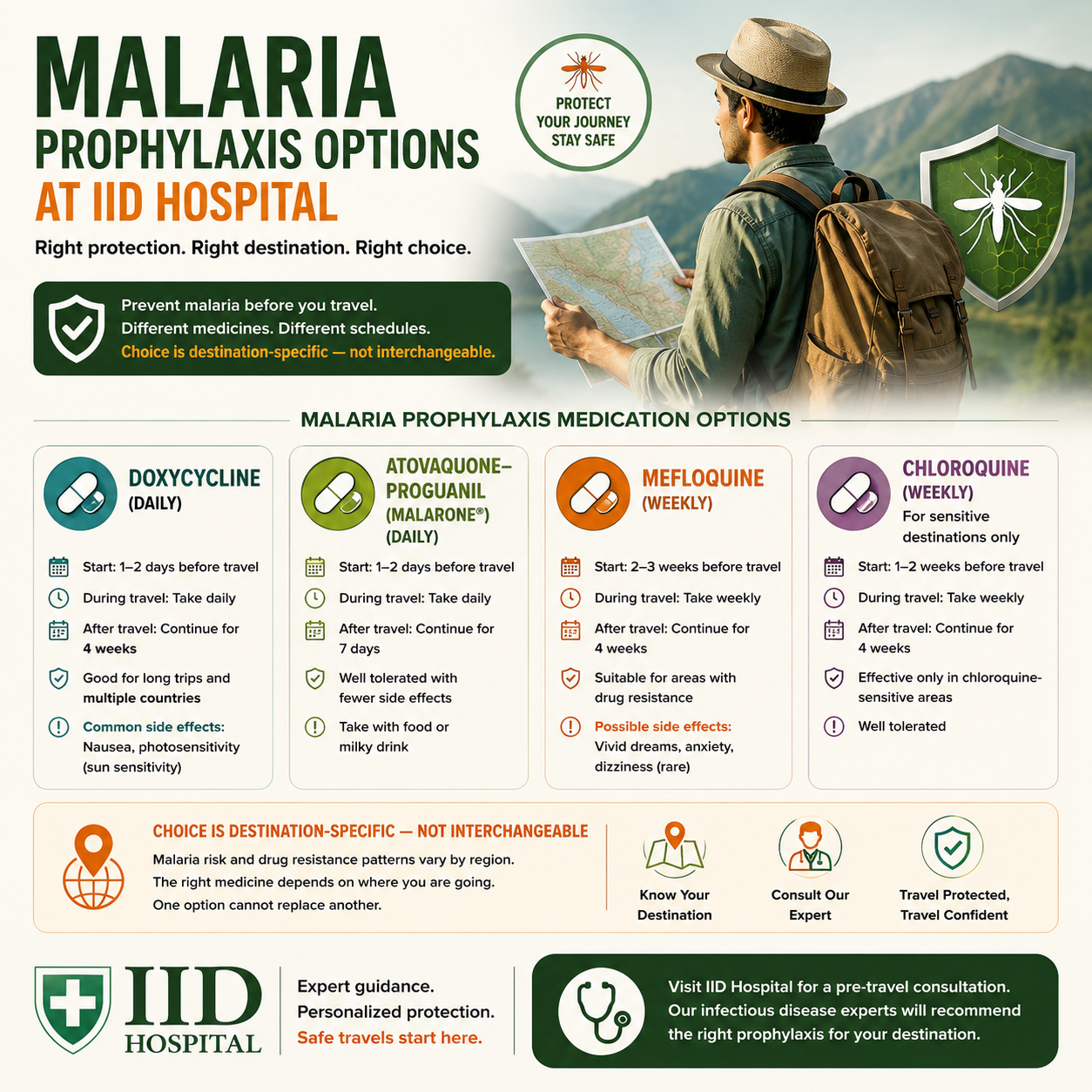
Malaria prophylaxis options at SCID-AI: doxycycline (daily), atovaquone-proguanil/Malarone (daily), mefloquine (weekly), chloroquine (weekly for sensitive destinations). Choice is destination-specific — not interchangeable.

The Four Prophylactic Drugs — Which One for Your Trip

Each malaria prophylactic has a different mechanism, start time, side effect profile, and suitability for different destinations. The choice must be individualised — not based on convenience or cost alone.

DrugStart Before TravelTake After ReturnBest ForKey Cautions
Doxycycline
100mg daily
1–2 days4 weeksAll high-risk destinations. First-line for Africa, PNG, resistance areas.Photosensitivity (use SPF 50). Take with food. Contraindicated in pregnancy + children <8 yrs.
Atovaquone-proguanil
(Malarone) daily
1–2 days7 days onlyHigh-risk destinations. Best option for short trips — shortest post-travel course.Must be taken with food (3× better absorption). More expensive. Avoid in severe renal impairment.
Mefloquine
Weekly
2–3 weeks4 weeksAfrica, where weekly dosing preferred. Long trips.Neuropsychiatric side effects (vivid dreams, anxiety, dizziness) in ~5%. History of psychiatric illness: avoid. Start 2–3 weeks early to test tolerability.
Chloroquine
Weekly
1–2 weeks4 weeksOnly for chloroquine-sensitive destinations. Central America (west of Panama Canal), Haiti, Dominican Republic.Resistance is widespread: most of Africa, India (falciparum), SE Asia. Do not use for Africa or most of Asia. Safe in pregnancy.

The Critical Mistake — Stopping Prophylaxis on Return Day

The most common prophylaxis error: stopping the drug the day the flight lands. Malaria parasites can incubate for up to 4 weeks (falciparum) or even months (vivax hypnozoites) after the last exposure. Stopping prophylaxis early removes protection during this window. Doxycycline and mefloquine: continue for 4 weeks after leaving the endemic area. Atovaquone-proguanil: continue for 7 days.
Malaria personal protection SCID-AI Surat
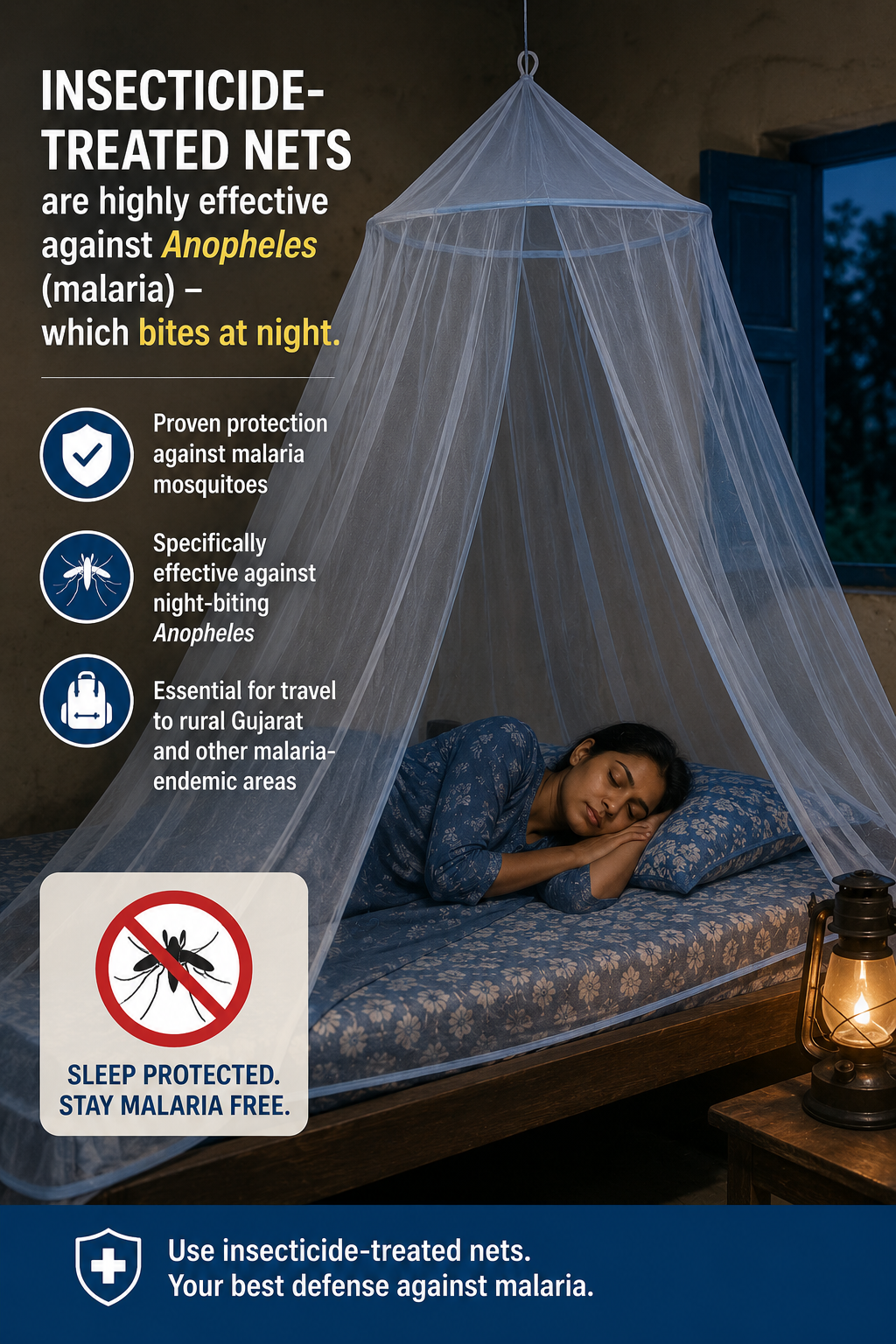
Mosquito nets, DEET repellent, long sleeves at dusk — personal protection measures reduce malaria risk by 50–80% even without prophylaxis. Combined with prophylaxis: risk reduction exceeds 95%.

Personal Protection — Prophylaxis Is Not Enough Alone

Drug prophylaxis and personal protection measures are complementary, not alternatives. The most effective malaria prevention combines both. Anopheles mosquitoes bite predominantly from dusk to dawn — the personal protection window.

Insecticide-treated nets (ITN): sleep under a net every night in endemic areas. Non-negotiable in sub-Saharan Africa.
DEET 20–30% repellent on all exposed skin from dusk. Reapply after sweating.
Long-sleeved clothing and long trousers from dusk. Loose-fitting, light-coloured.
Indoor residual spraying: choose accommodation with screened windows or air conditioning.
Permethrin-treated clothing: additional protection for high-risk jungle/forest settings.

The Complete Pre-, During-, and Post-Travel Protocol

1

Before Travel — 4–6 Weeks Before

Pre-travel consultation at SCID-AI: destination-specific risk assessment
Prophylaxis prescribed: correct drug for destination + health status
Start mefloquine 2–3 weeks early to test tolerability
Other vaccines: hepatitis A, typhoid, yellow fever (if required), JE (if rural Asia)
Medical kit: thermometer, ORS, paracetamol (NOT ibuprofen), standby treatment
G6PD test if vivax destination and primaquine may be needed
2

During Travel

Take prophylaxis daily (or weekly) without missing doses. Set phone reminders.
Sleep under ITN every night in endemic areas
DEET repellent from dusk, reapplied every 4–6 hours
Long sleeves + trousers from early evening
If fever >38°C: seek medical care same day. Request malaria test immediately.
Do not take ibuprofen for fever — dengue may also be present
3

After Return

Complete post-travel prophylaxis: doxy/mefloquine 4 weeks, Malarone 7 days
Any fever within 3 months of return: malaria blood smear + RDT same day
Tell Dr. Savaj your exact destination — not just “Africa” or “India”. Specific countries and regions change the differential.
Vivax area travel: consider primaquine after return (radical cure for hypnozoites) — requires G6PD testing first
No fever? Post-travel blood smear still recommended for high-risk destinations even without symptoms
Pre-travel consultation SCID-AI Surat
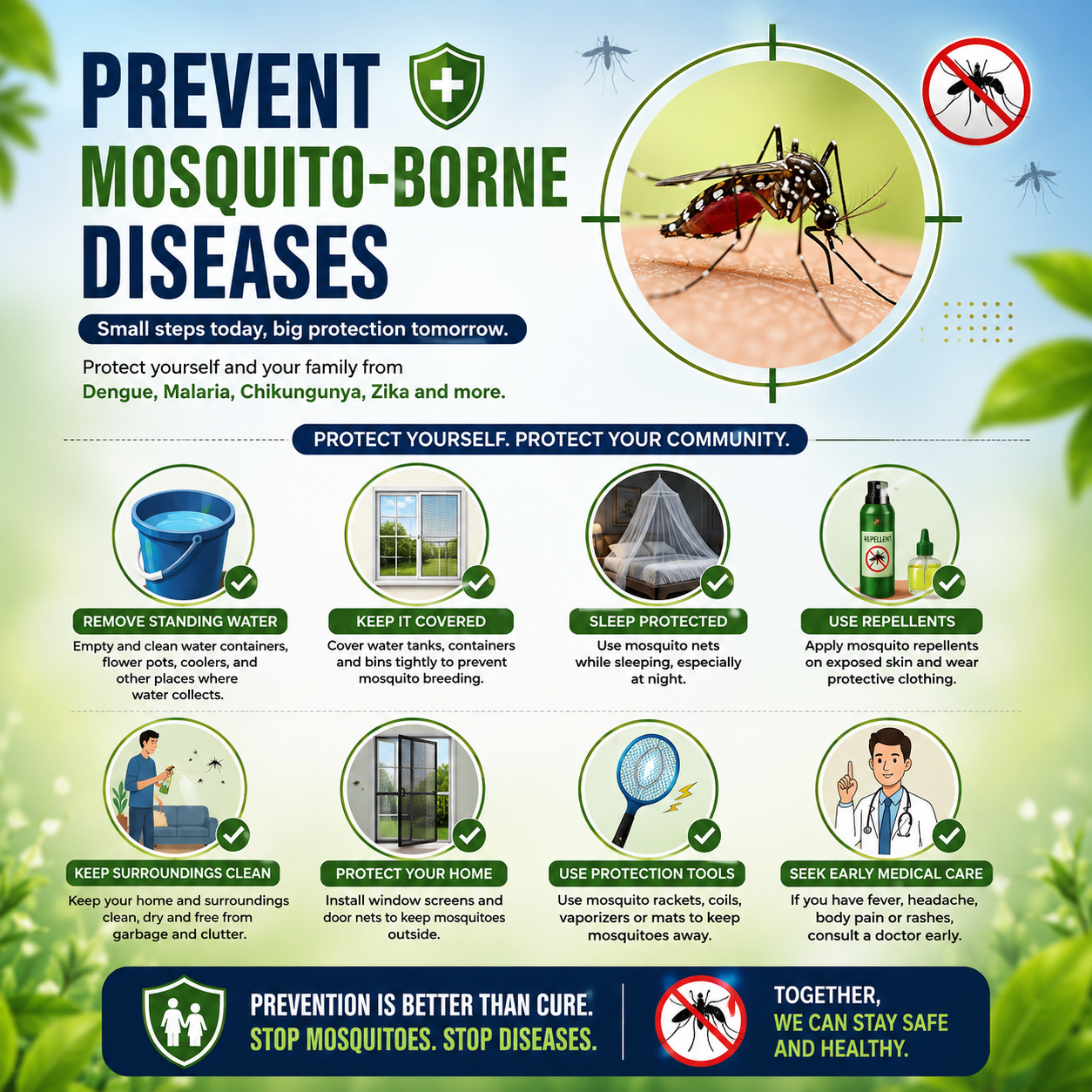
Pre-travel consultation at SCID-AI: destination-specific risk assessment, prophylaxis prescription, travel vaccines, and standby emergency treatment — all at one visit, at least 4–6 weeks before departure.

Pre-Travel Consultation at SCID-AI — What to Expect

Dr. Pratik Savaj provides pre-travel consultations at SCID-AI, Nanpura, Surat for both domestic high-risk travel (Odisha, Jharkhand, tribal areas) and international travel. The consultation covers: destination-specific malaria risk; correct prophylactic selection based on destination + personal health; travel vaccines (hepatitis A, typhoid, yellow fever, Japanese encephalitis); food and water precautions; standby emergency treatment; and post-travel follow-up.

Book at least 4–6 weeks before departure — some vaccines require multiple doses, and mefloquine needs 2–3 weeks to assess tolerability before travel.

Post-Travel Fever — Come on Day 1

Any fever within 3 months of return from an endemic area: come to SCID-AI immediately. Tell Dr. Savaj your exact destination. Blood smear + RDT on the same day — not after waiting to see if fever resolves. Falciparum malaria does not wait. Vivax malaria can relapse months later — fever after tropical travel is malaria until proven otherwise.

The Travel Malaria Rule

Prophylaxis reduces risk by 90–98% — it does not eliminate it. Any fever within 3 months of return from an endemic area = malaria blood smear same day. Complete the post-travel course: doxycycline and mefloquine for 4 weeks after return; Malarone for 7 days. Never stop prophylaxis on the day the flight lands.
Travel medicine SCID-AI Surat
Dr. Pratik Savaj MBBS · DNB Medicine · Fellowship ID · FNB Infectious Diseases · P.D. Hinduja Hospital, Mumbai

Dr. Savaj provides pre-travel malaria prophylaxis consultation and post-travel fever assessment at SCID-AI, Nanpura, Surat. Book at least 4–6 weeks before travel. +91 72839 34807.

Common Questions

Frequently Asked Questions

Answered by Dr. Pratik Savaj, FNB Infectious Diseases, SCID-AI, Surat.

Can I take malaria prophylaxis even if I've had malaria before?
Yes — and this is an important point. Previous malaria infection does not provide reliable immunity against future infections. Unlike some viral infections, malaria does not produce durable protective immunity in most people. A person who had vivax malaria in Jharkhand three years ago has no meaningful protection against a new vivax or falciparum exposure during their next visit. Partial immunity does develop in people with lifelong intense exposure (such as in highly endemic rural areas) — but this partial immunity wanes rapidly when exposure stops and does not prevent infection. Surat residents who grew up in Bihar or Odisha and moved to Surat may feel they are “immune” to malaria — they are not. Their partial immunity has diminished. Previous malaria infection should not be used as a reason to skip prophylaxis. If anything, a history of malaria means the person travels to endemic areas and should be seen for a pre-travel consultation at SCID-AI.
Is malaria prophylaxis safe during pregnancy?
Malaria in pregnancy is significantly more dangerous than malaria in non-pregnant individuals — it increases the risk of miscarriage, preterm birth, low birth weight, maternal anaemia, and maternal death. The WHO recommends that pregnant women avoid travel to high malaria-risk areas where possible. When travel is unavoidable: Chloroquine: safe throughout pregnancy (for chloroquine-sensitive destinations). Mefloquine: generally considered safe from the second trimester onwards; safety data for first trimester use is less robust. Doxycycline: contraindicated in pregnancy — causes tooth discolouration and bone development issues in the fetus. Atovaquone-proguanil (Malarone): limited safety data in pregnancy; generally avoided unless benefits clearly outweigh risks and no alternative is available. For pregnant women travelling from Surat to high-risk areas: consult Dr. Savaj at SCID-AI for destination-specific assessment. The default advice for high-risk falciparum areas (sub-Saharan Africa) is to postpone non-essential travel until after delivery. Non-negotiable: if a pregnant woman develops fever during or after travel to an endemic area, malaria must be excluded on the same day.
Do I need prophylaxis for travel within India?
It depends entirely on the destination within India. Low-risk urban destinations (Mumbai, Delhi, Chennai, Bengaluru, Kolkata city centres, Surat): malaria transmission is low. Prophylaxis not routinely recommended. Prompt testing if fever develops. Moderate-risk destinations (Rural Gujarat, Rajasthan, MP, most of Maharashtra, UP): vivax transmission. Chloroquine prophylaxis should be considered for extended stays (>4 weeks) or high-risk travellers (immunosuppressed, pregnant, infants). High-risk destinations (Odisha, Jharkhand, Chhattisgarh, tribal areas of MP, forest areas, Northeast India): both vivax and falciparum present. Chloroquine resistance may be present (falciparum). Doxycycline or atovaquone-proguanil recommended for high-risk destinations. In all cases: insecticide-treated nets at night; DEET repellent at dusk and evening; prompt same-day testing for any fever during or after the trip. A pre-travel consultation at SCID-AI is recommended for travel to high-risk domestic destinations — particularly for travellers who are pregnant, immunocompromised, or taking the destination for more than 2 weeks.
What should I do if I develop fever after returning from a malaria-endemic area?
Any fever within 3 months of return from a malaria-endemic area must be investigated for malaria on the same day — not after 24–48 hours of monitoring. Specifically: Come to SCID-AI on day 1 of fever. Tell Dr. Savaj the exact destination, dates of travel, and whether you took prophylaxis (and whether you completed the full post-travel course). Request blood smear + RDT immediately. Both should be done simultaneously. A single negative smear does not exclude malaria — repeat at 12–24 hours if clinical suspicion remains. If you took doxycycline or atovaquone-proguanil and developed fever: malaria is still possible, particularly if doses were missed or if the drug was inadequate for the destination. Falciparum malaria is a medical emergency. A traveller returning from sub-Saharan Africa with fever can deteriorate to cerebral malaria within hours. This is not “wait and see.” Do not take ibuprofen or aspirin until dengue is also excluded — both conditions cause fever; dengue bleeding risk makes ibuprofen dangerous. Take paracetamol only and come to SCID-AI immediately.
How long before travel should I start malaria prophylaxis?
The start time depends on which prophylactic drug is prescribed: Doxycycline: start 1–2 days before departure. Continue daily throughout travel and for 4 weeks after leaving the endemic area. Doxycycline must be taken with food and a full glass of water to avoid oesophageal irritation. Atovaquone-proguanil (Malarone): start 1–2 days before departure. Continue daily throughout travel and for only 7 days after return — this is the shortest post-travel period of any prophylactic. Taken with food. Mefloquine: start 2–3 weeks before departure — the longest lead time of any prophylactic. This is deliberate: if neuropsychiatric side effects occur (vivid dreams, anxiety, dizziness), there is time to switch to an alternative before travel. Continue for 4 weeks after return. Chloroquine (for chloroquine-sensitive destinations only): start 1–2 weeks before departure. Continue for 4 weeks after. The post-travel continuation period is critical — the most common error is stopping prophylaxis on the day of return. Malaria can incubate for up to 4 weeks (vivax even longer due to hypnozoites), and stopping prophylaxis early removes protection during this window.
What is the difference between vivax and falciparum malaria?
Plasmodium vivax and Plasmodium falciparum are the two most clinically important malaria species. They differ in distribution, severity, treatment, and risk of relapse. P. falciparum: the most dangerous species. Causes severe malaria — cerebral malaria, severe anaemia, respiratory distress, multi-organ failure. Can progress from mild illness to life-threatening disease within 24–48 hours. Predominant in sub-Saharan Africa, parts of Southeast Asia, and Papua New Guinea. Also present in some parts of India (Odisha, Jharkhand, Chhattisgarh, Northeast). No dormant liver stage (hypnozoites) — no risk of late relapse. P. vivax: the predominant species in India, including Gujarat. Generally less severe than falciparum but not benign — can cause significant anaemia and, rarely, severe disease. Has a dormant liver stage (hypnozoites) that can reactivate weeks to months after the initial infection — causing relapse malaria. Treatment requires both chloroquine (blood stage) and primaquine (liver stage) to prevent relapse. Primaquine is contraindicated in G6PD deficiency — G6PD testing before primaquine is mandatory. Surat sees both species but vivax predominates.
What are the side effects of doxycycline prophylaxis?
Doxycycline is widely used for malaria prophylaxis and is generally well tolerated, but has specific side effects worth knowing. Photosensitivity: the most common clinically significant side effect. Doxycycline makes the skin more sensitive to UV radiation — travellers to sunny destinations can develop severe sunburn after brief sun exposure. Always use SPF 50 sunscreen and wear protective clothing when on doxycycline. Gastrointestinal effects: nausea, vomiting, and oesophageal irritation occur if doxycycline is taken on an empty stomach or without adequate water. Always take with a full meal and a full glass of water, and remain upright for 30 minutes after taking. Vaginal candidiasis: antibiotic disruption of vaginal flora can cause yeast infections in women. Contraindications: pregnancy (causes fetal bone and tooth development issues); children under 8 years (same reason); tetracycline allergy. Doxycycline does not cause malaria immunity — it suppresses parasitaemia rather than killing the parasite before it enters the blood. This is why 4 weeks post-travel coverage is required.
Is it safe to eat and drink normally while taking malaria prophylaxis?
Yes, with a few specific caveats depending on which prophylactic drug is prescribed. Doxycycline: take with food to reduce GI side effects. Dairy products do not significantly reduce doxycycline absorption (unlike some other tetracyclines). Alcohol does not directly interact but contributes to dehydration and GI irritation. Atovaquone-proguanil (Malarone): must be taken with food or a milky drink. Atovaquone bioavailability is dramatically reduced (up to 3-fold) when taken on an empty stomach — this is clinically important. A fatty meal significantly increases absorption. Taking Malarone without food substantially reduces its protective efficacy. Mefloquine: take with food. Avoid alcohol during the first week (when neuropsychiatric side effects are most likely to emerge). Chloroquine: take with food to reduce GI effects. Avoid antacids within 4 hours (they reduce chloroquine absorption). All prophylactics: drink adequate water throughout travel, particularly in hot climates where dehydration worsens drug side effects. None of these drugs prevents traveller’s diarrhoea — food and water hygiene measures are still required.

Traveling to a Malaria Zone? Consult Before You Go.

Book at least 4–6 weeks before travel. Destination-specific prophylaxis, travel vaccines, and standby emergency treatment — all at one visit. Dr. Pratik Savaj, FNB Infectious Diseases, SCID-AI, Nanpura, Surat.

Dr. Pratik Savaj
Dr. Pratik Savaj FNB Infectious Diseases · SCID-AI, Surat
Morning11:00 AM – 1:00 PM, Mon–Sat
Evening4:00 PM – 6:00 PM, Mon–Sat
Phone+91 72839 34807
);document.body.style.overflow='';});}); })();