The Fundamental Difference
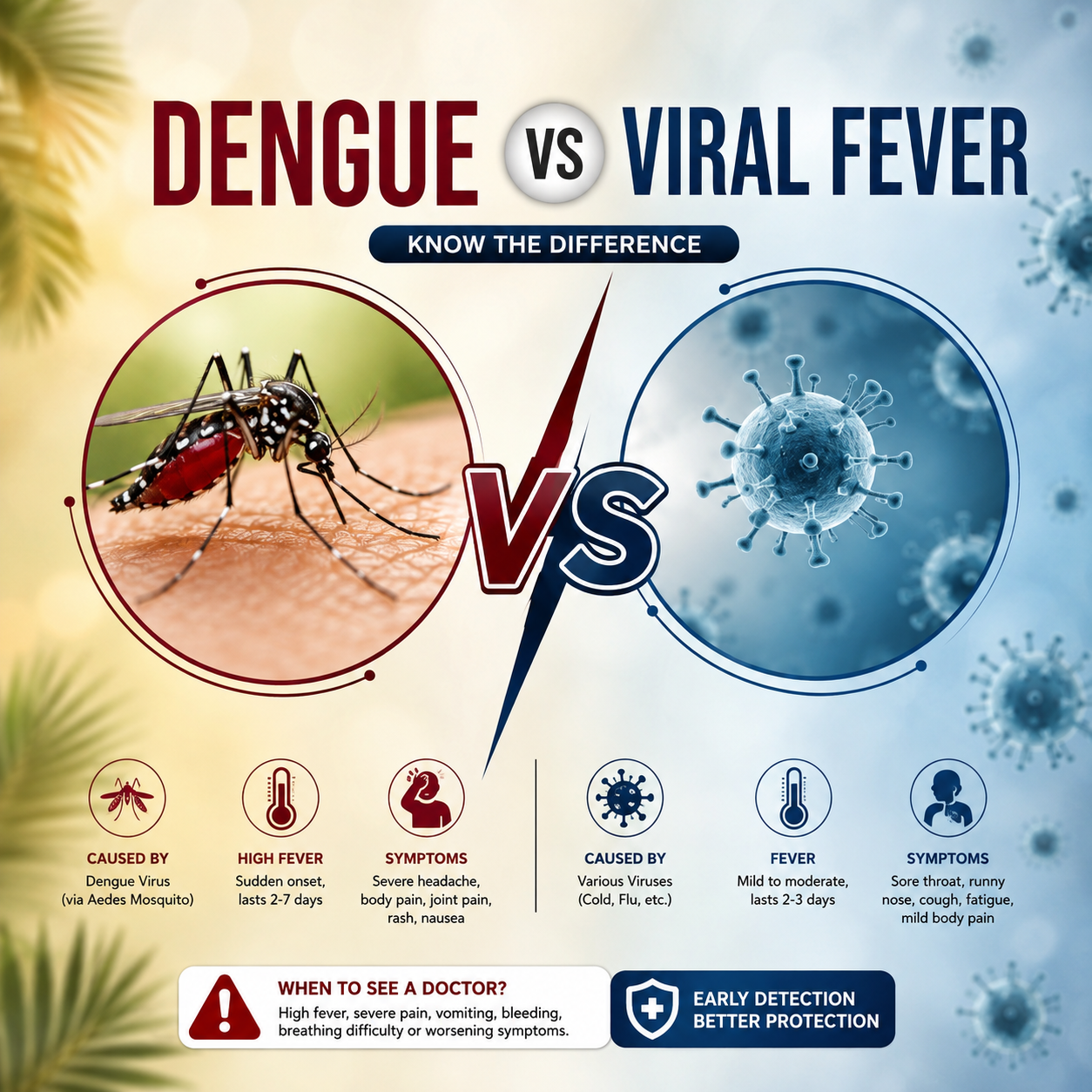
“Viral fever” is not a diagnosis — it is a placeholder. When a doctor says “viral fever,” they mean: I suspect this is a viral infection, I don’t know which one, and I think it will resolve on its own. For most viral fevers in Surat, that is correct. But dengue is also a viral fever — and unlike most viral fevers, it has a critical phase (days 4–6) when plasma leaks from blood vessels, platelets crash, and patients who appeared to be improving can deteriorate rapidly.
The clinical question is not “does this patient have a virus?” but “does this patient have dengue specifically?” Because dengue management is different: strict monitoring of platelet count, fluid balance, and warning signs during the critical phase; and the absolute prohibition of ibuprofen and aspirin, which increase bleeding risk in dengue.
The Most Important Rule
Never take ibuprofen (Brufen, Combiflam) or aspirin for fever during Surat’s monsoon season until dengue is excluded. Both drugs inhibit platelet function and increase the risk of severe bleeding in dengue haemorrhagic fever. Paracetamol (Calpol, Crocin) is the only safe fever medication when dengue has not been ruled out.
Dengue’s Day-by-Day Pattern — The Three Phases
Dengue has a characteristic day-by-day clinical pattern that distinguishes it from most other viral fevers. Understanding the three phases is critical — particularly the deceptive improvement on days 4–5 that precedes the critical phase.
The Deceptive Defervescence — The Most Dangerous Day
When dengue fever drops on days 4–5, patients and families feel relieved — “the fever broke, they’re getting better.” This is the most dangerous moment in dengue. The drop in fever marks the beginning of the critical phase — plasma leakage, platelet nadir, and potential haemorrhage. Patients who feel better on day 4 need monitoring, not reassurance.

Dengue vs Viral Fever vs Malaria vs Typhoid — The Comparison
In Surat’s monsoon, all four of these fevers are circulating simultaneously. Each has distinguishing features — though clinical features alone are never enough to diagnose; the right test at the right time is always needed.
| Feature | Dengue | Viral Fever (URTI) | Malaria | Typhoid |
|---|---|---|---|---|
| Fever onset | Sudden, high | Gradual | Cyclical / sudden | Step-ladder pattern |
| Body pain | Severe “breakbone” myalgia | Mild–moderate | Severe rigor + sweating | Mild |
| Rash | Day 3–5, islands of white | Absent | Absent | Rose spots (rare) |
| Bleeding risk | YES — haemorrhage | No | No (vivax); some (falciparum) | No |
| Platelets | Falling — hallmark | Normal | Normal or low | Normal or low |
| Key test | NS1 antigen (days 1–5) | Clinical / CBC | Blood smear + RDT | Blood culture |
| Safe fever drug | Paracetamol ONLY | Paracetamol | Paracetamol | Paracetamol |
| Antibiotics? | NO — harmful | No | No (antimalarials) | YES — essential |

When and What to Test
The NS1 antigen test is positive from day 1 through day 5 of dengue illness — it detects the dengue virus protein directly. After day 5, it becomes negative as the immune response clears the antigen. Testing on day 6 or 7 with NS1 alone will give a false negative. From day 5 onwards, dengue IgM antibody is the correct test. If in doubt about timing, send both. The platelet count and haematocrit must be checked daily during the critical phase regardless of test results.
Day 1–3 of fever (best window)
NS1 Antigen Test + CBC + Platelet
NS1 is most sensitive in the first 3 days. Send NS1 antigen + CBC with differential + platelet count simultaneously. A normal NS1 on day 1 with strong clinical suspicion: repeat on day 2–3 if symptoms persist. Also send blood smear + RDT for malaria at the same time.
Day 3–5 (active monitoring)
Daily Platelet Count + Haematocrit
Even if NS1 is positive and dengue is confirmed, daily monitoring continues. Platelet below 100,000: close outpatient monitoring. Platelet below 50,000: specialist assessment. Haematocrit rising by more than 20%: indicates plasma leakage — may need IV fluids.
Day 5+ (if NS1 was negative or not done)
Dengue IgM Antibody
From day 5 onwards, dengue IgM is the correct serological test. If the patient is on day 7 of fever with no previous testing: send dengue IgM + NS1 simultaneously + blood culture (to exclude typhoid).
Any day during monsoon fever
Blood Smear + RDT for Malaria
Every monsoon fever in Surat requires simultaneous malaria exclusion — not either/or. Dengue and malaria can co-exist. Send NS1 + blood smear + RDT together on day 1. Missing falciparum malaria while treating for dengue is a life-threatening error.
Warning Signs — When to Go to Hospital Immediately
Most dengue patients recover with outpatient monitoring. A minority develop severe dengue — characterised by plasma leakage, severe bleeding, or organ impairment. The warning signs below indicate severe dengue developing — any one of them requires immediate hospital assessment, not waiting until the next morning.
Severe Abdominal Pain
Persistent, severe pain or tenderness in the abdomen. Indicates plasma leakage into the peritoneal cavity. Go to hospital immediately.
Persistent Vomiting
Three or more episodes of vomiting in 1 hour. Prevents oral fluid intake. IV fluid replacement is needed urgently.
Any Bleeding
Blood in vomit, black tarry stools, heavy menstrual bleeding, blood in urine, or spontaneous bruising. Immediate hospitalisation.
Restlessness or Lethargy
Sudden change in mental state — either unusually agitated or unusually drowsy. Indicates circulatory compromise. Emergency.
Rapid Breathing
Breathlessness at rest or with minimal activity. Indicates pleural effusion or pulmonary oedema from plasma leakage. Emergency.
Fever Drops but Patient Worsens
The deceptive defervescence. Fever comes down on day 4–5 but the patient feels worse, more tired, or develops any of the above signs. Immediate assessment required.

What to Do and What Never to Do in Dengue
Dengue Management at IID Hospital, Surat
Dr. Pratik Savaj sees dengue patients at IID Hospital throughout Surat’s monsoon season. The assessment covers: NS1 + malaria exclusion on day 1; daily platelet and haematocrit monitoring during the critical phase; specific fluid balance guidance; and clear criteria for when outpatient monitoring is safe versus when hospitalisation is needed.
Dengue care at IID Hospital is not just diagnosis — it includes daily contact during the critical phase, specific instructions on what to watch for at home, and a clear threshold for when to come back immediately.
The Monsoon Fever Protocol
Every fever during Surat’s monsoon (July–November): NS1 + blood smear on day 1. Paracetamol only. No ibuprofen, no aspirin, no antibiotics. Platelet count daily from day 3. If fever drops on day 4–5 but the patient feels worse — come to IID Hospital immediately. Do not wait to see if it improves on its own.