SCID-AI · 405 SNS Axis Business Space, Nanpura, Surat
Mon–Sat: 11–1 PM & 4–6 PM
How infections spread transmission routes SCID-AI Transmission Routes · SCID-AI, Surat
 Educational Guide · SCID-AI, Surat

How Infections SpreadThe 5 Transmission Routes

The most important insight in infection prevention: the prevention strategy is entirely determined by the transmission route. Hand hygiene stops typhoid but not dengue. Mosquito nets stop malaria but not hepatitis B. Understanding how each disease spreads tells you exactly what to do — and what not to bother with.

Faecal–Oral Typhoid · Hepatitis A · Cholera
Airborne TB · COVID-19 · Influenza · Measles
Vector-Borne Dengue · Malaria · Chikungunya
Bloodborne Hepatitis B · HIV · Hepatitis C
Direct Contact Tinea · Scabies · Herpes · Leptospirosis
The Core Principle

Transmission Route = Prevention Strategy

Every infection follows a chain: source → transmission route → susceptible host. Breaking any link in this chain stops the infection. But you can only break the right link if you know which route is being used. This is not academic — it determines what you actually do to protect yourself and your family.

A person who understands that typhoid spreads via contaminated food and water will boil their water, wash their hands before eating, and get the typhoid vaccine. These actions directly interrupt the faecal-oral chain. The same person using mosquito repellent to prevent typhoid is wasting effort — because typhoid does not spread via mosquitoes. Right prevention requires right understanding of transmission.

The five transmission routes in this guide account for virtually all infections of clinical importance in India: faecal-oral (typhoid, hepatitis A), airborne (TB, COVID-19, influenza), vector-borne (dengue, malaria, chikungunya), bloodborne (HBV, HIV), and direct contact (tinea, scabies, leptospirosis). Each route has a specific mechanism, specific diseases, and specific preventive actions.

One Symptom, Five Possible Causes

A patient presents with fever. The cause could be typhoid (faecal-oral), TB (airborne), dengue (mosquito-borne), or typhus (flea-borne). Each needs a completely different test and treatment. This is why at SCID-AI, Dr. Savaj always asks about travel history, food and water sources, animal and mosquito exposure, and blood exposures — to identify which transmission route was involved.

5 Routes — Quick Reference

1
Faecal–Oral RouteTyphoid · Hepatitis A · Cholera · Polio
2
Airborne RouteTB · COVID-19 · Influenza · Measles · Chickenpox
3
Vector-Borne RouteDengue · Malaria · Chikungunya · Japanese Encephalitis
4
Bloodborne RouteHepatitis B · HIV · Hepatitis C · Malaria (transfusion)
5
Direct Contact RouteTinea · Scabies · Herpes · Leptospirosis · Rabies

Why This Matters Clinically

When Dr. Savaj asks “Did you eat outside?” or “Were you near someone with TB?” or “Did you have any needle exposure?” — he is systematically checking each transmission route. The history is the diagnosis.

Transmission Routes

The 5 Routes — How Each Works and How to Stop It

Each route has a specific entry point into the body, a specific mechanism, and therefore a specific set of preventive actions. Understanding one route at a time makes prevention rational rather than overwhelming.

 Route 01 — Faecal–Oral

Faecal–Oral Transmission

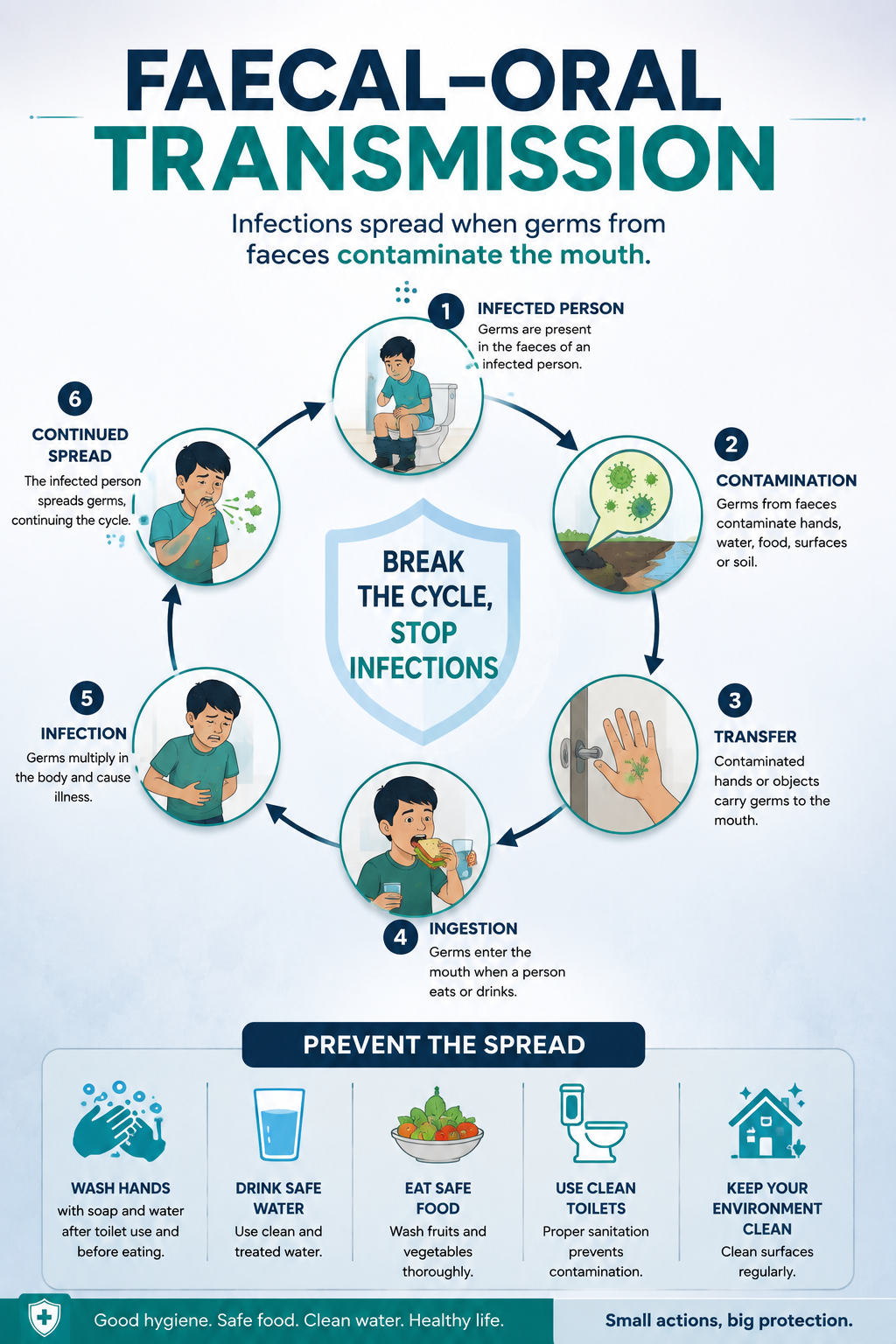
An infected person sheds pathogens in their stool. These contaminate food, water, or surfaces. A new host ingests them by eating contaminated food, drinking contaminated water, or touching a contaminated surface and then touching their mouth. The critical moment is the mouth.

Typhoid FeverHepatitis ACholeraHepatitis EPolioRotavirus

How It Spreads

Infected person sheds pathogen in stool
Contamination of food (unwashed hands of handler)
Contamination of water (sewage + water supply mixing)
Ingestion via food, water, or hand-to-mouth
Incubation then illness in new host

How to Prevent It

Handwashing with soap 40–60 sec before eating
Drink only boiled or RO/UV-treated water
Eat fully cooked food served hot — no raw salads
Typhoid Vi vaccine every 3 years
Hepatitis A vaccine 2-dose series
Faecal-oral transmission typhoid hepatitis A Surat

Most Common Route in India

Faecal-oral transmission is responsible for typhoid, hepatitis A, and hepatitis E — all of which circulate in Surat every monsoon season. The single most effective intervention: washing hands with soap before eating. No other measure has a higher impact per unit effort.

Airborne TB transmission Surat SCID-AI
 Route 02 — Airborne

Airborne Transmission

Infected persons expel respiratory particles when breathing, talking, coughing, or sneezing. Large droplets (influenza, COVID-19) fall within 1–2 metres. Droplet nuclei <5 microns (TB, measles) remain suspended for hours, travel across rooms, and accumulate in poorly ventilated spaces. These are fundamentally different risks requiring different precautions.

Tuberculosis (TB)COVID-19InfluenzaMeaslesVaricella (Chickenpox)Whooping Cough

How It Spreads

Infectious particles expelled from respiratory tract
Large droplets: fall within 2m (flu, cold)
Aerosol particles: remain airborne hours (TB, measles)
Inhalation by susceptible host in same space
Deposition in airways → infection

How to Prevent It

Ventilation: open windows, cross-ventilation reduces particle concentration
N95 mask: for aerosol risk (TB, COVID-19 high-risk settings)
Surgical mask: for large droplet diseases (flu, cold)
Influenza vaccine annually; MMR vaccine for measles
TB patients: separate room + surgical mask until sputum converts

TB vs Flu — Not the Same Risk

TB spreads via droplet nuclei that remain airborne for hours in a closed room — a fundamentally different risk from influenza droplets that fall within 2 metres. Open windows prevent TB. Avoiding a coughing colleague prevents flu. The right precaution depends on which disease you are trying to prevent.

 Route 03 — Vector-Borne

Vector-Borne Transmission

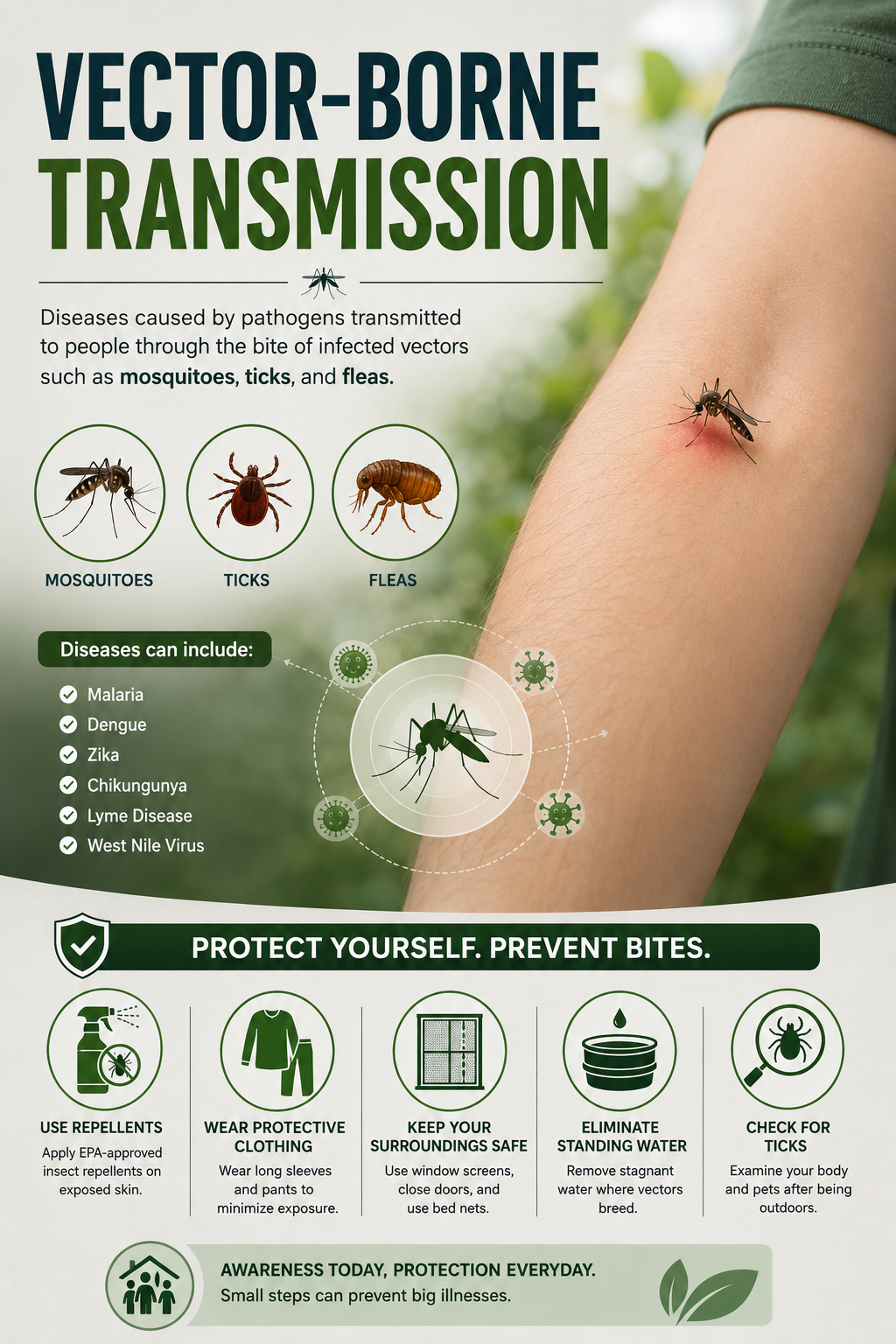
A vector — most commonly a mosquito — ingests a pathogen while feeding on an infected host. The pathogen replicates within the mosquito. When the infected mosquito feeds again, it injects the pathogen into a new host. Person-to-person contact plays no role — the vector is an essential intermediary. Prevention therefore targets the mosquito, not people-to-people interactions.

Dengue FeverMalariaChikungunyaJapanese EncephalitisZika

How It Spreads

Infected human/animal → mosquito ingests pathogen during bite
Pathogen replicates in mosquito (incubation period)
Infected mosquito bites new human host
Pathogen injected into bloodstream via saliva
Illness after incubation in new host

How to Prevent It

Eliminate Aedes breeding sites (dengue/chikungunya): empty containers every 3–5 days
DEET 20–30% repellent on exposed skin at dawn and dusk
Insecticide-treated nets at night (malaria: Anopheles)
Full-coverage clothing at peak biting hours
No hand hygiene or masks will prevent vector-borne disease
Vector-borne dengue malaria Surat prevention

Hand Hygiene Prevents Nothing Here

Vector-borne diseases are not transmitted by person-to-person contact. Washing hands after touching a dengue patient changes nothing. The only interventions that work are those that target the mosquito: eliminating breeding sites, applying repellent, using nets. Prevention strategy must match transmission route.
Bloodborne HIV hepatitis B prevention SCID-AI Surat
 Route 04 — Bloodborne

Bloodborne Transmission

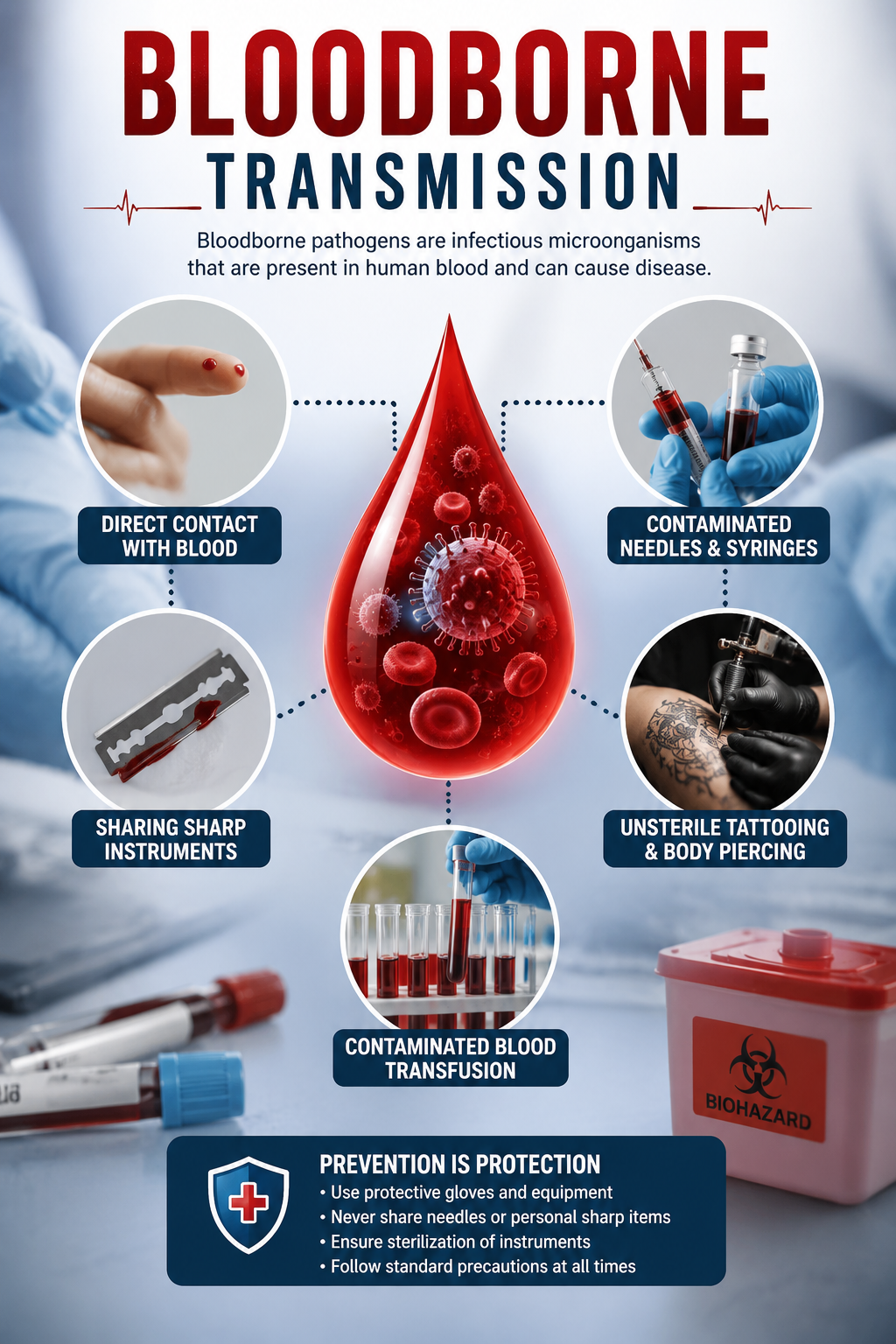
Bloodborne pathogens are present in blood (and for HIV/HBV, in semen and vaginal secretions). Transmission requires direct contact between infected blood/body fluid and a susceptible host's bloodstream or mucous membranes. Casual contact — meals, handshaking, hugging, coughing — cannot transmit bloodborne pathogens. This distinction matters enormously for preventing discrimination.

Hepatitis B (HBV)HIVHepatitis C (HCV)Malaria (transfusion)

How It Spreads

Needlestick or sharps injury from infected source
Shared injecting equipment (needles, syringes)
Unprotected sexual contact (HIV, HBV, HCV)
Mother-to-child during birth (HBV, HIV)
Shared personal items: razors, tattoo needles, glucose lancets

How to Prevent It

Hepatitis B vaccine 3-dose series (95%+ protective)
Safe sex: condoms consistently for HIV/HBV/HCV prevention
Never share: razors, needles, glucose lancets, tattoo equipment
PEP within 72 hours of HIV exposure (needlestick or sexual)
PrEP for high-risk individuals: prescribed at SCID-AI

HBV Cannot Spread Through Shared Meals

Hepatitis B is NOT transmitted through sharing food, utensils, hugging, or casual contact. This is the basis for the harmful social discrimination against HBV-positive individuals in India. HBV-positive people can work, share meals, and live normally — only blood and sexual contact carry risk. Hepatitis B vaccine prevents infection.

 Route 05 — Direct Contact

Direct Contact Transmission

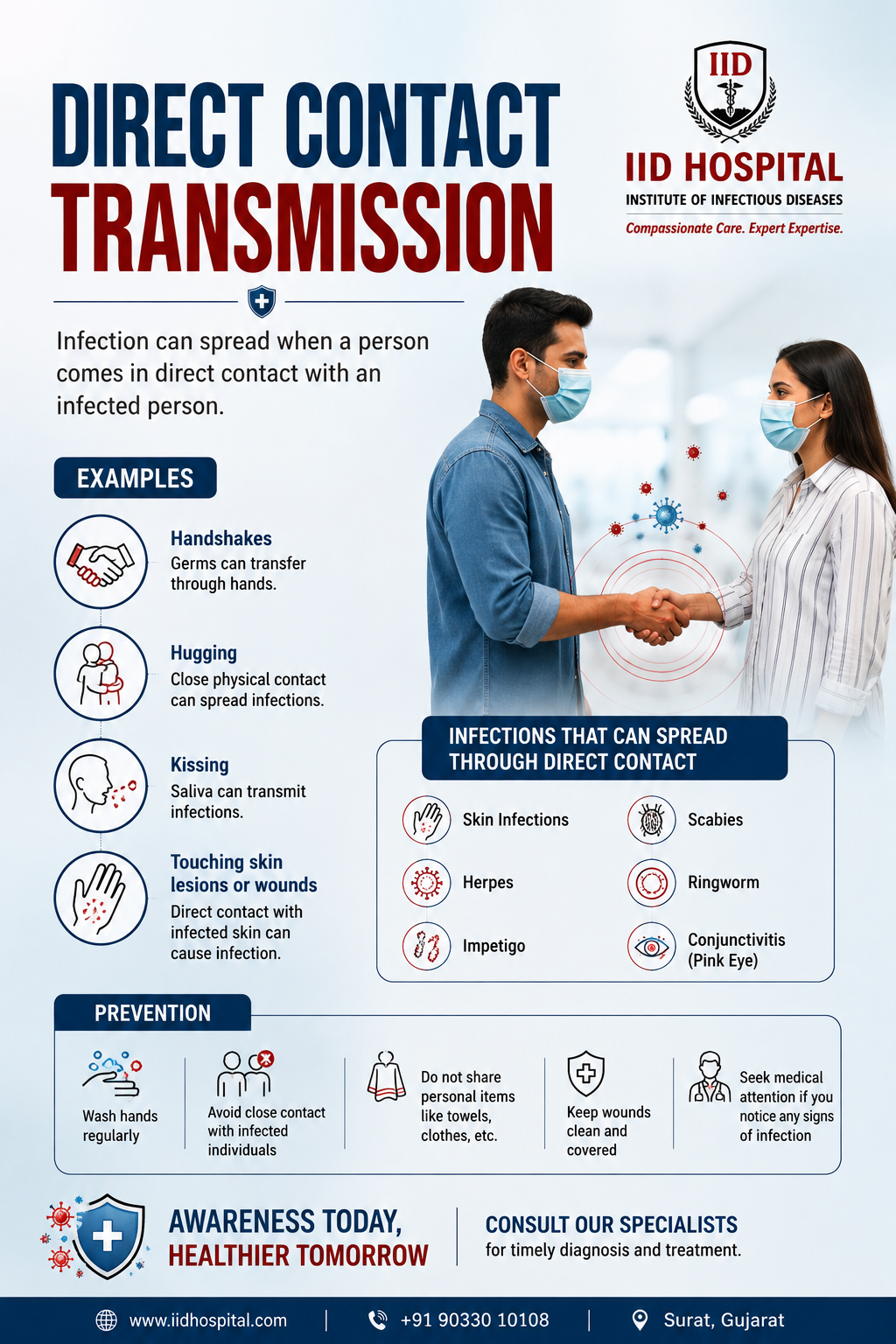
Direct contact transmission occurs when a pathogen passes directly from an infected source to a new host through skin-to-skin contact, contact with infected bodily secretions, or contact with contaminated environmental surfaces (indirect contact). A critical variant is percutaneous infection — where pathogens penetrate intact or broken skin from the environment (leptospirosis from flood water; hookworm from soil).

Tinea (Ringworm)ScabiesHerpes SimplexLeptospirosisRabiesImpetigo

How It Spreads

Skin-to-skin contact with infected person (tinea, scabies, herpes)
Contact with infected animal (rabies from bite, leptospirosis from rat urine)
Contact with contaminated soil or water (hookworm, leptospirosis)
Contact with contaminated surfaces (MRSA, norovirus on fomites)
Entry through broken skin, mucous membranes, or intact skin (lepto)

How to Prevent It

Closed footwear outdoors: prevents hookworm, leptospirosis, tetanus
Waterproof footwear in flood water: leptospirosis high risk during Surat monsoon
Do not share: towels, clothing, combs (tinea, scabies)
Avoid animal bites: rabies — wash wound 15 min + seek PEP immediately if bitten
Wash and cover wounds: prevents secondary infection with contact pathogens
Contact transmission leptospirosis tinea Surat

Leptospirosis During Surat Floods

Leptospirosis — a bacterial infection from rat urine in flood water — is a significant risk during Surat monsoon flooding. The bacteria penetrate intact skin as well as cuts. Waterproof footwear in flood water is mandatory. Fever within 1–2 weeks of flood water exposure: see Dr. Savaj and specifically mention the exposure.

Pathogen Survival

How Long Pathogens Survive Outside the Body

Understanding how long a pathogen survives in the environment explains why some infections spread through contaminated surfaces and others do not. HIV dies within minutes outside the body — which is why it cannot spread through handshakes or shared utensils. Hepatitis B survives on surfaces for up to 7 days — which is why healthcare workers need to handle blood-contaminated equipment with strict precautions.

PathogenRouteOn SurfacesIn WaterIn Air
M. tuberculosisAirborneHours–days in dried sputumWeeks in water (rare route)Hours as droplet nuclei
SARS-CoV-2AirborneUp to 72 hrs (plastic/steel)Brief in waterHours as aerosol
InfluenzaAirborne24–48 hrs on hard surfacesBriefMinutes–hours
Measles virusAirborneUp to 2 hoursNot a routeUp to 2 hours in room air
Hepatitis BBloodborneUp to 7 days (most stable)Days in waterNot a route
HIVBloodborneMinutes–hours (very fragile)MinutesNot a route
Salmonella typhiFaecal-oralHours on surfacesWeeks in waterNot a route
Hepatitis AFaecal-oralHours–daysMonths in waterNot a route
NorovirusFaecal-oralUp to 2 weeksMonths in shellfishNot a route
LeptospiraDirect contactHours (moisture needed)Weeks in moist soil/waterNot a route
Pathogen survival SCID-AI Surat

 High-Risk Situations in Surat

Monsoon flooding — leptospirosis, hepatitis A, typhoid all risk
Crowded public transport — TB, influenza, COVID-19 aerosol accumulation
Cooler trays + flower pots — Aedes breeding, dengue risk
Street food from unwashed hands — typhoid, hepatitis A primary source
Shared razors / tattoo needles — hepatitis B, HIV bloodborne risk
Wading barefoot in flood water — leptospirosis penetrates intact skin
Crowded indoor spaces + AC recirculation — TB + respiratory viruses

When in Doubt: See Dr. Savaj

Fever after any of these exposures in Surat: tell Dr. Savaj your exact exposure. The history determines the test. The test determines the treatment.

Prevention Reference

Which Prevention Works for Which Route

The table below shows which preventive measures are effective against which transmission routes. A tick means the measure directly interrupts this route. A cross means it has no effect — applying it is wasted effort for that disease.

Prevention Measure
Faecal–Oral
Airborne
Vector-Borne
Bloodborne
Direct Contact
Hand hygiene (soap & water)
Boil / treat drinking water
Eat fully cooked food
Typhoid vaccine
Hepatitis A vaccine
Surgical face mask
N95 respirator mask
Ventilation / open windows
Influenza / measles vaccine
Mosquito repellent (DEET)
Eliminate breeding sites
Mosquito net at night
Hepatitis B vaccine
Never share needles / razors
Condoms (sexual contact)
Closed footwear outdoors
Avoid / wash animal bites
Works — directly interrupts this route
Vaccine — builds immunity before exposure
No effect — wrong tool for this route

How to Read This Table

Mosquito repellent (✓ for vector-borne) prevents dengue and malaria. The same repellent has zero effect on typhoid (faecal-oral) or TB (airborne). This is not a weakness of repellent — it is simply not the right tool for those diseases. Using the right prevention for the right route is more effective than doing everything randomly. This table helps you apply effort where it actually works.

Patient Feedback

What Patients Say About Infection Education at SCID-AI

I had typhoid three times in four years. I thought it was from the water. Dr. Savaj explained the faecal-oral route in detail — that the real risk was often unwashed hands of food handlers at my regular lunch spot, not the water I was drinking. I changed where I ate, started washing hands consistently before eating. No typhoid in 2 years. Understanding the route changed my behaviour.

AK
Arvind K.Recurrent typhoid — source identified · Surat

I developed fever 10 days after wading through flood water during the Surat floods without shoes. The first doctor said it was viral fever. Dr. Savaj asked about the flood water exposure immediately and tested for leptospirosis — positive. Correct antibiotic, quick recovery. He explained how leptospira penetrates intact skin from contaminated water. I now wear rubber boots in flooding season.

VP
Vijay P.Leptospirosis — flood water exposure · Surat
Common Questions

Frequently Asked Questions About Infection Transmission

Answered by Dr. Pratik Savaj, FNB Infectious Diseases, SCID-AI, Surat.

Why does knowing the transmission route matter?
Because the prevention strategy is entirely determined by the transmission route. Hand hygiene prevents typhoid and hepatitis A (faecal-oral) but does nothing to prevent dengue (vector-borne). Mosquito repellent prevents dengue but cannot prevent TB (airborne) or hepatitis B (bloodborne). A person who knows that TB spreads through the air will open windows and wear a mask around an infectious patient — the correct prevention. A person who thinks TB spreads through food sharing or physical contact applies the wrong prevention entirely. Understanding transmission routes is the foundation of rational, effective infection prevention.
Can airborne diseases spread through air conditioning?
Yes — this is an important and under-appreciated risk. Air conditioning systems that recirculate room air without adequate fresh air exchange or filtration can concentrate infectious aerosol particles and spread them to everyone in the space. This is particularly relevant for: TB in enclosed workplaces, hospitals, and public transport with poor ventilation; COVID-19 in restaurants, offices, and enclosed gyms; influenza in crowded air-conditioned spaces during peak season. The prevention is not to avoid air conditioning but to ensure systems have adequate fresh air exchange, HEPA filtration where possible, and that the space is not overcrowded. Opening windows in addition to using air conditioning dramatically reduces risk.
How does typhoid spread even when I eat at clean-looking restaurants?
Typhoid is caused by Salmonella typhi and spreads via the faecal-oral route — meaning an infected food handler contaminates food with faecal bacteria, often because they did not wash hands after using the toilet. The restaurant may look clean — clean surfaces, clean tables — but if a food handler has typhoid or is an asymptomatic carrier and did not wash hands properly, contamination of food is invisible. The food itself may look and taste completely normal. In India, typhoid transmission most commonly occurs through contaminated food prepared by infected handlers, not primarily through visibly dirty food. This is why typhoid vaccination (every 3 years) and hand hygiene before eating matter even at apparently clean establishments.
Can I get hepatitis B from sharing a meal or casual contact?
No. Hepatitis B is a bloodborne pathogen — it is NOT transmitted through sharing meals, utensils, hugging, handshaking, coughing, sneezing, or casual social contact. HBV is transmitted through: direct blood-to-blood contact (needlestick, shared razor, tattoo needles, shared glucose monitoring equipment); sexual contact with an infected person; mother to infant during childbirth. The virus is present in blood, semen, and vaginal secretions — not in saliva at infectious concentrations, not in tears, not in sweat. Knowing this prevents the harmful discrimination against HBV-positive individuals in India — they can share meals, work together, and live in the same household without risk to others, provided blood exposure is avoided.
How long do viruses survive on surfaces outside the body?
Survival varies enormously by pathogen: Influenza virus: 24–48 hours on hard surfaces; 5 minutes on hands. SARS-CoV-2 (COVID-19): up to 72 hours on plastic and stainless steel; much shorter on porous surfaces. Norovirus (gastroenteritis): up to 2 weeks on surfaces, highly resistant to many disinfectants. Rhinovirus (common cold): up to 18 hours on hard surfaces. HIV: minutes to hours outside the body — very fragile in the environment. Hepatitis B virus: up to 7 days on surfaces at room temperature — the most environmentally stable of common bloodborne viruses. Mycobacterium tuberculosis: hours to days in dried sputum on surfaces. The practical implication: frequently touched surfaces (door handles, lift buttons, phone screens) in crowded environments carry meaningful contamination risk for respiratory viruses.
Does mosquito type matter for prevention?
Yes — critically. Aedes aegypti (dengue, chikungunya): bites during the day (peak dawn and dusk), breeds in small clean stagnant water in household containers. Prevention: eliminate breeding sites by emptying and scrubbing containers every 3–5 days; repellent during day. Anopheles (malaria): bites at night, breeds in larger outdoor water bodies (rice fields, slow streams). Prevention: mosquito nets at night; repellent at dusk; window screens. Culex (West Nile virus, Japanese encephalitis): bites at dusk and night, breeds in polluted stagnant water. Prevention: similar to Anopheles. Because different mosquitoes bite at different times and breed in different habitats, effective prevention requires knowing which disease is relevant at your destination — and targeting that species’ specific behaviour.
Can a person spread infection before they feel sick?
Yes — for many infections, the pre-symptomatic period carries significant transmission risk. COVID-19: peak transmission occurs 1–2 days before symptom onset. Influenza: infectious 1 day before symptoms appear; most contagious in the first 3–4 days of illness. Typhoid: some individuals are asymptomatic carriers who permanently shed Salmonella typhi in stool without ever developing illness — a major source of sustained community transmission. HIV: acute HIV infection (2–4 weeks post-exposure) carries very high viral loads and high transmission risk, often before the person knows they are infected. Hepatitis B: infectious during incubation period (1–4 months before jaundice). This pre-symptomatic infectiousness is why preventive measures must be applied consistently — not only when someone appears visibly sick.
How does TB spread differently from a cold or flu?
All three spread through the respiratory route, but the mechanism and risk differ significantly. Common cold (rhinovirus) and influenza: spread primarily through large respiratory droplets (expelled by coughing, sneezing, talking) that fall to the ground within 1–2 metres; also through contact with contaminated surfaces then touching the face. TB (Mycobacterium tuberculosis): spreads through very small droplet nuclei (aerosol particles <5 microns) that remain suspended in the air for hours and can travel across a room or accumulate in poorly ventilated spaces. A person with active pulmonary TB can infect others simply by breathing in a shared enclosed space — no coughing, sneezing, or physical proximity required. This is why TB transmission occurs in households, public transport, and workplaces with poor ventilation, and why adequate ventilation (open windows) is a primary TB prevention measure — something that does not apply to colds or flu in the same way.
Consult Dr. Pratik Savaj

Concerned About an Infection? Get the Right Diagnosis.

No referral needed. Dr. Pratik Savaj, FNB Infectious Diseases, SCID-AI, Nanpura, Surat takes a systematic history to identify the transmission route — and orders the right test for the right disease. The transmission route is the diagnosis. The diagnosis determines the treatment.

SCID-AI, Nanpura, Surat — 405 SNS Axis Business Space, Besides Mahavir Hospital, Surat 395001
Mon–Sat: 11 AM–1 PM & 4–6 PM · Sunday: Closed
+91 72839 34807 — Call or WhatsApp
Dr. Pratik Savaj
Dr. Pratik Savaj FNB Infectious Diseases
MBBS · DNB Medicine · Fellowship ID
P.D. Hinduja Hospital, Mumbai
Morning11:00 AM – 1:00 PM, Mon–Sat
Evening4:00 PM – 6:00 PM, Mon–Sat
Phone+91 72839 34807
 WhatsApp to Book