SCID-AI · 405 SNS Axis Business Space, Nanpura, Surat
Mon–Sat: 11–1 PM & 4–6 PM
Causes of persistent fever SCID-AI Surat  Fever · SCID-AI Blog
7 days Fever beyond 7 days without a diagnosis
needs an ID specialist, not another antibiotic
 Fever · SCID-AI Blog

Causes of Persistent Fever — What Your Doctor Should Be Looking For

Dr. Pratik Savaj
Dr. Pratik SavajFNB Infectious Diseases · SCID-AI, Surat
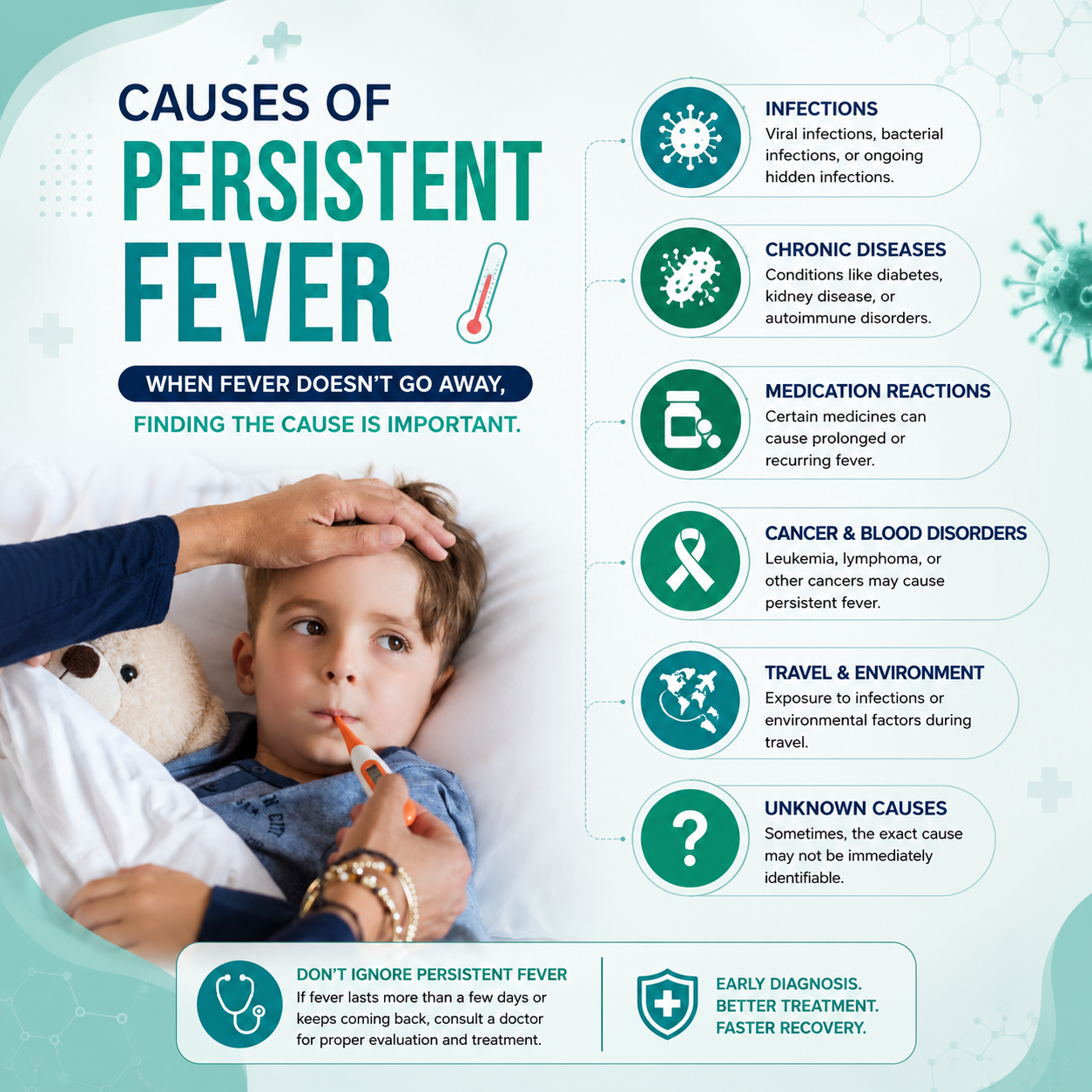
A fever that persists beyond 7 days without a confirmed diagnosis is not a “viral fever.” It is an undiagnosed infection, an inflammatory condition, or occasionally a malignancy — and the difference matters enormously for treatment. In India, the most common cause of persistent fever is still infectious — and the most commonly missed infectious cause is tuberculosis. This article explains what persistent fever means clinically, what the systematic differential looks like, and what tests actually find the answer.

What Is Persistent Fever?

Persistent fever is a clinical state, not a diagnosis. It is defined by duration — fever lasting more than 7–10 days without resolution or a confirmed aetiology. When the duration exceeds 3 weeks with fever above 38.3°C on multiple occasions and no diagnosis after initial investigation, it meets the formal definition of Fever of Unknown Origin (FUO).

The critical distinction: a fever that has lasted 10 days is not “the same viral fever but longer.” Self-limiting viral illnesses — influenza, common cold, dengue — virtually always resolve within 7–10 days. A fever that persists beyond this window has either a different cause than originally assumed, or a complication of the original illness. The clinical response to persistent fever is not another antibiotic — it is a systematic reassessment.

The Most Common Clinical Error

Prescribing a third or fourth course of antibiotics for persistent fever without identifying the cause. Each course of antibiotics given empirically without culture: makes subsequent cultures less reliable; may suppress the fever temporarily while the underlying cause progresses; selects for resistant organisms; and delays the diagnosis by creating a false sense of “trying something.” The correct response to persistent fever is a systematic workup — not escalating empirical antibiotics.

The Four Categories of Persistent Fever

The causes of persistent fever fall into four broad categories. In India, infectious causes dominate — accounting for 40–60% of FUO cases in Indian series, compared to 20–30% in Western series. This reflects the high burden of TB, enteric fever, and endemic infectious diseases in our setting.

Infectious Causes

40–60% of FUO in India
Tuberculosis — most commonly missed; pulmonary + extrapulmonary
Typhoid fever (Salmonella typhi) — step-ladder fever pattern
Infective endocarditis — fever + heart murmur + embolic signs
Malaria — Plasmodium vivax (cyclical) or falciparum (continuous)
Brucellosis — undulant fever, livestock/dairy exposure
Visceral leishmaniasis (Kala-azar) — travel to Bihar/Jharkhand endemic areas
Liver abscess (amoebic or pyogenic) — RUQ pain + fever
HIV — primary infection or opportunistic infections
Rickettsial disease — tick exposure, eschar, rash
Leptospirosis — flood water exposure, jaundice

Inflammatory & Autoimmune Causes

15–25% of FUO
Adult-onset Still's disease — quotidian fever + salmon rash + arthritis
Systemic lupus erythematosus (SLE) — multi-system, positive ANA
Rheumatoid arthritis (systemic onset) — joint + systemic features
Vasculitis (PAN, GPA) — multi-organ involvement
Inflammatory bowel disease — fever + GI symptoms
Sarcoidosis — bilateral hilar lymphadenopathy on CXR
Haemophagocytic syndrome (HLH) — very high ferritin, cytopenia
Periodic fever syndromes — familial, recurrent pattern

Malignant Causes

10–20% of FUO
Lymphoma (Hodgkin's and Non-Hodgkin's) — B symptoms + lymphadenopathy
Leukaemia — anaemia + thrombocytopaenia + fever
Renal cell carcinoma — classic paraneoplastic fever
Hepatocellular carcinoma — fever + liver mass on imaging
Colon carcinoma — occult bleeding + fever + weight loss
Atrial myxoma — cardiac tumour mimicking endocarditis

Miscellaneous & Drug Causes

5–15% of FUO
Drug fever — any medication; antibiotics, anticonvulsants, allopurinol
Deep vein thrombosis / pulmonary embolism — Virchow's triad
Factitious fever — thermometer manipulation (rare)
Thyroiditis — thyroid tenderness + raised TFTs
Adrenal insufficiency — intermittent fever + hypotension
Undiagnosed / no cause found — 5–15% of rigorously evaluated FUO
FUO workup blood tests SCID-AI Surat
Systematic blood culture, CBC, CRP, IGRA, and serologies — the staged FUO workup at SCID-AI targets the most likely causes first based on history, not a blanket panel of every available test.

Clinical Clues That Point to the Diagnosis

The history and examination contain clues that narrow the differential before any test is ordered. These are the patterns that an experienced ID specialist looks for systematically at every evaluation of persistent fever.

Fever pattern

Step-ladder fever rising daily over first week

Typhoid fever — Salmonella typhi. Send blood culture on week 1.

Fever pattern

Cyclical fever every 48 or 72 hours with rigors

Malaria — vivax (48h) or falciparum (irregular). Blood smear + RDT day 1.

Associated symptom

Cough 3+ weeks + night sweats + weight loss

Tuberculosis — GeneXpert on sputum. HRCT chest. IGRA.

Associated symptom

Fever + firm painless cervical lymph nodes

TB lymphadenitis or lymphoma — FNAC + excision biopsy if needed.

Associated symptom

Fever + new or changing heart murmur

Infective endocarditis — blood culture ×3 + echocardiogram urgently.

Exposure history

Fever + flood water exposure + jaundice

Leptospirosis — Leptospira antibody + LFT + urine microscopy.

Exposure history

Fever + livestock / raw dairy exposure

Brucellosis — Brucella serology + blood culture in specific media.

Associated symptom

Fever + salmon-coloured evanescent rash + arthritis

Adult-onset Still's disease — serum ferritin (often >10,000), ANA negative.

Blood test clue

Leukopenia (low WBC) in a febrile patient

Typhoid, viral infections, SLE, or leishmaniasis — not reassuring.

Blood test clue

Very high ferritin (>5,000) + cytopenia + fever

Haemophagocytic syndrome (HLH) — requires urgent bone marrow biopsy.

Imaging clue

Bilateral hilar lymphadenopathy on CXR

Sarcoidosis or lymphoma — HRCT chest + serum ACE + PET-CT.

Response to treatment

Fever responds to NSAIDs but not antibiotics

Inflammatory or malignant cause — reassess the entire differential. Stop empirical antibiotics.

FUO workup SCID-AI Surat
A systematic workup finds the cause in 85–95% of FUO cases. The key is a staged approach — basic tests first, then targeted second-line tests based on what the history and initial results suggest.

The Systematic Workup for Persistent Fever

The workup for persistent fever is staged — not a simultaneous panel of every test. Stage 1 targets the most common and most treatable causes first. Stage 2 is triggered when Stage 1 is negative and fever persists. Stage 3 includes invasive procedures when non-invasive workup has not yielded a diagnosis.

StageTestsWhat It Looks ForWhen
Stage 1CBC + differential, CRP, ESR, LFT, RFTLeucocytosis (bacterial), leucopenia (typhoid/viral), elevated CRPDay 1 of evaluation
Stage 1Blood culture ×2 (before antibiotics)Bacteraemia — typhoid, endocarditis, pyogenicDay 1 — never after antibiotics started
Stage 1Malaria smear + RDTPlasmodium vivax or falciparumDay 1 — monsoon season mandatory
Stage 1HIV ELISA + dengue serologyHIV primary / late; dengue IgMDay 1
Stage 1Chest X-rayTB infiltrates, lymphadenopathy, effusionDay 1
Stage 2GeneXpert on sputum / BALMycobacterium tuberculosis + rifampicin resistanceFever >10 days, CXR abnormal or clinical suspicion
Stage 2IGRA (QuantiFERON-TB Gold)Latent TB — immune sensitisation to TB antigensAll persistent fever of unknown cause
Stage 2HRCT chestEarly TB, lymphadenopathy, pleural disease missed on CXRCXR normal but TB suspected
Stage 2ANA + anti-dsDNA + C3/C4SLE and connective tissue diseaseJoint pain, rash, multi-system features
Stage 2Serum ferritinHLH if >10,000; Still's disease if markedly elevatedCytopenia + fever + splenomegaly
Stage 2EchocardiogramInfective endocarditis vegetationsMurmur + persistent fever + positive blood culture
Stage 3Bone marrow biopsyLymphoma, leukaemia, HLH, miliary TB, leishmaniasisUnexplained cytopenia + fever persisting after Stage 2
Stage 3PET-CT scanOccult lymphoma, sarcoidosis, vasculitis, occult infectionFUO persisting after full non-invasive workup
Stage 3Lymph node excision biopsyDefinitive diagnosis of lymphoma, TB lymphadenitisAccessible lymphadenopathy, FNAC non-diagnostic

Why TB Must Always Be First in India

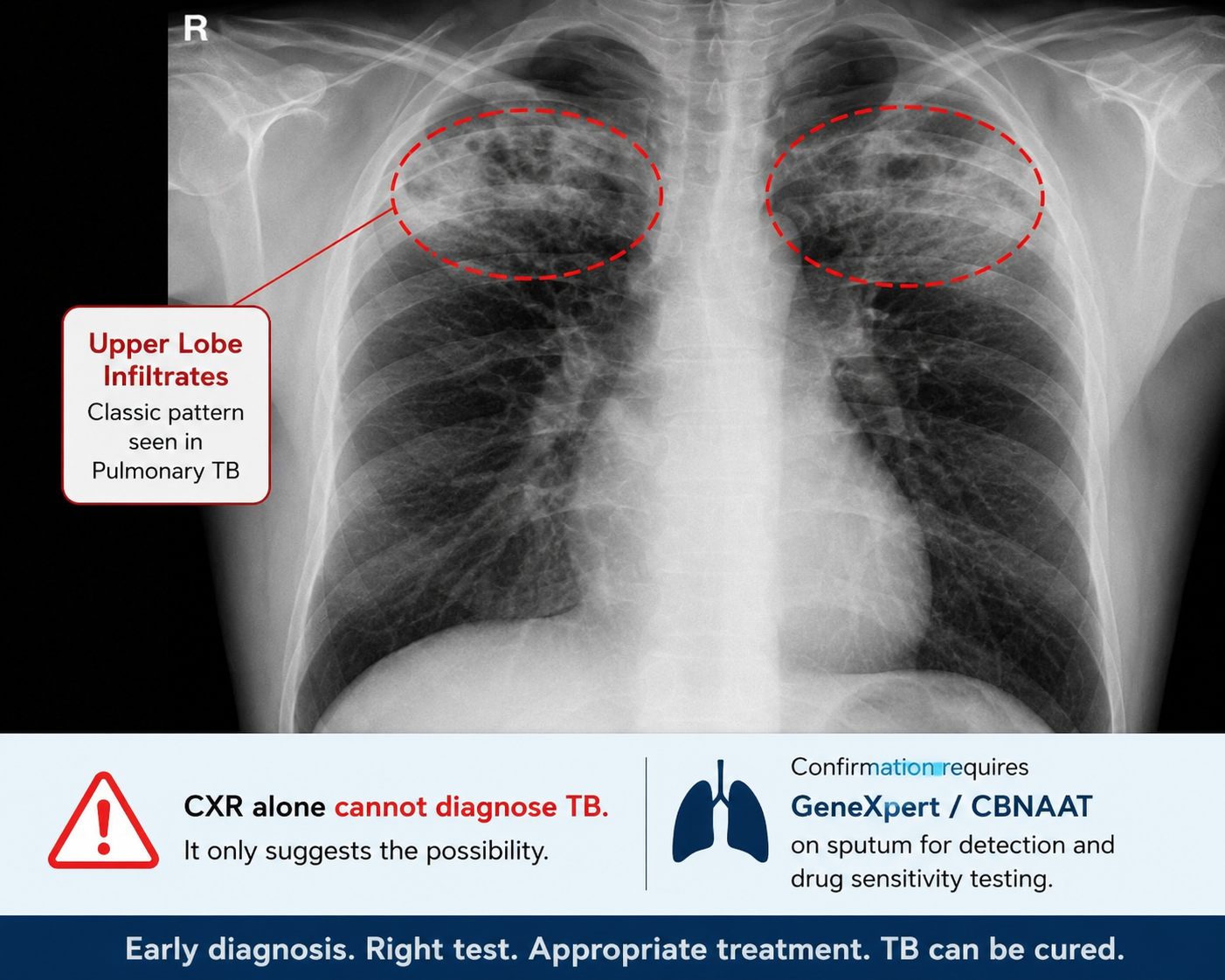
In Indian FUO series, TB is the single most common cause — accounting for 20–40% of diagnosed cases. Yet it is consistently the most commonly missed diagnosis because: chest X-ray can be normal in early pulmonary TB and in all extrapulmonary forms; standard antibiotics have no effect on TB but may suppress secondary infections creating false improvement; GeneXpert is still not ordered as a first-line test in many outpatient settings; and TB carries social stigma that delays the patient seeking appropriate care.

At SCID-AI, TB is actively excluded in every patient with persistent fever — with IGRA and GeneXpert, not just a chest X-ray. A normal CXR is never interpreted as TB excluded.
TB chest xray SCID-AI Surat
Chest X-ray showing TB infiltrates — but a normal CXR never excludes TB. IGRA and GeneXpert are required for TB exclusion in persistent fever.

The TB Rule in Persistent Fever

Any patient in India with fever lasting more than 2–3 weeks, especially with weight loss or night sweats, requires: IGRA + GeneXpert on sputum (or appropriate sample) + HRCT chest. Not a chest X-ray alone. Not “empirical anti-TB treatment.” A proper diagnostic workup. Starting anti-TB treatment empirically without a diagnosis exposes the patient to 6 months of toxic drugs, misses the real diagnosis, and makes subsequent diagnosis harder.

FUO specialist SCID-AI Surat Dr Savaj
Dr. Savaj’s FUO workup at SCID-AI: systematic history including all exposures, staged investigation starting with the most common causes in India, and culture-before-treatment as an absolute rule.

FUO Assessment at SCID-AI — What to Expect

Dr. Pratik Savaj, FNB Infectious Diseases, provides systematic FUO workup at SCID-AI, Nanpura, Surat. The approach: a detailed exposure history (every travel destination, food and water sources, animal and mosquito exposures, all medications, all previous treatments); a targeted examination (lymph nodes, spleen, liver, heart sounds, skin); and a staged investigation plan targeting the most likely causes in the Indian context.

What to bring to your first consultation: all previous blood test reports (even normal ones); all culture results with sensitivity; all antibiotic prescriptions received; a written timeline of fever pattern and all symptoms; travel history including destinations in the last 3 months. The more detail brought, the faster the assessment.

Culture Before Every Antibiotic — Without Exception

The most important rule at SCID-AI for persistent fever: blood culture is sent before any antibiotic is started or changed. Once an antibiotic has been given, cultures become negative and the window for bacteriological diagnosis closes. If a previous doctor started antibiotics before cultures were taken, a new set of blood cultures is sent after a minimum antibiotic-free period. The diagnosis must be made before treatment is decided.

The Clinical Rule for Persistent Fever

Fever beyond 7 days without a confirmed diagnosis is not “viral fever.” It is an undiagnosed condition that requires systematic evaluation. The most common cause in India is TB — which does not respond to antibiotics and requires specific testing to diagnose. Three courses of antibiotics for a fever that does not resolve is not treatment — it is a 3-week delay in diagnosis. Come to SCID-AI for a workup.

Dr. Pratik Savaj FUO specialist SCID-AI
Dr. Pratik Savaj MBBS · DNB Medicine · Fellowship ID · FNB Infectious Diseases · P.D. Hinduja Hospital, Mumbai

Dr. Savaj specialises in the systematic workup of persistent fever and Fever of Unknown Origin (FUO) at SCID-AI, Nanpura, Surat. Fever beyond 7 days without a diagnosis: +91 72839 34807.

Common Questions

Frequently Asked Questions

Answered by Dr. Pratik Savaj, FNB Infectious Diseases, SCID-AI, Surat.

What is Fever of Unknown Origin (FUO) and how is it defined?
Fever of Unknown Origin (FUO) is defined clinically as: temperature above 38.3°C on multiple occasions, lasting more than 3 weeks, without a diagnosis established after a thorough initial outpatient evaluation (1 week of investigations). The original Petersdorf-Beeson definition (1961) required hospitalisation, but modern practice applies the 3-week + 1-week-of-investigation threshold in outpatient settings. FUO is classified into four categories: Classic FUO (the above definition in immunocompetent patients); Nosocomial FUO (fever in hospitalised patients, not present on admission, without diagnosis after 3 days); Immune-deficient FUO (fever in neutropenic or HIV-positive patients); HIV-associated FUO (in HIV patients, CD4 below 500). In India, the most common cause of classic FUO is still infectious — TB accounts for 20–40% of FUO diagnoses in Indian series.
Can fever itself cause harm, or is it just a symptom?
Fever itself — as a physiological response — is generally beneficial and not harmful at temperatures below 41°C. Fever inhibits the replication of many pathogens (bacteria and viruses replicate less efficiently at elevated temperatures), activates immune cells, and enhances immune signalling. Suppressing fever with antipyretics in mild to moderate illness may actually prolong the illness in some infections by removing this protective mechanism. However, fever above 41°C (hyperpyrexia) can cause direct cellular damage and requires urgent treatment. Fever in specific high-risk groups needs careful management: children under 3 months (any fever is an emergency); patients with a history of febrile seizures; immunocompromised patients. The general principle: treat fever to improve patient comfort, not to suppress the immune response — and investigate the cause rather than just controlling the temperature.
Is malaria still a risk in Surat?
Yes — malaria is endemic in Gujarat, and Surat sees both Plasmodium vivax and Plasmodium falciparum cases, particularly during and after the monsoon season. Plasmodium vivax is the more common species in Gujarat — it causes recurring fevers with rigors, sweating, and anaemia, and can relapse months or years later due to dormant liver-stage parasites (hypnozoites). Treatment requires both chloroquine (for the blood stage) and primaquine (for the liver stage to prevent relapse). Plasmodium falciparum is the dangerous species — cerebral malaria, severe anaemia, and organ failure can develop within 24–48 hours. Any fever in Surat — particularly with rigors, cyclical pattern, or travel to rural Gujarat — needs a blood smear and RDT on day 1. Waiting 48–72 hours to see if falciparum malaria “resolves” is not safe.
Why does fever come back after antibiotics seem to have helped?
Recurring or relapsing fever after antibiotics is one of the most important clinical patterns and carries several explanations: 1. Wrong antibiotic for the organism: the antibiotic suppressed secondary bacterial flora but not the actual causative pathogen. The causative organism was never identified by culture. 2. Drug-resistant organism: ciprofloxacin for XDR typhoid, for example — partial suppression then relapse. 3. Undrained focus of infection: an abscess, empyema, or infected collection that antibiotics cannot penetrate — needs drainage. 4. TB: TB does not respond to standard antibiotics; courses of amoxicillin or ciprofloxacin temporarily suppress secondary infections but the TB smoulders on. 5. Non-infectious cause: lymphoma, adult-onset Still’s disease, SLE, or other inflammatory conditions that were assumed infectious and “treated” with antibiotics that had no effect. Recurring fever after antibiotics is an indication for an ID specialist assessment — not another antibiotic course.
How many days of fever before I should see an infectious disease specialist?
The short answer: sooner than most people wait. Specific thresholds: Day 1–3 during Surat’s monsoon: any fever — see Dr. Savaj on day 1 for NS1 + malaria exclusion. Day 3–5 any fever with warning signs: dengue critical phase, any bleeding, severe abdominal pain, confusion — emergency assessment. Day 7 without a diagnosis: if you have had fever for 7 days and have not been given a specific confirmed diagnosis (not just “viral fever”), you need an ID specialist assessment. Day 14 or more: meets threshold for persistent fever — systematic FUO workup is needed. Any fever with weight loss, night sweats, or lymphadenopathy: TB and lymphoma must be excluded — see Dr. Savaj regardless of duration. The most common error is waiting 2–4 weeks before escalating — during which time TB progresses, antibiotic courses are tried empirically, and blood cultures become negative.
What blood tests are done for persistent fever?
The workup for persistent fever is staged. First-line tests (all persistent fever, day 1 of evaluation): CBC with differential (WBC, neutrophil %, lymphocyte %, eosinophil %); CRP + ESR; LFT + RFT; blood culture ×2 (before any antibiotics); thick blood smear + RDT for malaria; dengue NS1 / IgM; HIV test (ELISA); Widal test or typhoid blood culture; chest X-ray / HRCT chest. Second-line (if first-line negative, fever persists >10–14 days): GeneXpert on sputum or BAL; IGRA for TB; ANA + anti-dsDNA (autoimmune screen); serum ferritin (very high in adult-onset Still’s, haemophagocytic syndrome); serum protein electrophoresis; blood culture for Brucella; Leishmania antibody (rK39 ELISA) if from endemic region; echocardiogram if cardiac murmur or risk factors for endocarditis. At SCID-AI, Dr. Savaj selects tests based on the specific clinical history — not a blanket panel — targeting the most likely causes first.
What is typhoid fever and how is it different from other fevers?
Typhoid fever is caused by Salmonella typhi, transmitted via the faecal-oral route — contaminated food or water. Its distinguishing clinical features: Step-ladder fever: temperature rises progressively over the first week, peaking at 39–40°C by end of week 1. Relative bradycardia: pulse rate lower than expected for the degree of fever — a classic sign. Abdominal pain and distension: the organism infects Peyer’s patches in the gut. Rose spots: faint pink macules on the trunk, present in only 20–30% and easily missed on darker skin. Hepatosplenomegaly: enlarged liver and spleen on examination. The Widal test is unreliable — it produces high rates of false positives in India due to prior exposure. The correct test is blood culture — positive in 60–80% in the first week if taken before antibiotics. In Surat, ciprofloxacin-resistant typhoid (XDR typhoid) is now common — azithromycin or cefixime is used first-line.
Does a normal blood test mean I don't have a serious infection?
No — a “normal blood test” does not exclude serious infection. This is one of the most dangerous false reassurances in clinical medicine. Examples where serious infections can present with normal or near-normal initial blood tests: TB: WBC can be normal or even low; CRP may be mildly elevated; CXR can be normal in early disease. A normal CBC does not exclude TB. Typhoid: leukopenia (low WBC) is actually characteristic — a “normal” or low WBC in a febrile patient in India should increase suspicion for typhoid, not decrease it. Infective endocarditis: CBC may show only mild anaemia initially; diagnosis requires blood culture and echocardiogram. Viral hepatitis: CBC is usually normal; diagnosis requires specific hepatitis serology. Malaria: early infection may have a normal WBC; diagnosis requires blood smear or RDT, not CBC alone. The rule: normal blood tests do not equal no infection — they mean the basic panel has not found the cause. Further investigation is needed.

Fever Beyond 7 Days? Get a Proper Workup.

Not another antibiotic. A systematic evaluation — blood culture before treatment, TB exclusion with IGRA + GeneXpert, and a staged investigation targeting India’s most common FUO causes. Dr. Pratik Savaj, FNB Infectious Diseases, SCID-AI, Nanpura, Surat — no referral needed.

Dr. Pratik Savaj
Dr. Pratik Savaj FNB Infectious Diseases · SCID-AI, Surat
Morning11:00 AM – 1:00 PM, Mon–Sat
Evening4:00 PM – 6:00 PM, Mon–Sat
Phone+91 72839 34807
);document.body.style.overflow='';});}); })();