 Educational Guide · IID Hospital, Surat
When to See an Infectious Disease SpecialistSituations That Need Expert Assessment
Most infections are appropriately managed by a GP. But certain clinical situations — unknown diagnosis after basic workup, treatment failure, specific complex infections, post-travel fever, or immunocompromised patients — require the specific training of an infectious disease specialist to get the right answer quickly.
The Three Things an ID Specialist Does That a GP Cannot
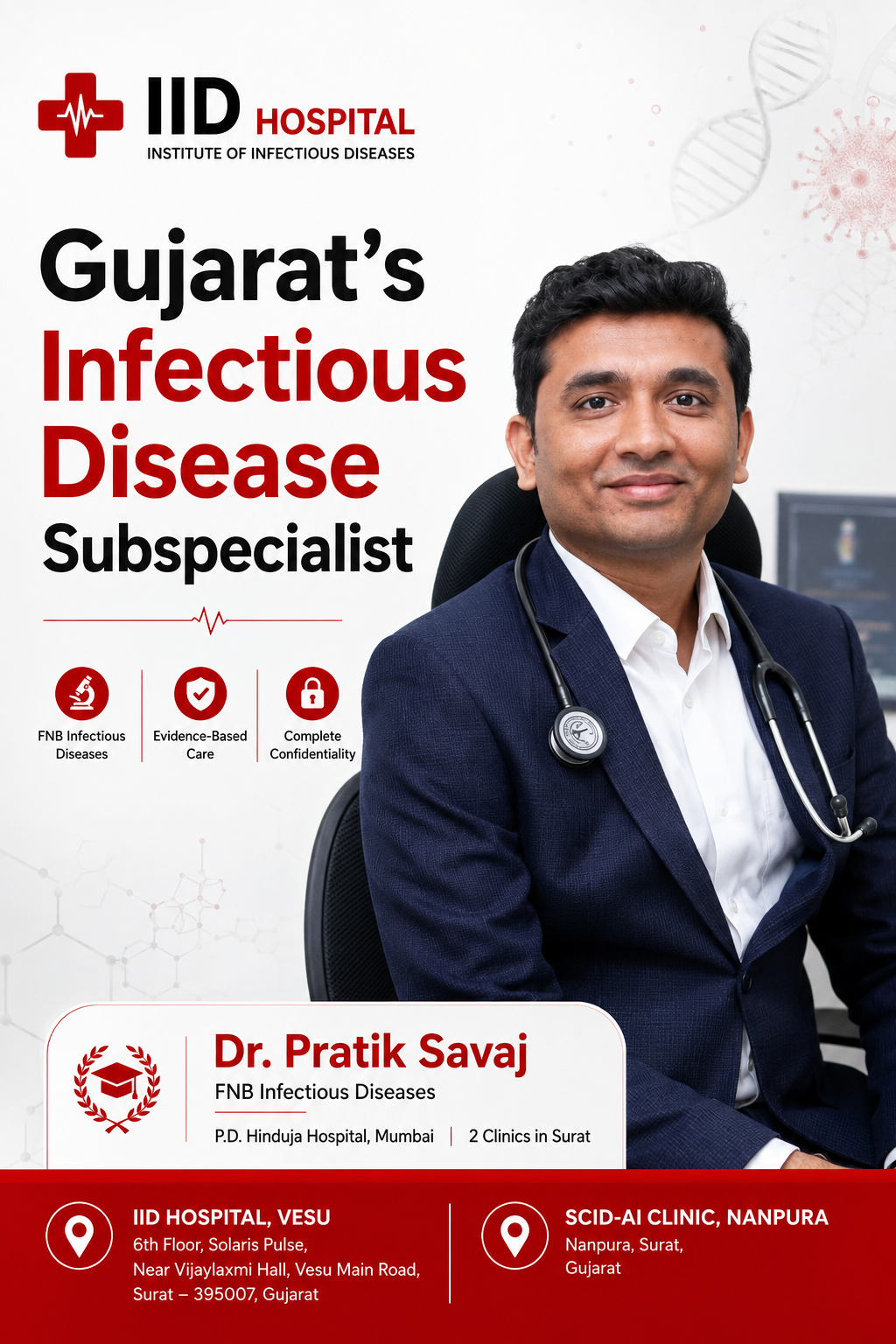
Infectious disease is a full medical specialty — not just a sub-interest of general medicine. FNB Infectious Diseases (the qualification Dr. Savaj holds) requires 2 years of dedicated fellowship training after DNB Medicine, focused specifically on the diagnosis and management of complex infections. Three skills define the specialty.
Diagnostic Breadth Across All Infections
A GP’s differential for fever typically spans the common infections of one organ system. An ID specialist’s differential spans all organisms, all body sites, and all patient populations — including rare, atypical, and imported infections that are missed at the GP level. The history, the travel, the exposure, and the microbiology are synthesised into a single diagnosis.
Microbiology Integration & Antibiotic Stewardship
Interpreting culture results requires knowing when a positive is genuine versus contaminated, when a sensitive result means the antibiotic will work in the tissue site of infection, and when resistance mechanisms mean a “sensitive” result is clinically misleading. ID specialists culture before treating and prescribe the narrowest effective antibiotic — never broad-spectrum empirically without cause.
Complex Infection Management
TB treatment, HIV antiretroviral therapy, antifungal selection for invasive fungal disease, management of infections in immunocompromised patients (diabetics, HIV-positive, post-transplant, on biologics) — these require ID-level training. Getting the wrong antibiotic for MDR-TB or the wrong antifungal for cryptococcal meningitis is not just ineffective — it is dangerous.
When to See Dr. Savaj — Specific Clinical Situations
These are the clinical situations where an ID specialist adds the most value — where the GP level of assessment is appropriate as a first step, but specialist input changes the diagnosis, the treatment, or the outcome.
Fever Without a Diagnosis
Specific High-Stakes Infections
Treatment Has Failed
Immunocompromised Patients
Post-Travel Fever & Other Situations
What Changes When You See an ID Specialist
This is not a comparison that diminishes GPs — they are the appropriate first point of contact for most infections. It is a description of what additional expertise an ID specialist brings to the situations listed above.
General Practitioner
Appropriate first contact for common infections
ID Specialist (Dr. Savaj)
When the clinical situation demands specialist-level assessment
This Is Collaboration, Not Competition
At IID Hospital, Dr. Savaj works alongside the patient’s existing GP and specialists — not as a replacement. A letter is sent to the referring physician after every consultation, summarising the assessment, investigation plan, and treatment recommendations. The GP continues to manage the patient’s other health conditions. The ID specialist manages the infection that required specialist assessment.

The IID Hospital Approach to Infectious Disease
Culture Before Every Antibiotic
No antibiotic is prescribed at IID Hospital without a culture where the clinical situation allows. This identifies the organism, detects resistance, and selects the narrowest effective drug. Empirical antibiotics without culture are never repeated for the same infection.
HIV and TB Excluded in Every Workup
Every patient presenting with fever, weight loss, night sweats, or recurrent infections has HIV tested and TB systematically excluded as a non-negotiable first step. Both are treatable. Both are frequently missed. Missing either means treating the symptom without treating the cause.
The History Is the Diagnosis
The travel history, food and water exposures, animal and mosquito exposures, blood exposures, medication history, and household contacts are taken systematically at every consultation. In infectious disease, a complete exposure history changes the diagnosis more often than any blood test.
Systematic Contact Investigation
If a patient has TB, their household contacts are evaluated. If a patient has hepatitis B, their family members are tested and vaccinated. Infectious disease management is not complete until the source and contacts have been assessed. This prevents the next case.
Prevention at Every Consultation
Pre-travel consultation, TB preventive therapy for IGRA-positive contacts, vaccination review, and monsoon preparedness advice are provided at every relevant consultation. Preventing the infection is always more effective than treating it.
How to Come to IID Hospital — What to Expect
No Referral Needed — Self-Refer Directly
Call +91 92747 93759 or WhatsApp to book. No referral letter is needed. You can come directly. Mention the main concern: “I have had fever for 10 days without a diagnosis” or “I returned from travel with fever” or “I have been told I may have TB.” This helps the team prepare for the consultation.
Bring Everything
All previous blood test reports (even if “normal” — normal results are diagnostically useful). All culture reports with sensitivity patterns. All antibiotic prescriptions. Imaging reports (X-ray, CT, ultrasound). A written symptom timeline. Travel destinations with dates. Vaccination records if available.
The Consultation
Detailed history first — 15–20 minutes. Exact onset, timeline, pattern of fever (constant / spiking / step-ladder), all associated symptoms, travel, food, water, animal, mosquito, and blood exposures. Examination. Review of existing results. Investigation planning — the minimum necessary tests, not a panel of everything.
Results and Treatment Plan
For urgent infections (malaria, dengue, meningitis), initial results are reviewed the same day and treatment started immediately. For less urgent situations, results are typically available within 24–72 hours. A treatment plan — or explanation of why treatment is not needed — is given at the results review. Nothing is left unexplained.
Follow-Up and Communication
A consultation summary is sent to the referring or existing doctor. Follow-up appointments are booked based on clinical need — culture review, treatment monitoring, contact investigation results. For HIV and TB patients: regular structured follow-up is part of the management plan.

Clinic Details
What Patients Say About Dr. Pratik Savaj
Three GPs had given me antibiotics for three weeks of fever. Dr. Savaj was the first to culture my blood, identify the correct pathogen, and prescribe the right antibiotic. Within days I had a diagnosis I'd been waiting weeks for. I should have come to an ID specialist sooner.
I came back from Kerala with fever and was told it was viral. Dr. Savaj was suspicious of the travel history, tested for both dengue and leptospirosis simultaneously, and confirmed leptospirosis. The GP had never considered it. An infectious disease specialist thinks differently.
I was exposed to a TB patient and didn't know whether to take preventive treatment. Dr. Savaj assessed my exposure, arranged a tuberculin test, reviewed my chest X-ray, and gave me a clear recommendation. This is exactly the kind of specialist decision a GP cannot make.
I had four UTIs in six months treated with the same antibiotic each time. Dr. Savaj cultured the organism, found antibiotic resistance, changed the treatment, and identified an anatomical cause that no one had investigated. The recurrence stopped completely after the right specialist review.
I needed PEP after a high-risk exposure and had no idea where to go. Dr. Savaj saw me the same day, started PEP within the 72-hour window, and explained the full course. His non-judgmental, expert approach made an extremely stressful situation completely manageable.
My GP found hepatitis B on a routine test and didn't know what to do next. Dr. Savaj staged my infection correctly, explained the difference between phases, and told me exactly who needed treatment and who needed monitoring. This is specialist-level care that cannot be replicated at a GP level.
Frequently Asked Questions
About Seeing an ID Specialist
Answered by Dr. Pratik Savaj, FNB Infectious Diseases — IID Hospital, Vesu, Surat.