 Mosquito Disease Prevention · Surat
Dengue · Chikungunya · Zika (Aedes aegypti)
Mosquito DiseasePrevention in Surat
Not all mosquitoes are the same, and not all prevention methods work against all species. Knowing which mosquito transmits which disease — and where and when it bites and breeds — determines which prevention strategy works. This guide covers the biology, the breeding sites, the repellents, and the specific prevention for dengue, malaria, and chikungunya in Surat.
Two Species, Two Completely Different Prevention Strategies
The most important thing to understand about mosquito prevention in Surat is that the two disease-causing species have completely different behaviour — different biting times, different breeding habitats, and different prevention targets. A strategy that works against one may not work against the other.
Aedes aegypti
The daytime biter — urban indoor-outdoor mosquito
Anopheles
The night biter — rural-urban fringe mosquito
Why This Matters for Prevention
Scrubbing cooler water trays every 3 days eliminates Aedes breeding sites — but has no effect on Anopheles, which breeds in outdoor water bodies. Conversely, mosquito nets are highly effective against Anopheles — but Aedes bites during the day when people are not under nets. Comprehensive protection requires strategies targeting both species simultaneously.
Where Dengue Mosquitoes Breed — and What to Do
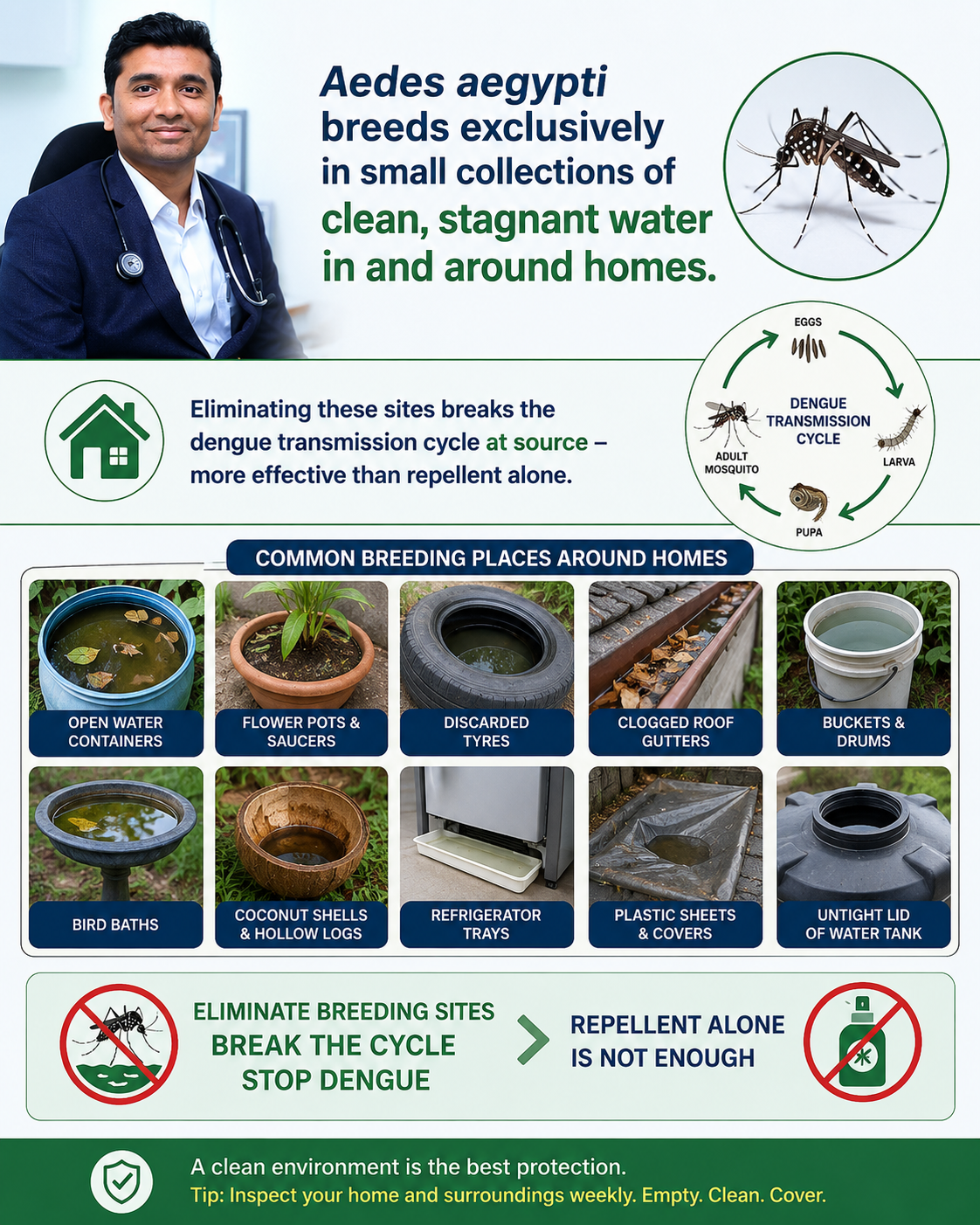
The Aedes aegypti mosquito breeds exclusively in small, clean, stagnant water in and around the home. It does not breed in drains, rivers, or large open water bodies. This is both a strength and a weakness of dengue prevention: the breeding sites are controllable at the household level, but they are numerous, easy to overlook, and eggs are resistant to drying.
The key technique is emptying AND scrubbing every 3–5 days. Aedes eggs are laid at the waterline of containers — they stick to the container wall and can survive drying for weeks. Emptying water removes adult larvae but leaves eggs behind. Scrubbing removes the eggs. A single cup-sized container can produce 200–300 adult mosquitoes.
High-Risk Breeding Sites — Check These Weekly
What to Do — Every 3–5 Days
The Aedes Mosquito Flies Only 200 Metres
Your dengue mosquito is almost certainly breeding in your own home or within your immediate building compound. You can control your dengue risk more directly than any other mosquito-borne disease — by eliminating breeding sites within your control. Report uncovered water sources in your building to your housing society.
Which Repellent Works — and How to Use It Correctly
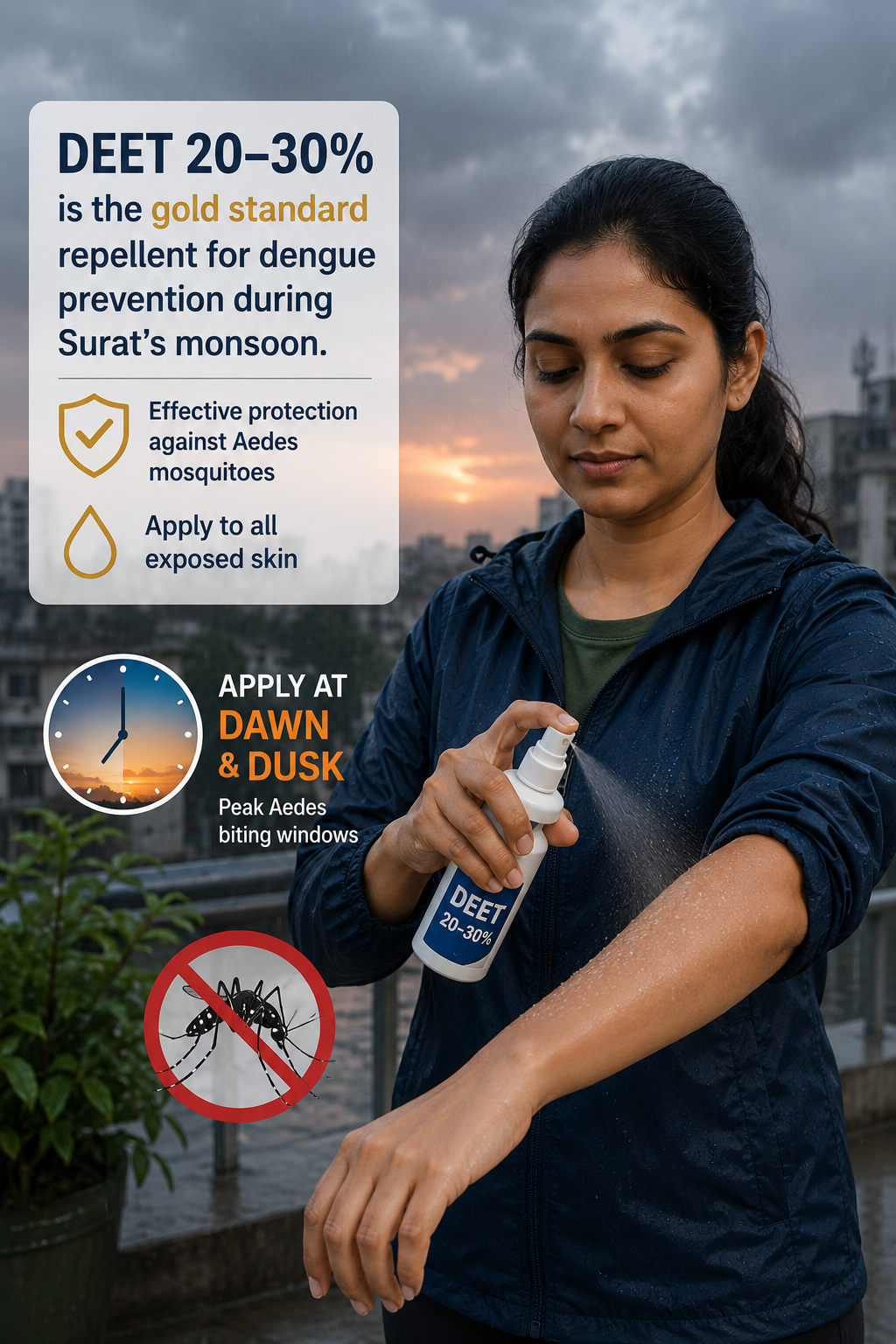
Not all repellents are equally effective. The choice of repellent, its concentration, and correct application technique all determine whether you are protected for 2 hours or 8 hours. During Surat monsoon, repellent is a critical part of daily routine — applied at dawn before morning activities and again at dusk before evening time outdoors.
| Repellent | Concentration | Duration | Age Safety | Best For |
|---|---|---|---|---|
| DEET | 20–30% | 4–8 hours | 2+ months (≤30%) | Best overall — gold standard |
| Picaridin | 20% | 4–8 hours | 2+ months | Equal to DEET; less irritation; no smell |
| IR3535 | 20% | 2–4 hours | 2+ months | Children; gentler formula |
| DEET (low dose) | 7–10% | 1–2 hours | 2+ months | Short outdoor activities only |
| Citronella oil | Varies | 30–60 min | All ages | Minimal protection — not recommended |
| Neem oil | Varies | 30–60 min | All ages | Insufficient evidence — not recommended |
Correct Application
Common Mistakes
Protection Beyond Repellent
Prevention for Each Mosquito-Borne Disease
Each disease has specific prevention priorities based on the mosquito’s behaviour, the disease’s characteristics, and what is known to work in the Surat context.
Dengue Prevention
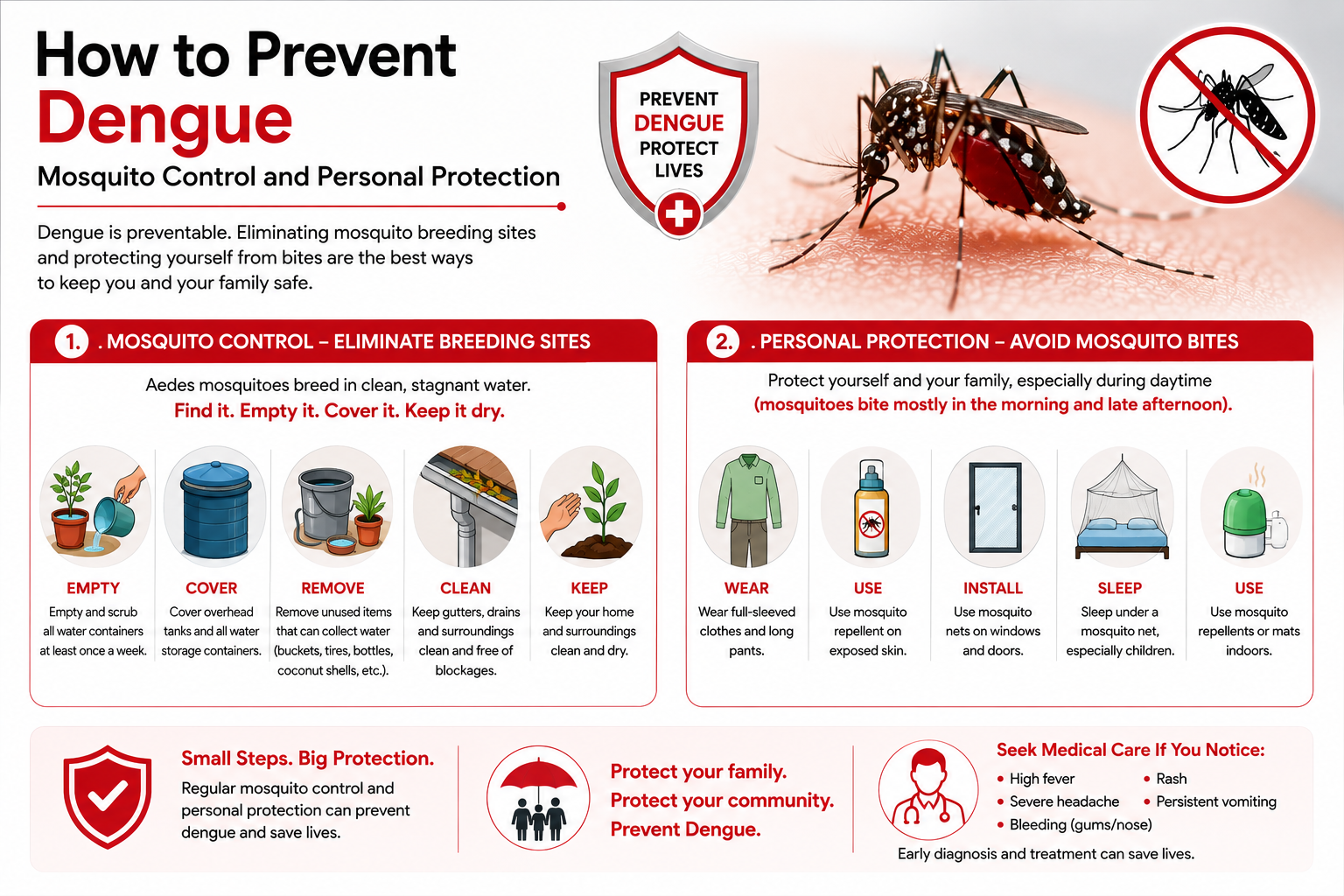
The most important mosquito-borne disease to prevent in Surat. No vaccine is widely available for adults. No specific antiviral treatment exists. Prevention is the only intervention that actually works. The core strategy is source reduction — eliminating Aedes breeding sites in and around the home.
Prevention Priorities
If Fever Occurs
Malaria Prevention
Less common than dengue in urban Surat, but falciparum malaria can be fatal within 24–48 hours of symptom onset. Night-time protection is the priority because Anopheles bites when people are sleeping. Vivax malaria can relapse from liver dormant forms months after the initial infection.
Prevention Priorities
If Fever Occurs
Chikungunya Prevention
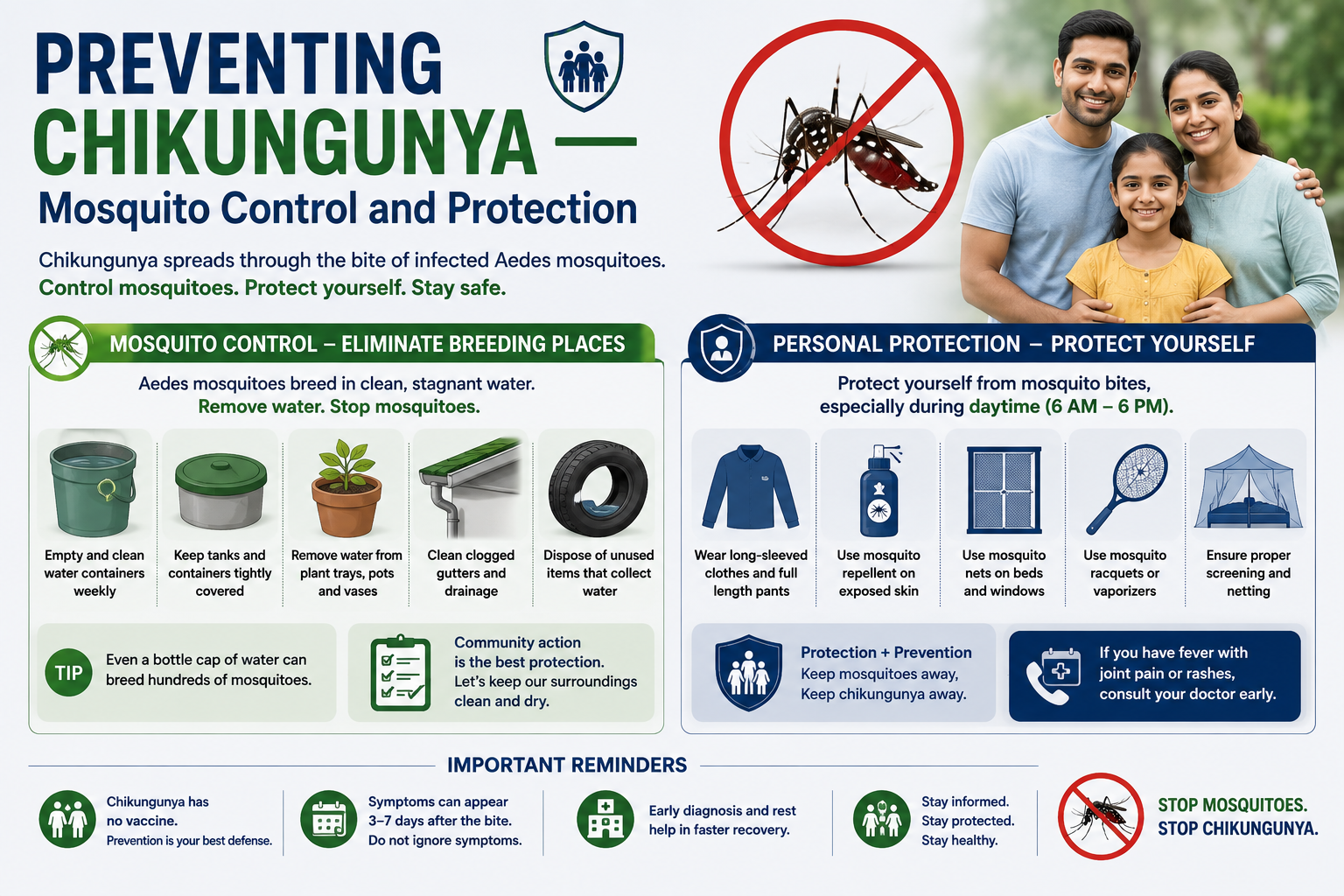
Chikungunya is transmitted by the same Aedes aegypti mosquito as dengue — so all dengue source reduction measures also prevent chikungunya. The distinction matters clinically: chikungunya’s severe bilateral joint pain can persist for months as post-chikungunya arthritis, which requires hydroxychloroquine — not just paracetamol.
Prevention — Same as Dengue
Post-Chikungunya Arthritis
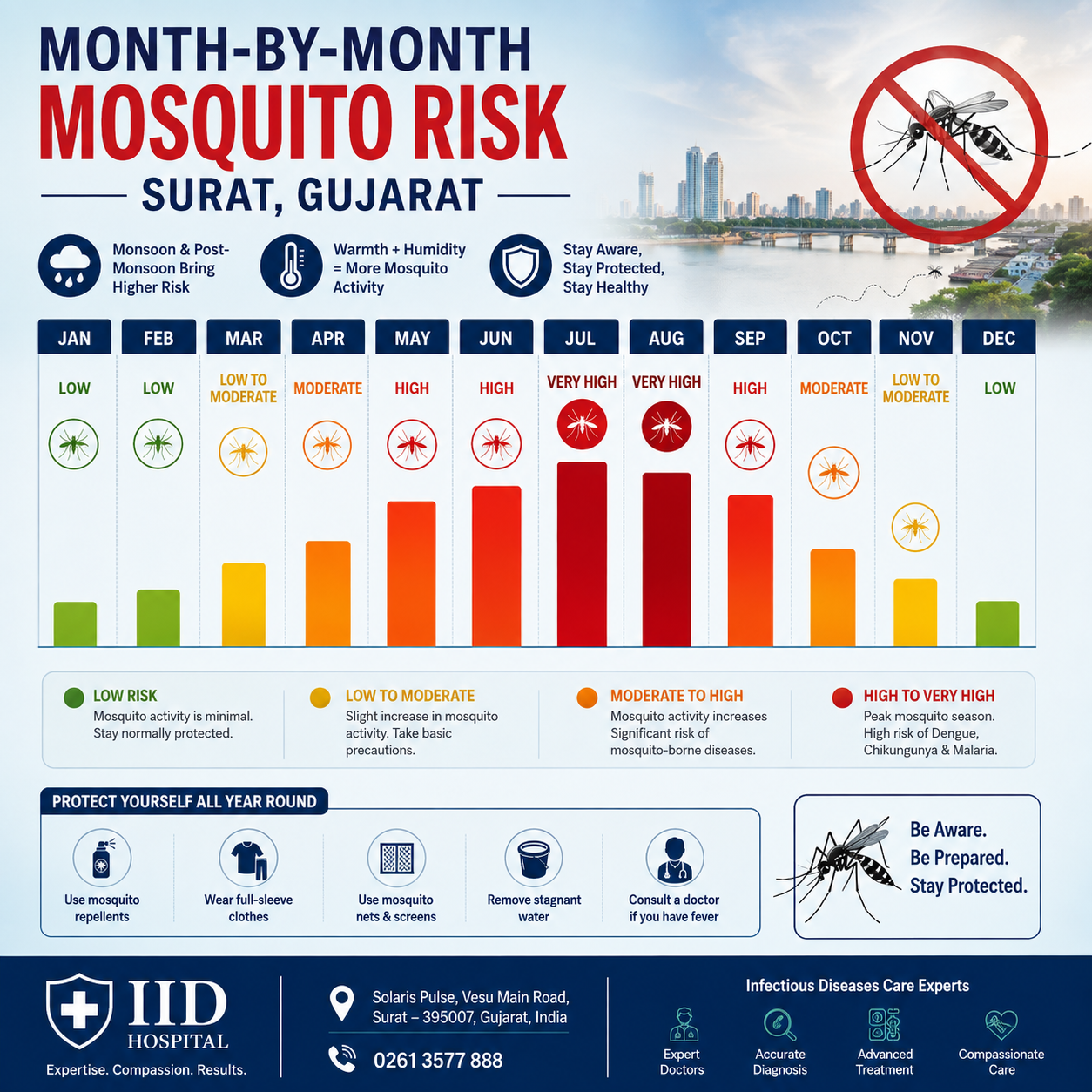
When to Be Most Vigilant — Month by Month
Mosquito populations in Surat follow a predictable annual pattern tied to the monsoon. Knowing when each disease peaks helps you time your prevention efforts correctly.
Dec – May
Low Season
Jun – Jul
Building Season
Aug – Oct
Peak Season
Nov
Post-Monsoon
What Patients Say About Mosquito Disease Care at IID Hospital
My son got dengue two years running. After the second time I brought him to Dr. Savaj. He asked one question: “Where are the mosquitoes breeding?” We did a walk-through of our terrace — found a dish under a pot collecting water. He explained scrubbing, not just emptying. My son has not had dengue since. The smallest change, the biggest result.
I had chikungunya in September and joint pain lasted 5 months. I was taking paracetamol every day with no improvement. Dr. Savaj diagnosed post-chikungunya arthritis and started hydroxychloroquine. Within 6 weeks the pain was 80% better. I did not know this was a treatable condition — I thought I just had to live with it.
My father had malaria and the first doctor gave him chloroquine. He did not improve. Dr. Savaj repeated the smear — it was falciparum malaria, not vivax, and chloroquine does not work for falciparum. He changed treatment to ACT. My father recovered within 3 days. Species identification before treatment — something the first doctor did not do — saved his life.
Frequently Asked Questions About Mosquito Diseases
Answered by Dr. Pratik Savaj, FNB Infectious Diseases, IID Hospital, Surat.
Can a single mosquito net protect the whole family?
Which insect repellent is most effective against dengue mosquitoes?
Is dengue or malaria more dangerous in Surat?
Can dengue occur outside the monsoon season in Surat?
Does indoor spraying by the municipality prevent dengue?
How long does protection from a single application of DEET repellent last?
Are mosquito coils and electric repellents effective?
What should I do if I develop fever during dengue or malaria season?
Monsoon Fever or Joint Pain After Chikungunya? See Dr. Savaj.
No referral needed. Any fever during Surat monsoon needs NS1 + blood smear on day 1. Post-chikungunya joint pain needs hydroxychloroquine — not just paracetamol. Falciparum malaria needs species-specific ACT. Dr. Pratik Savaj, FNB Infectious Diseases, IID Hospital, Lal Darwaja, Surat gets the diagnosis right before starting treatment.

MBBS · DNB Medicine · Fellowship ID
P.D. Hinduja Hospital, Mumbai