 IID Hospital, Vesu & Lal Darwaja — Surat
 Morning 10:30 AM–12:30 PM & Evening 3:00–6:00 PM
 24×7 Emergency
 HIV Act 2017 — Full Confidentiality
CD4 count HIV IID Hospital Surat  HIV · IID Hospital Blog
500–1500 Normal CD4 range in a healthy adult (cells/mm³)
The immune system’s report card in HIV
 HIV · IID Hospital Blog

CD4 Count in HIV — What Your Number Actually Means

A CD4 count is not just a number — it is the immune system’s report card in HIV. It tells you how much damage the HIV virus has done to your immune defences, what infections you are at risk of developing, and whether your treatment is working. Understanding what your CD4 number means — and what to do at each level — is the foundation of HIV management.

What Is a CD4 Cell and Why Does It Matter in HIV?

CD4 T-cells (also called T-helper cells or CD4+ lymphocytes) are a type of white blood cell that plays a central role in coordinating the immune response. They recognise foreign pathogens, activate other immune cells (CD8 T-cells, B-cells, macrophages), and orchestrate the immune response that eliminates infections.

HIV specifically targets CD4 cells — the virus uses the CD4 receptor on the cell surface to gain entry, then replicates inside the cell and destroys it. Over years of untreated HIV infection, the CD4 count falls progressively as the virus destroys more cells than the immune system can replace. When CD4 falls below critical thresholds, the immune system can no longer defend against pathogens that a healthy immune system would easily eliminate — these are the opportunistic infections (OIs) that define AIDS.

Normal CD4 vs HIV-Infected

A healthy HIV-negative adult has a CD4 count of 500–1,500 cells/mm³. In HIV infection without treatment, CD4 declines at approximately 50–100 cells/mm³ per year — reaching the AIDS-defining threshold of 200 in roughly 3–10 years. Individual variation is high — some people are “rapid progressors” who fall quickly; others are “long-term non-progressors” whose CD4 remains stable for decades. ART halts this decline and produces recovery.

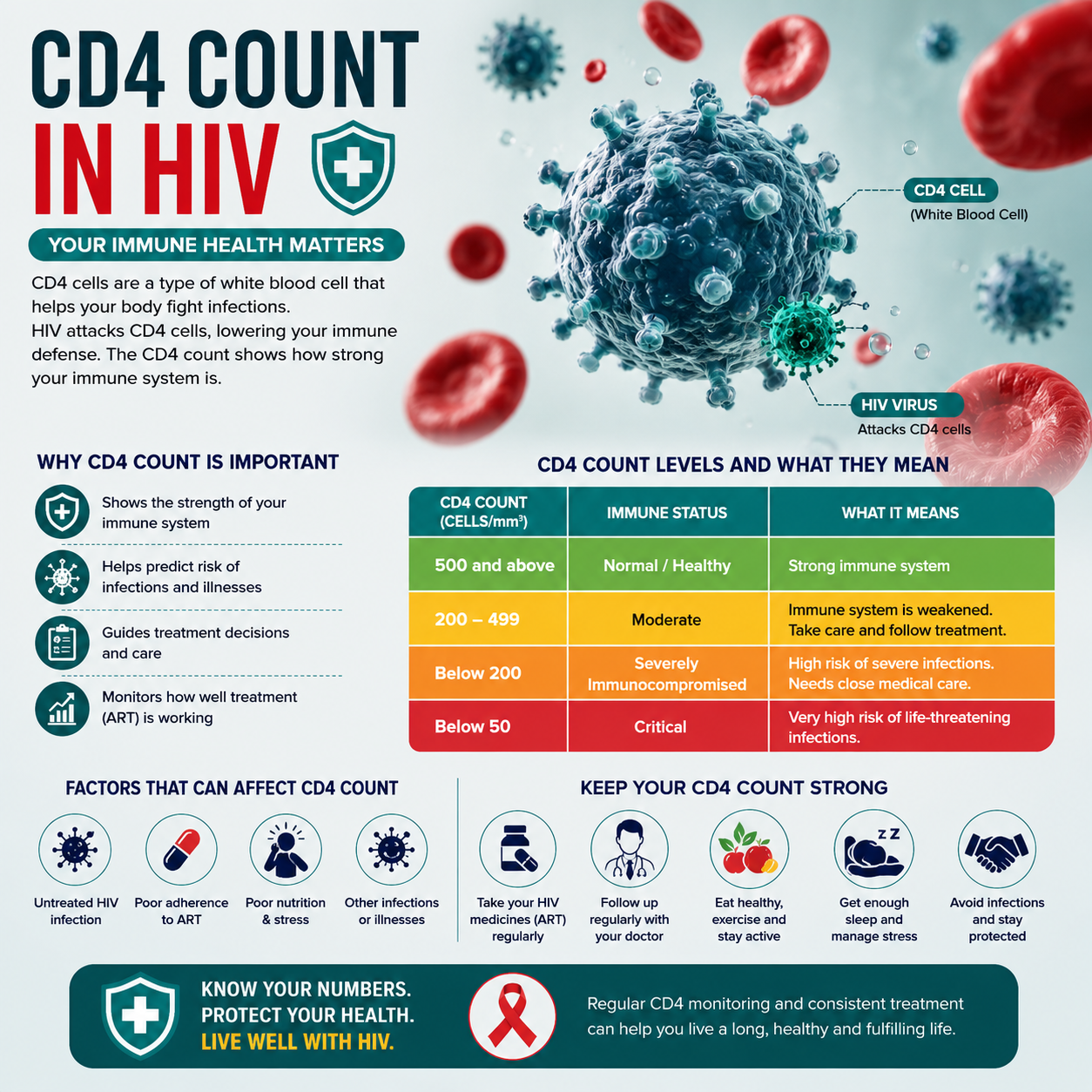
The CD4 Count Range — What Each Level Means

Each CD4 level corresponds to a different degree of immune compromise and different clinical risks. The zones below are clinical thresholds — not absolute cutoffs — that guide management decisions.

CD4 Count Range — cells/mm³

Green = adequate immune function  →  Red = severe immune compromise

0Absent
50Critical
200AIDS threshold
500Lower normal
1500Upper normal
<50 Critical

Most severe OIs. CMV retinitis, disseminated MAC. Urgent ART + OI treatment.

50–200 Advanced

PCP, toxoplasma, cryptococcal risk. Cotrimoxazole prophylaxis. CrAg screen.

200–350 Moderate

TB risk elevated. Bacterial pneumonia. Continue cotrimoxazole. ART essential.

350–500 Recovering

Good ART response. Most OI risks reducing. Continue ART + 6-monthly monitoring.

>500 Good

Near-normal immunity. Stop cotrimoxazole if CD4 >200 for 6+ months. Annual monitoring.
CD4 count blood test HIV IID Hospital Surat
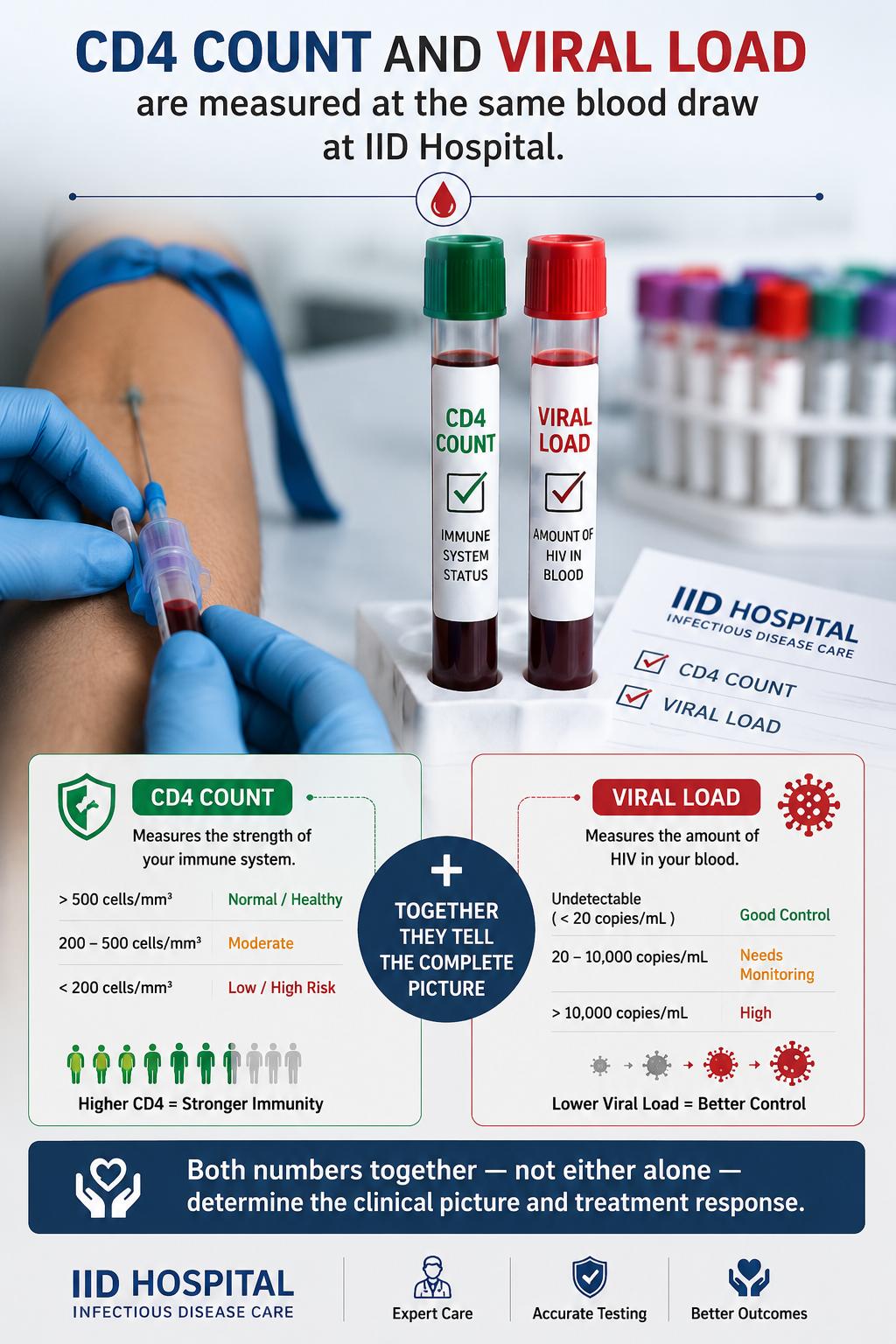
CD4 count and viral load are measured at the same blood draw at IID Hospital. Both numbers together — not either alone — determine the clinical picture and treatment response.

What Opportunistic Infections Occur at Each CD4 Level

Opportunistic infections are caused by organisms that a healthy immune system would eliminate without illness. In HIV, as CD4 falls below specific thresholds, these pathogens find an immune system that can no longer control them. Knowing the thresholds allows prevention — cotrimoxazole prophylaxis, CrAg screening, and ART together prevent the majority of OIs.

CD4 LevelOpportunistic InfectionsPreventionAction
<50CMV retinitis (blindness), disseminated MAC, microsporidiosis, PML. Most severe OIs.ART is the primary prevention. No specific prophylaxis for CMV/MAC until ART immune recovery.Urgent ART. Ophthalmology referral for CMV retinitis if visual symptoms.
50–100Cryptococcal meningitis, toxoplasma encephalitis, PCP, CMV. High mortality if missed.CrAg screen (serum cryptococcal antigen). Pre-emptive fluconazole if CrAg positive. Cotrimoxazole for PCP + toxoplasma.CrAg test at diagnosis. Cotrimoxazole started. ART urgently.
100–200PCP (Pneumocystis pneumonia), toxoplasma, oesophageal candidiasis, TB. AIDS-defining threshold.Cotrimoxazole prophylaxis started. TB screening mandatory.Start cotrimoxazole. Screen and exclude TB. ART.
200–350TB (20–30× higher risk), bacterial pneumonia, oral candidiasis, herpes zoster.Cotrimoxazole continued. TB screening at every visit. Isoniazid preventive therapy (IPT) if IGRA positive.Continue cotrimoxazole. TB IGRA + CXR. ART.
>350TB risk still elevated vs HIV-negative. Major OI risk substantially reduced.Stop cotrimoxazole when CD4 >200 for 6+ months. Annual TB screen.Cotrimoxazole can be stopped. Annual monitoring. Continue ART.
ART HIV treatment CD4 recovery IID Hospital Surat
ART (antiretroviral therapy) — once daily oral tablet. Within 6 months of starting ART, viral load should be undetectable and CD4 begins its recovery trajectory.

CD4 Count vs Viral Load — Two Different Questions

CD4 count and viral load are both essential HIV monitoring tools but they answer different clinical questions. They must always be interpreted together — never in isolation.

Viral Load (HIV RNA)

How fast is the virus replicating?

Measures: copies of HIV RNA per mL of blood
Target on ART: below 50 copies/mL (“undetectable”)
Primary ART response marker: should be undetectable at 6 months
Detectable VL on ART = treatment failure or non-adherence
U=U: undetectable viral load = cannot transmit HIV sexually
Check every 3–6 months on ART; annually when stable

CD4 Count

How much immune damage has occurred?

Measures: CD4 T-cells per mm³ of blood
Target on ART: above 500 (near-normal immune function)
Immune recovery marker: rises 100–150 in first 6 months
Low CD4 despite undetectable VL = immunological non-response
Determines OI prophylaxis thresholds and surveillance needs
Check every 6 months on ART; annually when CD4 >500

The Most Important Combined Reading

Undetectable viral load + Rising CD4: ART is working perfectly. The immune system is recovering. Continue ART and monitoring. Undetectable viral load + Stable/Low CD4: ART is working virologically but immune recovery is slow. Enhanced OI monitoring. Check for co-infections (TB, HBV). Detectable viral load + Falling CD4: treatment failure. Resistance testing and regimen change needed.

The CD4 Monitoring Schedule at IID Hospital

CD4 monitoring frequency is adjusted based on clinical status, time on ART, and viral load stability. The schedule below reflects current WHO and NACO guidelines as implemented at IID Hospital.

CD4 + Viral Load ART initiation baseline. Determines starting OI risk and treatment urgency. At ART start
Viral Load Primary marker of ART response. Must be undetectable by month 6. Month 3, Month 6
CD4 + Viral Load Confirm sustained suppression and document immune recovery trajectory. Month 6, Month 12
Viral Load Ongoing suppression monitoring once stable. Every 6 months (stable)
CD4 Immune recovery tracking. Frequency reduces as CD4 stabilises above 500. Every 12 months (CD4 >500)
CrAg (Cryptococcal Antigen) Screen for subclinical cryptococcal infection before starting ART. At baseline if CD4 <100
TB screen (IGRA + CXR) TB is the most common OI in India at any CD4 level. Screen at every visit. Every 6–12 months

CD4 Recovery on ART — What to Expect

Most patients who start ART with a low CD4 count experience dramatic immune recovery. The pattern: 100–150 cells/mm³ increase in the first 3–6 months, followed by a slower sustained rise of 50–100 per year.

Patients who start with CD4 below 50 and achieve viral suppression may have slower recovery — some reach only 200–300 despite years of undetectable viral load. But even at CD4 200–300 with undetectable viral load, life expectancy on modern ART approaches normal. The CD4 number is one part of the clinical picture — viral suppression is the primary goal.

Starting ART with Very Low CD4

Patients who start ART with CD4 below 50 have Immune Reconstitution Inflammatory Syndrome (IRIS) risk — a paradoxical worsening of existing OIs as the immune system recovers. TB-IRIS is common in India. Dr. Savaj manages IRIS at IID Hospital and adjusts ART timing when active OIs are present.

CD4 recovery ART HIV IID Hospital Surat
CD4 recovery on ART: most patients with baseline CD4 of 100–200 reach CD4 above 350 within 2 years of viral suppression. Life expectancy on ART approaches normal.

The CD4 Rule

CD4 count tells you the degree of immune damage. Viral load tells you if ART is working. Both are needed together — every monitoring visit. The goal: undetectable viral load + rising CD4. Start ART regardless of CD4 count. Never stop ART. Adherence is everything — a missed dose is an invitation for resistance.
Know Your CD4 Count. Understand What It Means.

CD4 + viral load monitoring, OI prophylaxis, ART management — all fully confidential. Dr. Pratik Savaj, FNB Infectious Diseases, IID Hospital, Vesu, Surat — no referral needed.

Dr. Pratik Savaj
Dr. Pratik Savaj FNB Infectious Diseases · IID Hospital, Surat
Morning10:30 AM – 12:30 PM, Mon–Sat
Evening3:00 PM – 6:00 PM, Mon–Sat
Phone+91 92747 93759
Patient Feedback

What Patients Say About Dr. Pratik Savaj

★★★★★
CD4 Recovery

My CD4 was 89 when I started. Dr. Savaj monitored my CD4 every 3 months — it crossed 500 within 18 months. He explained every result clearly.

R
Rajan P.HIV on ART · Surat
Verified Patient
★★★★★
OI Prevention

Dr. Savaj started me on cotrimoxazole prophylaxis when my CD4 was below 200. He explained exactly which infections I was at risk for and how to prevent them.

S
Sunita K.HIV · Surat
Verified Patient
★★★★★
Viral Suppression

Undetectable at 6 months. Dr. Savaj explained the difference between viral load and CD4 — I finally understood why both matter and how to track my own progress.

A
Arun B.HIV · Surat
Verified Patient
★★★★★
Safe Delivery

Dr. Savaj monitored my CD4 and viral load monthly during pregnancy. My baby is HIV-negative. The monitoring protocol he used was meticulous.

M
Meera D.HIV in Pregnancy · Surat
Verified Patient
★★★★★
Immune Recovery

CD4 was 34 at diagnosis. Dr. Savaj watched for IRIS carefully as my CD4 rose. No complications — he knew exactly what to look for and when.

P
Priya N.HIV · Surat
Verified Patient
★★★★★
Long-term Care

Seven years on ART with Dr. Savaj. CD4 stable above 600 for five years. He reviews my full panel — not just CD4 — at every visit.

K
Karim S.HIV · Surat
Verified Patient
Common Questions

Frequently Asked Questions
About CD4 Count in HIV

Answered by Dr. Pratik Savaj, FNB Infectious Diseases — IID Hospital, Vesu, Surat.

What is a normal CD4 count?
A normal CD4 count in an HIV-negative adult is 500–1500 cells/mm³. In HIV, values above 500 indicate a functioning immune system with low risk of opportunistic infections. Below 200 is defined as AIDS by CDC criteria.
How often should CD4 be tested?
Every 3–6 months during the first 2 years on ART, or until the count is consistently above 350 and viral load is undetectable. Once stable and suppressed for 2+ years, every 6–12 months. More frequent testing if viral load rebounds or immune decline is suspected.
What CD4 count triggers cotrimoxazole prophylaxis?
CD4 below 200 cells/mm³ — cotrimoxazole (Bactrim/Septran) is started to prevent Pneumocystis pneumonia (PCP) and toxoplasmosis. It can be stopped when CD4 has been above 200 for at least 3–6 months on ART.
Can CD4 count recover to normal on ART?
Yes — most people on effective ART see CD4 recover to above 500 within 3–5 years. Recovery is faster when ART is started early (CD4 above 500). Those who start late (CD4 below 100) may have slower or incomplete immune reconstitution.
What is IRIS and when does it occur?
Immune Reconstitution Inflammatory Syndrome — a paradoxical worsening of a pre-existing or previously undetected infection as CD4 rises on ART. Most common in the first 3 months. TB-IRIS is the most frequent form in India. Dr. Savaj monitors for IRIS at every early ART visit.
Is CD4 or viral load more important?
Both: viral load measures treatment effectiveness (undetectable = ART working); CD4 measures immune recovery (above 200 = OI risk low, above 500 = near-normal immunity). Viral load is the primary guide for ART decisions; CD4 guides prophylaxis and monitoring intensity.
What does a low CD4 with undetectable viral load mean?
Discordant response — ART is suppressing the virus but CD4 is not recovering well. Seen in patients who started ART late, older patients, or those with persistent inflammation. Requires closer follow-up, continued prophylaxis, and investigation for concurrent conditions.
At what CD4 count should ART be started?
All HIV-positive people regardless of CD4 count — this is current WHO and India NACO guidance (treat all). Starting ART early, before CD4 drops below 500, results in better immune recovery and lower long-term complication risk.