Why Hepatitis B Is Silent
The hepatitis B virus is not immediately destructive. It infects liver cells (hepatocytes) and uses them as factories for viral replication — but unlike hepatitis A or acute hepatitis B, chronic HBV does not cause dramatic acute illness in most people. The damage is cumulative and slow: years of low-level inflammation, repeated cycles of hepatocyte death and regeneration, gradual accumulation of scar tissue (fibrosis), eventual cirrhosis, and the risk of hepatocellular carcinoma (HCC).
The patient feels nothing abnormal — no jaundice, no pain, no fatigue — until the liver is already significantly damaged. By the time symptoms appear (ascites, jaundice, bleeding from oesophageal varices), the disease may be at an advanced stage. This is why testing is the only way to know. Symptoms are not a reliable indicator of HBV status or liver health.
Who Should Be Tested for Hepatitis B
Anyone born in India before routine HBV vaccination was introduced (before 2002 in most states) who has never been tested. Family members of an HBV-positive person: spouses, children, parents. Anyone who has had unprotected sexual contact with a person of unknown HBV status. Healthcare workers: occupational blood exposure risk. Anyone who has received a blood transfusion before blood screening was universal. People who inject drugs: shared needles. All pregnant women: to prevent mother-to-child transmission. If you have never been tested for hepatitis B — test now.
The 5 Phases of Chronic Hepatitis B
Chronic HBV infection is not a single state — it evolves through phases over years. Understanding which phase a patient is in determines whether treatment is needed now, and what the liver damage risk is.
Immune-Tolerant Phase
HBeAg positive. Very high HBV DNA. Normal ALT. Minimal liver inflammation. Common in perinatally-infected adults.
No treatment — monitorImmune-Active (HBeAg+)
HBeAg positive. High HBV DNA. Elevated ALT. Active liver inflammation. Significant fibrosis risk.
Treatment indicatedInactive Carrier
HBeAg negative, Anti-HBe positive. Low/undetectable HBV DNA. Normal ALT. Minimal inflammation.
Monitor every 6 monthsHBeAg-Negative CHB
HBeAg negative. Fluctuating HBV DNA. Elevated ALT. Pre-core mutant — still active and damaging.
Treatment indicatedCirrhosis / HCC Risk
Advanced fibrosis or cirrhosis. HCC risk 2–6% per year. Requires treatment + 6-monthly HCC surveillance.
Urgent treatmentThe Phase Determines Everything
Telling a patient “your HBV is positive but your ALT is normal so you don’t need treatment” without measuring HBV DNA, assessing fibrosis by fibroscan, and determining the phase is incomplete assessment. Phase 4 HBeAg-negative CHB has a normal or fluctuating ALT in 40% of patients — and still causes progressive fibrosis. HBV DNA and fibroscan, not ALT alone, determine treatment decisions.
Understanding the Hepatitis B Blood Tests
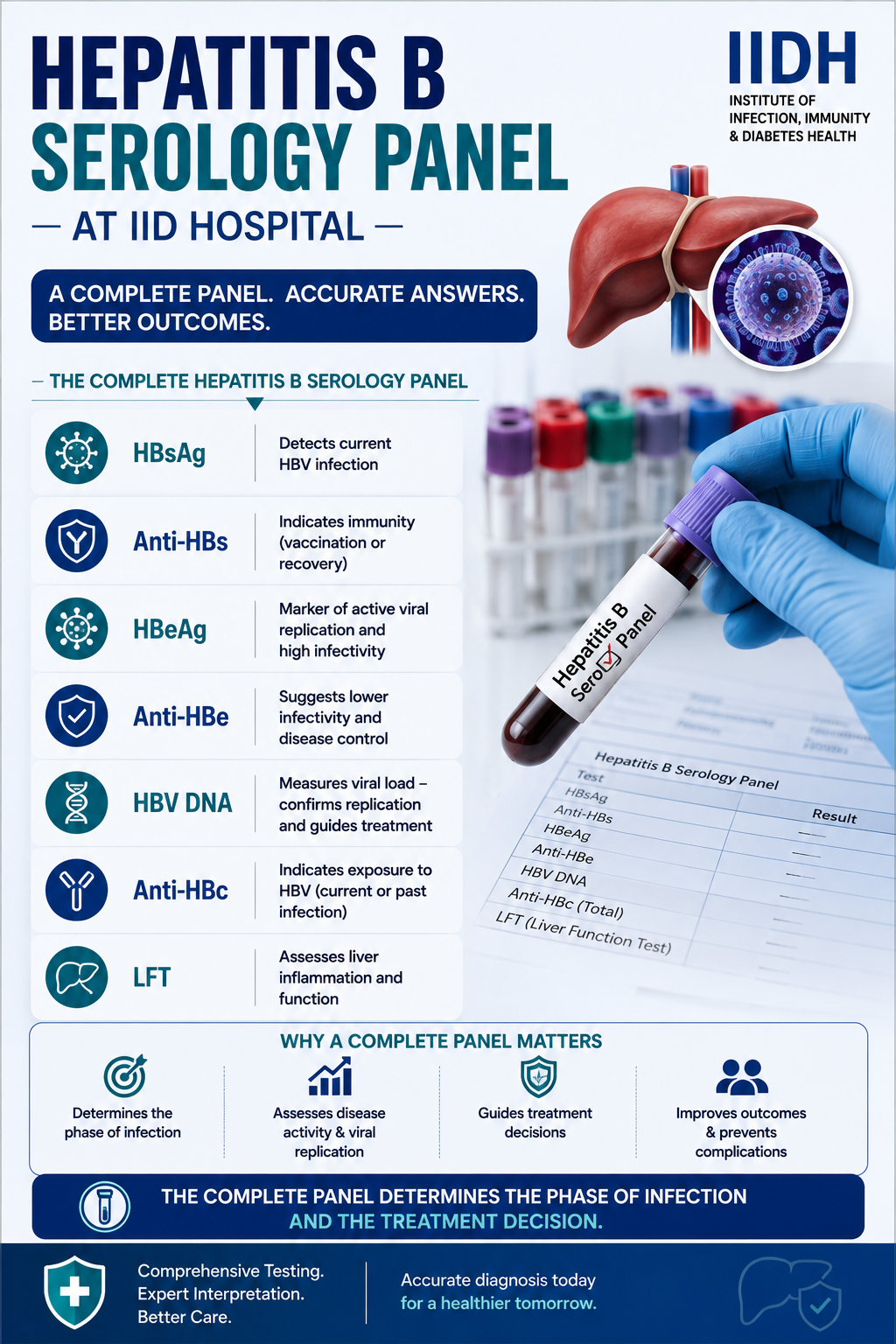
A single HBsAg positive result is only the starting point. The full serology panel below tells the complete story of HBV status — whether the infection is acute or chronic, active or controlled, infectious or resolved.
| Status | HBsAg | Anti-HBs | HBeAg | HBV DNA | Meaning |
|---|---|---|---|---|---|
| Susceptible (never infected) | h | h | h | h | Not infected, not immune. Vaccinate now. |
| Vaccinated / Immune | h | h | h | h | Immune from vaccine. No infection. No action needed. |
| Acute HBV | h | h | h | h | Active acute infection. Monitor for clearance or chronicity. |
| Chronic HBV — Active | h | h | h | h | Chronic infection. Phase assessment + treatment decision needed. |
| Inactive Carrier | h | h | h | h | Low replication. Needs monitoring but usually no treatment now. |
| Past Infection / Resolved | h | h | h | h | HBV cleared. Usually immune. HCC risk reduced but not zero. |
Treatment — What It Can and Cannot Do
Modern HBV treatment does not cure HBV in the traditional sense — it cannot eliminate the virus completely from liver cells. But it achieves something nearly as important: viral suppression so complete that the liver heals, fibrosis reverses, and the risk of cirrhosis and liver cancer falls by 50–80%.
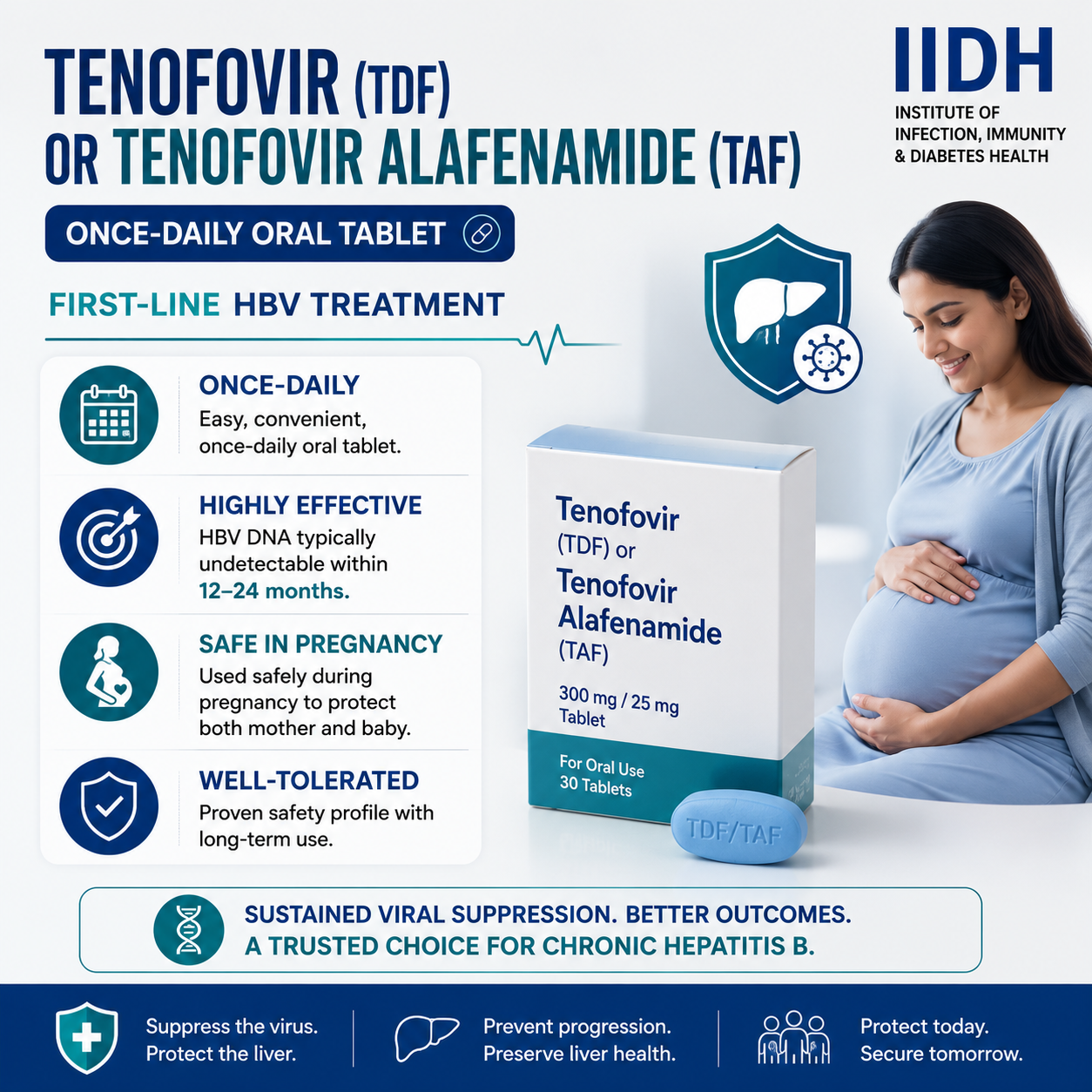
Tenofovir (once daily) suppresses HBV DNA to undetectable levels in most patients within 12–24 months. ALT normalises. Liver stiffness on fibroscan decreases over years. Life expectancy on treatment approaches normal. The drug is safe, well-tolerated, and inexpensive under the generic programme.
Treatment Cannot Be Stopped
HBV antivirals suppress but do not eliminate the virus. Stopping treatment risks HBV reactivation — sometimes a severe hepatic flare that can cause acute liver failure and death. Treatment is typically lifelong unless HBsAg clearance occurs.
Myths About Hepatitis B Transmission — Corrected
The discrimination against HBV-positive individuals in India is driven by myths about transmission. The correction of these myths is as important as the clinical management.
"Hepatitis B spreads through sharing food and utensils."
False. HBV is bloodborne — it cannot spread through sharing food, cups, plates, or utensils. Saliva does not contain infectious concentrations of HBV. Sharing meals is completely safe.
"You can get hepatitis B from a mosquito bite."
False. HBV is not transmitted by mosquitoes. Mosquitoes cannot carry or transmit HBV. There is no insect vector for hepatitis B.
"If someone in my family has hepatitis B I should avoid physical contact."
False. Casual physical contact — hugging, handshaking, kissing on the cheek — does not transmit HBV. Family members need vaccination, not social distancing.
"Hepatitis B always causes jaundice and liver symptoms."
False. Most people with chronic HBV have no symptoms at all. The absence of jaundice or fatigue does not mean the liver is undamaged — only testing reveals the true state.
"There is no treatment for hepatitis B."
False. Effective oral antiviral therapy (tenofovir, entecavir) suppresses HBV DNA to undetectable, reverses fibrosis, and dramatically reduces liver cancer risk. Treatment works.
"HBV-positive people cannot have children or get married."
False. HBV-positive individuals can have children safely with appropriate management. The partner needs vaccination. Mother-to-child transmission is preventable in >95% of cases with HBIG + birth-dose vaccine.
The Monitoring Protocol — What Every HBV Patient Needs Regularly
Hepatitis B management is not “take a tablet and forget.” Regular monitoring detects treatment response, identifies drug resistance (rare with tenofovir), screens for liver cancer, and adjusts management as the phase of infection evolves.
Hepatitis B Management at IID Hospital
Dr. Pratik Savaj provides complete chronic hepatitis B management at IID Hospital, Vesu, Surat: phase determination; treatment initiation with tenofovir or entecavir; HBV DNA monitoring; fibroscan interpretation; HCC surveillance; household contact evaluation and vaccination; and management of HBV in pregnancy.
Every HBV-positive patient at IID Hospital has their household contacts systematically tested and vaccinated. A diagnosis of HBV in one family member is an opportunity to protect every other family member. The vaccine is 95% effective and provides lifelong protection.

The Hepatitis B Rule
40 million Indians have chronic hepatitis B. Most don’t know. Testing is the only way to find out — symptoms are not a reliable indicator. Treatment suppresses the virus, reverses liver damage, and reduces liver cancer risk by 50–80%. The HBV vaccine is 95% effective. A family member with HBV is not a danger to eat with — they need medical management and their family needs vaccination.