Yellow FeverSymptoms, Vaccine, Travel Requirements & Treatment — Surat
Yellow fever is a viral haemorrhagic fever caused by the yellow fever virus (Flaviviridae family), transmitted by Aedes and Haemagogus mosquitoes in endemic zones across sub-Saharan Africa and tropical South America. Although India has no endemic yellow fever, it is critically relevant for Indian travellers going abroad — vaccination is compulsory for entry into many countries and mandatory for re-entry into India from endemic zones. The vaccine is the only effective protection; there is no specific antiviral treatment.

What Is Yellow Fever?
Yellow fever is an acute viral haemorrhagic disease caused by the yellow fever virus, a single-stranded RNA flavivirus closely related to dengue, Zika, and Japanese encephalitis viruses. It is transmitted exclusively by the bite of infected Aedes aegypti (urban cycle) and Haemagogus species mosquitoes (sylvatic/jungle cycle).
The name derives from the characteristic jaundice (yellowing of the skin and eyes) that develops in severe cases due to liver involvement. The virus attacks hepatocytes (liver cells), kidney tubular cells, and cardiac muscle, leading to multi-organ dysfunction in severe disease.
Yellow fever occurs endemically in sub-Saharan Africa and tropical South America. India does not have endemic yellow fever, but Indian travellers visiting these regions face significant risk without vaccination. According to WHO, yellow fever causes approximately 30,000 deaths annually, with 90% occurring in Africa.
Yellow Fever in the Context of Surat, Gujarat
While yellow fever does not occur in Surat or anywhere in India, IID Hospital sees patients requiring travel health consultations for yellow fever vaccination before visiting Africa or South America, and occasionally patients who have returned from endemic regions with fever who need differential diagnosis including yellow fever. Dr. Savaj provides specialist travel medicine consultation and yellow fever vaccination advice.

Dr. Pratik Savaj
FNB Infectious Diseases · IID Hospital, Surat
Travel medicine & vaccine-preventable disease specialist
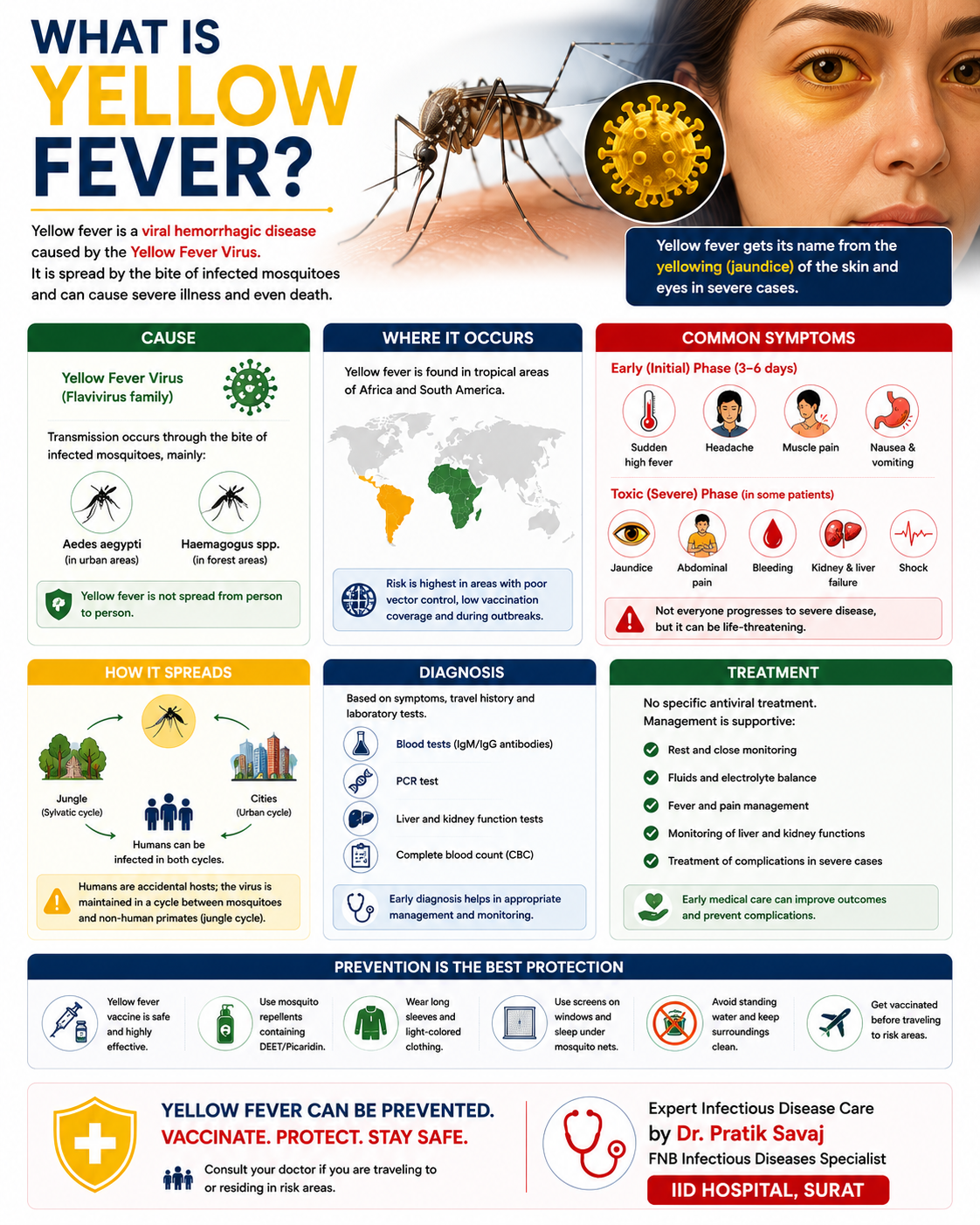
How Yellow Fever Spreads — Transmission Cycles
Yellow fever virus is transmitted between humans (and non-human primates) through mosquito vectors. There are three distinct transmission cycles:
Yellow Fever Cannot Spread Person-to-Person
Yellow fever is NOT transmitted by contact with a sick person, through the air, by sharing food or water, or through sexual contact. The ONLY route of transmission is the bite of an infected mosquito. Patients with yellow fever do not need isolation to protect others — though mosquito control around the patient is recommended to prevent mosquitoes from feeding on the viraemic patient and transmitting to others.
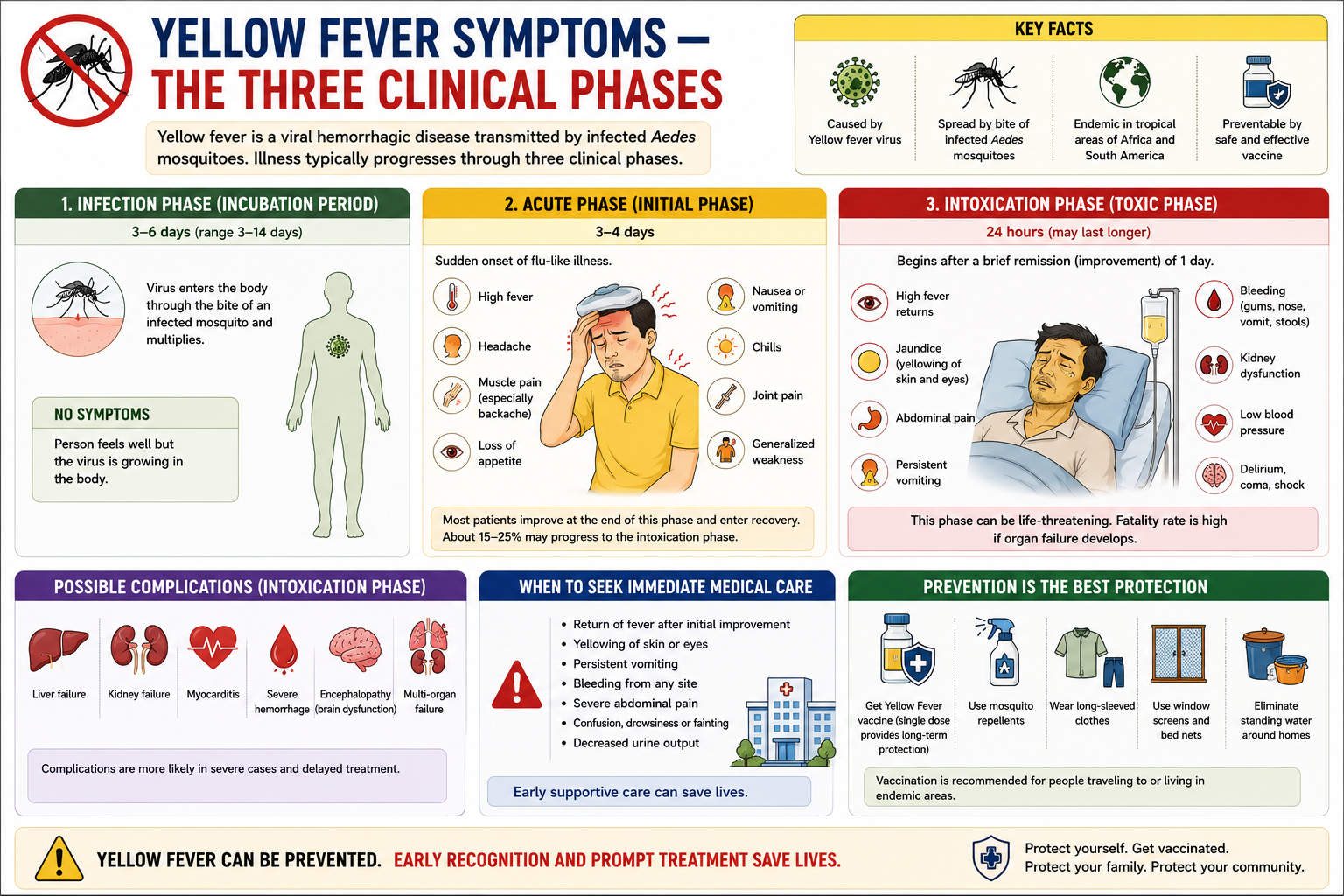
Yellow Fever Symptoms — The Three Clinical Phases
Yellow fever has a characteristic triphasic clinical course. Understanding the phases is critical because the transition from remission to the intoxication phase — if it occurs — represents a medical emergency.
| Phase | Timing | Key Features | Clinical Significance |
|---|---|---|---|
| Incubation | 3–6 days | No symptoms | Patient infectious to mosquitoes in this phase |
| Acute (Infection) | Days 1–3 | Sudden fever 38–40°C, severe headache, back pain, myalgia, nausea, vomiting, relative bradycardia | Most patients recover fully after this phase |
| Remission | Hours to 24 hrs | Fever drops, patient feels better | ~85% of patients recover permanently here |
| Intoxication | Days 4–8 (15% of cases) | Fever returns, jaundice, haemorrhage (black vomit), oliguria, multi-organ failure | High mortality — 20–50% in this phase. ICU required. |
Acute Phase — Symptoms in Detail
The acute (infection) phase begins abruptly after the 3–6 day incubation period:
The Intoxication Phase — When Yellow Fever Becomes Dangerous
Jaundice (yellow skin and eyes) — from hepatic involvement — gives the disease its name. Haemorrhage — bleeding from the gums, nose, eyes, stomach. Classic 'black vomit' (vómito negro) — haemorrhage into the stomach causing dark vomit. Oliguria or anuria — acute kidney injury. Multi-organ failure, shock, and death occur in 20–50% of patients who reach this phase. ICU care is mandatory.
Diagnosing Yellow Fever
Yellow fever diagnosis requires specific virology testing and clinical correlation. It cannot be reliably diagnosed on clinical grounds alone because the acute phase mimics many other febrile illnesses common in travellers.
Key Diagnostic Tests
Yellow Fever vs. Dengue — Key Differentiator
Both are Aedes-transmitted flaviviruses presenting with acute fever, headache, and myalgia. Jaundice favours yellow fever — it is rare in dengue. Black vomit strongly suggests yellow fever. The epidemiological context is paramount — if the patient has not been in an endemic country, yellow fever is essentially ruled out.
Yellow Fever Vaccine — Everything You Need to Know
The yellow fever vaccine (17D live attenuated vaccine) is one of the most effective vaccines ever developed — a single dose provides immunity in over 99% of recipients within 10 days, and WHO confirmed in 2016 that a single dose provides lifelong protection for most people.
| Vaccine Type | Dose | When to Give | Duration |
|---|---|---|---|
| 17D Live Attenuated (only licensed type) | Single subcutaneous dose (0.5 mL) | At least 10 days before travel to endemic area | Lifelong (WHO 2016) |
| Booster (select cases) | Second dose | For those vaccinated <9 months old, immunocompromised, or those vaccinated >10 years ago (country-specific) | As required by destination |
Who Needs the Yellow Fever Vaccine?
Who Should NOT Get the Vaccine?
The yellow fever vaccine is a live attenuated vaccine with specific contraindications:
The International Certificate of Vaccination (Yellow Card)
After yellow fever vaccination at an authorised centre, you will receive the International Certificate of Vaccination or Prophylaxis (ICVP) — commonly known as the Yellow Card. This is a lifelong document required for entry into many countries. Keep it with your passport. If lost, replacement requires documentation from the vaccinating centre.
Yellow fever vaccination in Surat: Vaccination must be administered at a Government of India authorised yellow fever vaccination centre. Contact IID Hospital for guidance on the current vaccination arrangements and to complete your full travel health consultation.
Countries Where Yellow Fever Vaccination Is Required or Recommended
The following countries have endemic yellow fever transmission. Many require proof of vaccination for entry, and India requires proof on re-entry from any of these countries.
Africa (34 Countries)
Angola, Benin, Burkina Faso, Burundi, Cameroon, CAR, Chad, Congo, Côte d'Ivoire, DRC, Equatorial Guinea, Ethiopia, Gabon, Gambia, Ghana, Guinea, Guinea-Bissau, Kenya, Liberia, Mali, Mauritania, Niger, Nigeria, Rwanda, São Tomé & Príncipe, Senegal, Sierra Leone, Somalia, South Sudan, Sudan, Togo, Uganda, United Republic of Tanzania, Zambia
South America (13 Countries)
Bolivia, Brazil, Colombia, Ecuador, French Guiana, Guyana, Panama, Paraguay, Peru, Suriname, Trinidad & Tobago, Venezuela
Check Before You Travel
Entry requirements for yellow fever vaccination change frequently. Always verify the specific requirements for your destination — and any transit countries — with the relevant embassy or WHO International Travel and Health guidelines before travel. Consult Dr. Savaj at IID Hospital at least 4 weeks before departure for a full travel health consultation.
Travellers from Surat and Gujarat who require yellow fever vaccination for travel to Africa or South America should seek a specialist travel medicine consultation to ensure correct timing, appropriate documentation, and assessment of any contraindications.
Treatment of Yellow Fever
There is no specific antiviral drug approved for yellow fever. This makes vaccination absolutely critical — once infected, treatment is entirely supportive.
Supportive Management
Avoid Aspirin and NSAIDs
Aspirin, ibuprofen, naproxen, and other NSAIDs must be avoided in yellow fever. These medications inhibit platelet function and increase the risk of haemorrhage — which is already the primary cause of death in severe yellow fever. Paracetamol (acetaminophen) at standard doses is the only safe antipyretic.
Patients who survive the intoxication phase typically recover completely within 1–2 weeks. The kidneys and liver gradually recover. Yellow fever does not become chronic.

What Patients Say About Dr. Pratik Savaj
I was travelling to Kenya and needed yellow fever vaccination with an official ICVP certificate. Dr. Savaj explained everything clearly — why the certificate is mandatory, how long it lasts, and what to do if I had a fever on arrival. The process was completely smooth.
Our family was travelling to Brazil during Carnival. Dr. Savaj assessed each family member individually — exempted my elderly mother (cardiac history), vaccinated the rest, and provided proper documentation. His understanding of individual contraindications was excellent.
I developed fever after returning from a yellow fever endemic country. Dr. Savaj evaluated me systematically, ran the right diagnostic tests, and managed my case with complete confidence. His knowledge of tropical infectious disease is remarkable.
I needed yellow fever vaccination urgently — my travel was in 12 days. Dr. Savaj saw me immediately, vaccinated me, and explained that immunity develops by day 10. I received my ICVP certificate in time and travelled without any issues.
I needed yellow fever documentation for a visa application, not just travel. Dr. Savaj understood the requirement, vaccinated me at the correct centre, and provided the stamped ICVP. The visa was approved without any problems.
After returning from Nigeria I developed high fever on day 5. I was concerned about yellow fever despite vaccination. Dr. Savaj assessed me, explained that my vaccination provided strong protection, identified another cause, and treated me correctly. His reassurance and accuracy were both excellent.
Frequently Asked Questions
About Yellow Fever
Answered by Dr. Pratik Savaj, FNB Infectious Diseases — IID Hospital, Vesu, Surat.
If you are travelling to a yellow fever endemic country (any country in sub-Saharan Africa or tropical South America), vaccination is strongly recommended and in many cases compulsory for entry. Additionally, if you are returning to India from an endemic country, India may require proof of vaccination. Speak with Dr. Savaj at IID Hospital at least 10 days before travel.
No. India has no endemic yellow fever transmission. However, India is classified as a country at risk of yellow fever introduction due to the presence of Aedes aegypti mosquitoes. This is why travellers arriving from endemic countries are required to show proof of vaccination at Indian points of entry.
As of 2016, the WHO considers a single dose of yellow fever vaccine to provide lifelong immunity for most people. A booster is no longer routinely required. However, some countries still require proof of booster — check your specific destination's entry requirements. The International Certificate of Vaccination (Yellow Card) is valid for life.
Dr. Pratik Savaj at IID Hospital, Surat can advise on yellow fever vaccination requirements and administer travel vaccines. Yellow fever vaccination must be given at a designated vaccination centre authorised by the Government of India. Contact IID Hospital to confirm the current arrangement and get your travel health consultation.
The International Certificate of Vaccination or Prophylaxis (ICVP) — commonly called the 'Yellow Card' — is an official WHO document that records your yellow fever vaccination. It is required for entry into many yellow fever endemic countries and when returning to India from endemic countries. It is issued only at authorised vaccination centres.
The yellow fever vaccine is highly effective — a single dose provides over 99% protection within 10 days for most people. Severe disease after vaccination is extremely rare. The vaccine is a live attenuated vaccine and should not be given to infants under 6 months, pregnant women (unless the risk of exposure is high), people with severe immunodeficiency, or those with severe egg allergy.
There is no specific antiviral treatment for yellow fever. Management is supportive — fever control, hydration, liver and kidney function monitoring, and managing haemorrhagic complications. This is why vaccination is so critical. Patients with yellow fever require hospital admission and specialist infectious disease management.
Both yellow fever and dengue are mosquito-borne flaviviruses transmitted by Aedes mosquitoes, and both can cause fever, headache, muscle pain, and haemorrhagic complications. However, they are distinct diseases: yellow fever causes characteristic jaundice and liver involvement not seen in dengue, while dengue causes the characteristic platelet drop and dengue rash. Yellow fever occurs only in endemic zones, whereas dengue is present in Surat.