What Is Acute HIV Infection?
HIV infection passes through three clinical stages. The first — Acute HIV Infection (AHI), also called Primary HIV Infection or Acute Retroviral Syndrome — begins approximately 2–4 weeks after the virus enters the body. This is the stage with the highest viral load of the entire infection, often exceeding 1 million copies per millilitre.
This extremely high viral load has two critical consequences. The person is maximally infectious — the risk of transmitting HIV is highest during this window, often before the person knows they are infected. And the immune system mounts an intense response, producing the symptoms described in this article, before temporarily gaining some control over viral replication.
Stage 01
Weeks 2–4 after infection
Acute HIV Infection (AHI)
Highest viral load. Most infectious. Flu-like symptoms in 50–90% of people. Standard antibody tests often still negative. 4th-generation Ag/Ab test or HIV RNA PCR is the correct test. ART started now produces the best long-term outcomes.
Stage 02
Months to years
Chronic HIV (Clinical Latency)
Symptoms resolve. Person feels well. HIV replicates slowly, CD4 declines ~50–100 cells/mm³ per year without ART. Without treatment: lasts ~10 years. On ART: near-normal life expectancy maintained indefinitely.
Stage 03
CD4 below 200
AIDS (Advanced HIV Disease)
Severe immune deficiency. Opportunistic infections: PCP, cryptococcal meningitis, CMV, disseminated TB. Entirely preventable with early diagnosis and ART. Patients diagnosed in Stage 1 or 2 almost never reach this stage.

HIV testing at IID Hospital, Surat — including 4th-generation Ag/Ab assays and HIV RNA PCR for acute HIV diagnosis. All consultations are fully confidential.
The 8 Early Signs of HIV — Acute Retroviral Syndrome
The symptoms of acute HIV infection resemble a severe viral illness — which is why they are so frequently dismissed. The clinical clue is not any single symptom but the combination: multiple symptoms together, in a person with a possible HIV exposure, within 2–4 weeks of that exposure.
70–90%
Fever
Typically 38–40°C, high and spiking. Usually the first symptom — onset 10–14 days post-exposure. May be accompanied by chills.
50–74%
Swollen Lymph Nodes
Neck, armpits, and groin simultaneously. Firm and non-tender — unlike tender nodes of bacterial infection. May persist for weeks.
60–70%
Severe Fatigue
Disproportionate exhaustion not proportional to fever severity. Interferes with daily activities. Often the most debilitating symptom.
50–70%
Sore Throat
Pharyngitis without white exudate — distinguishing it from streptococcal pharyngitis. Often painful enough to make swallowing difficult.
40–70%
HIV Rash
Red maculopapular rash on the trunk, face, and upper arms. Appears 2–3 days after fever onset. Lasts 5–8 days. Non-itchy. This rash is highly specific for AHI.
50–60%
Headache & Myalgia
Severe headache and intense body pain. Mimics dengue and influenza — the primary reason AHI is misdiagnosed as ‘viral fever’ at the first consultation.
10–30%
Mouth or Genital Ulcers
Painful ulcers on the oral mucosa or genitals. Not a feature of dengue or influenza. Oral or genital ulcers alongside fever = strong signal to test for HIV specifically.
30–50%
GI Symptoms
Nausea, vomiting, and diarrhoea alongside fever, rash, and lymphadenopathy. This combination in a person with possible HIV exposure = test immediately.
The Combination Is the Clue
None of these symptoms alone is specific for HIV. The alert is: fever + rash + swollen lymph nodes + sore throat, in a person with a possible HIV exposure in the past 2–6 weeks. Dengue causes fever + rash but not bilateral painless lymphadenopathy. Influenza causes fever + body pain but not the HIV rash pattern. The combination and the exposure history make the diagnosis.

Blood tests during AHI: lymphocytosis then lymphopaenia. CD4 may drop acutely. HIV viral load extremely high — often over 1 million copies/mL.
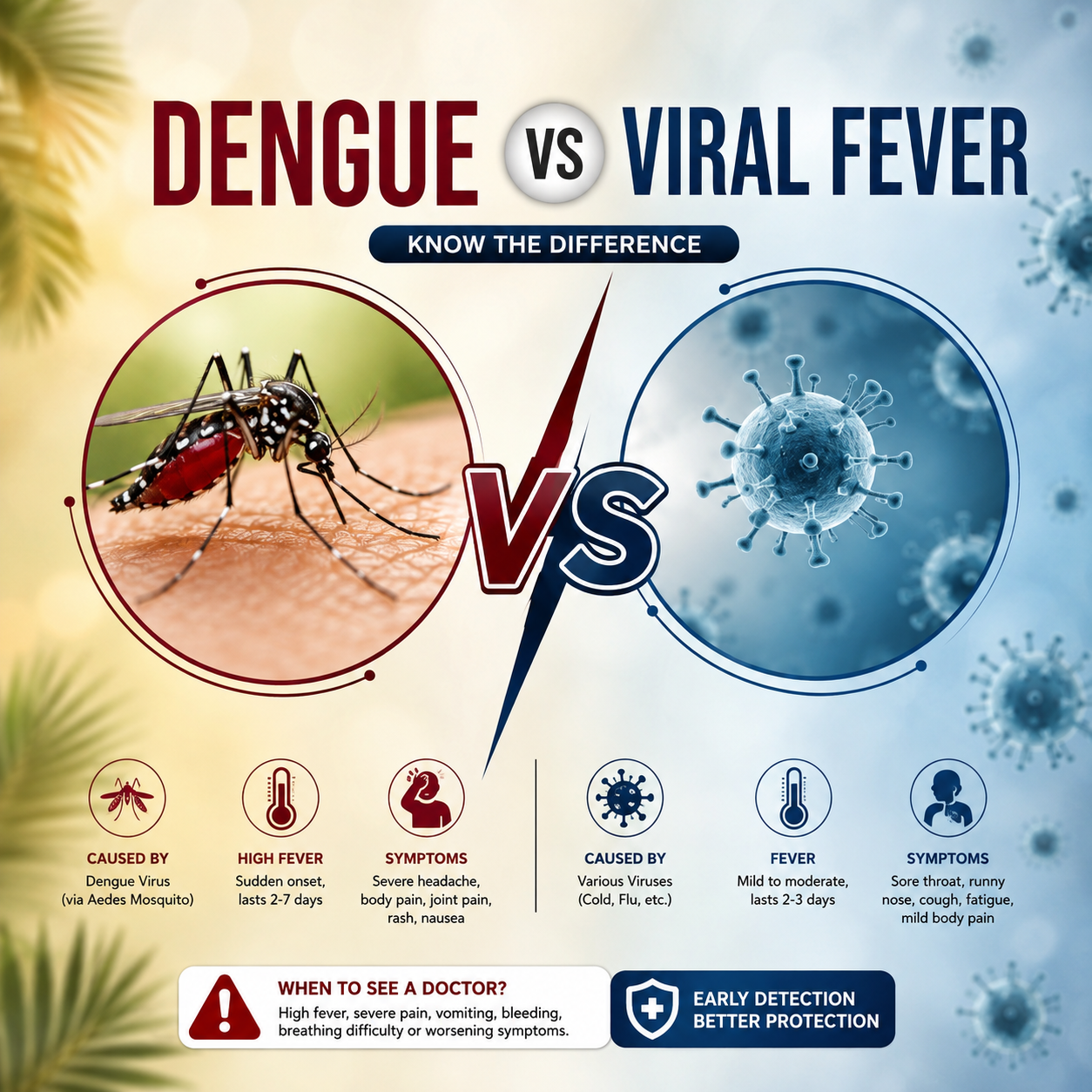
How AHI Differs from Dengue and Viral Fever
In Surat, where dengue is endemic and “viral fever” is the default diagnosis, acute HIV infection is frequently misclassified. Three clinical differences guide the suspicion: the HIV rash is non-itchy and appears on day 2–3 of fever (dengue rash appears on day 3–5 and can be itchy); the lymphadenopathy in AHI is bilateral and non-tender (tender cervical nodes are typical of bacterial infection, not AHI); and mouth or genital ulcers are not a feature of dengue or common viral fever at all.
| Feature | Acute HIV (AHI) | Dengue Fever | Influenza |
|---|---|---|---|
| Rash | Maculopapular, trunk + face. Day 2–3. Non-itchy. Lasts 5–8 days. | Day 3–5. “Islands of white in red sea.” May be itchy. | Uncommon. No characteristic rash. |
| Lymph nodes | Bilateral, firm, non-tender — neck, axilla, groin. | Mild, less prominent. | Mild cervical tender nodes only. |
| Mouth ulcers | Present in 10–30%. Specific signal for HIV. | Not a feature. | Not a feature. |
| Platelets | Usually normal during AHI. | Falling platelets — hallmark of dengue. | Normal or mildly low. |
| HIV test | Standard antibody test NEGATIVE. Need 4th-gen or RNA PCR. | Negative (unrelated). | Negative (unrelated). |
| NS1 antigen | Negative. | Positive days 1–5. | Negative. |
Testing During Acute HIV — The Right Test at the Right Time
The standard HIV test used by most laboratories in India is an antibody test. These antibodies take 3–12 weeks to reach detectable levels — the “window period.” During acute HIV infection (weeks 2–4), antibodies have not yet formed. A standard antibody test will be negative even with very high viral loads.
Within 72 hours of exposure
PEP — Not a Test
Do not test — start Post-Exposure Prophylaxis (PEP) immediately. Call IID Hospital now. PEP prevents HIV infection when started within 72 hours.
2–4 weeks after exposure (with symptoms)
4th-Gen Ag/Ab or HIV RNA PCR
These detect the virus itself (p24 antigen + RNA), not just antibodies. Positive 10–18 days after infection. Tell Dr. Savaj the exact exposure date.
6–12 weeks after exposure
4th-Gen Ag/Ab Assay
By this point antibodies have formed. Standard 4th-gen test is highly reliable. A negative result at 12 weeks effectively excludes HIV infection from that exposure.
No symptoms — routine screening
Standard Rapid HIV Test
Standard 3rd-generation antibody test is appropriate and reliable at 3+ months post-exposure. Annual HIV screening recommended for all sexually active adults in India.
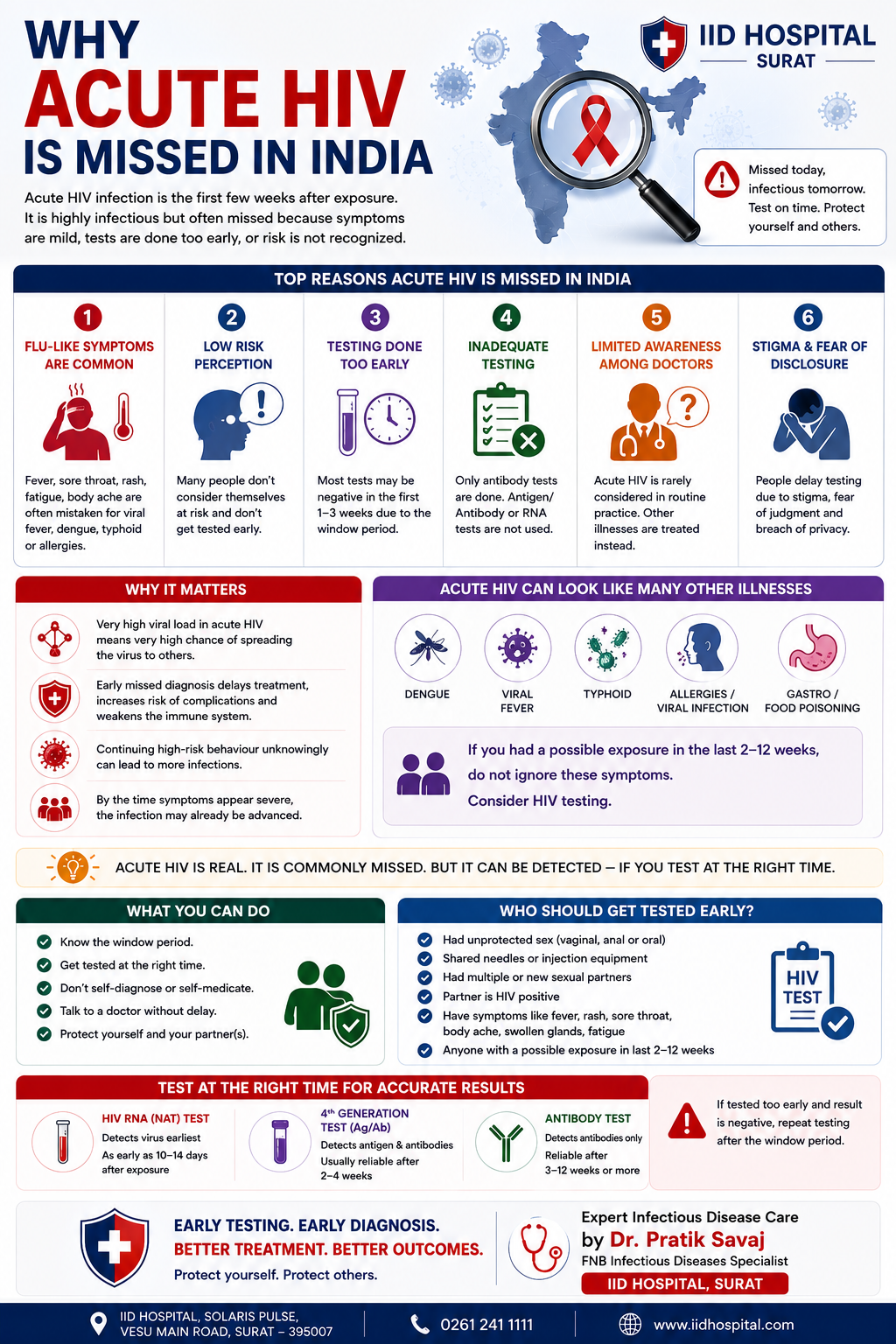
Why Acute HIV Is Missed in India
Three factors specific to India drive late diagnosis. Stigma prevents testing — a person who suspects exposure avoids testing because of fear about their family, work, and social life. Doctors do not ask about exposure history — when a patient presents with fever + rash + lymphadenopathy, the clinical pathway is dengue NS1 and malaria smear; HIV is not in the differential unless the patient volunteers. Wrong test is ordered — even when HIV is considered, a 3rd-generation rapid antibody test is used, which is negative during AHI, and the patient is falsely reassured.
At IID Hospital, HIV testing is part of every fever workup. All consultations are fully confidential.
At IID Hospital — HIV in Every Fever Workup
Dr. Savaj includes HIV testing in every systematic fever workup — not as an optional add-on, but as a standard component. A negative antibody test is never interpreted as excluding acute HIV infection without knowing the exposure timeline. If AHI is possible, the 4th-generation test or RNA PCR is ordered.
What Happens After the Acute Phase?
After 2–4 weeks, the acute symptoms resolve in virtually all patients — with or without treatment. The immune system gains partial control. Viral load drops. The person feels well. This begins the chronic latent phase — average 10 years untreated. During this asymptomatic period, HIV continues replicating and CD4 cells decline gradually.
Without ART, most people eventually reach CD4 below 200 and develop AIDS-defining illnesses. None of this is inevitable with early diagnosis and treatment. Patients who start ART during acute HIV infection achieve faster viral suppression, better CD4 recovery, lower transmission risk to partners, and near-normal life expectancy.
The Key Clinical Point
If you have had a possible HIV exposure in the past 2–6 weeks and now have fever, rash, swollen lymph nodes, or mouth ulcers: do not rely on a standard rapid HIV antibody test to reassure you. Come to IID Hospital, tell Dr. Savaj the exposure and date, and ask for a 4th-generation Ag/Ab test or HIV RNA PCR. A negative antibody test does not exclude acute HIV infection.
HIV Testing and Care at IID Hospital, Surat
Dr. Pratik Savaj provides HIV testing, acute HIV diagnosis, ART initiation, PEP, PrEP, and opportunistic infection management at IID Hospital, Vesu, Surat. All consultations are fully confidential — HIV status is never shared without explicit written consent.
For any HIV exposure within the past 72 hours: call +91 92747 93759 immediately. PEP cannot wait for a scheduled appointment. Come the same day.
U = U — Undetectable = Untransmittable
People with HIV who are on effective ART and have an undetectable viral load cannot transmit HIV sexually. This is not a theory — it is established science. Starting ART early, achieving viral suppression, and maintaining adherence means living a full, healthy life without transmitting HIV to partners.

Dr. Pratik Savaj
MBBS · DNB Medicine · Fellowship ID · FNB Infectious Diseases · P.D. Hinduja Hospital, Mumbai
Dr. Savaj specialises in HIV, TB, and complex infectious diseases at IID Hospital, Vesu, Surat. All HIV consultations are fully confidential. Appointments: +91 92747 93759 (call or WhatsApp).