
Hepatitis BSilent. Chronic. Preventable.
Hepatitis B is a viral infection that attacks the liver. Unlike dengue or malaria which announce themselves with fever, most chronic hepatitis B infections are completely silent for decades — until cirrhosis or liver cancer appears. Hepatitis B is the world’s most common serious liver infection and the leading cause of liver cancer globally. It is also 100% preventable with one of the world’s most effective vaccines.
What Is Hepatitis B?
Hepatitis B is caused by the hepatitis B virus (HBV) — a hepadnavirus that specifically infects hepatocytes (liver cells). HBV is present in blood, semen, vaginal secretions, and breast milk. It is 50–100 times more infectious than HIV and can survive on surfaces outside the body for up to 7 days.
HBV replicates inside liver cells using a reverse transcription step — similar to HIV — which is why some antiretroviral drugs (tenofovir, lamivudine) are effective against both. Unlike HIV, HBV integrates its DNA into the host genome, which is why it is so difficult to completely cure.
The clinical outcome of HBV infection depends critically on the age at which infection occurs. Newborns infected during birth have a 90–95% chance of developing chronic hepatitis B. Children infected between 1–5 years have a 25–50% chance. Adults infected for the first time have less than 5% chance — most adult acute HBV infections resolve spontaneously. This age-dependent chronicity explains why childhood vaccination is so critical.
Acute Hepatitis B
First 6 months after infection
Chronic Hepatitis B
HBsAg positive for more than 6 months

Dr. Pratik Savaj
FNB Infectious Diseases · IID Hospital, Surat
Hepatitis B & HBV-HIV co-infection specialist
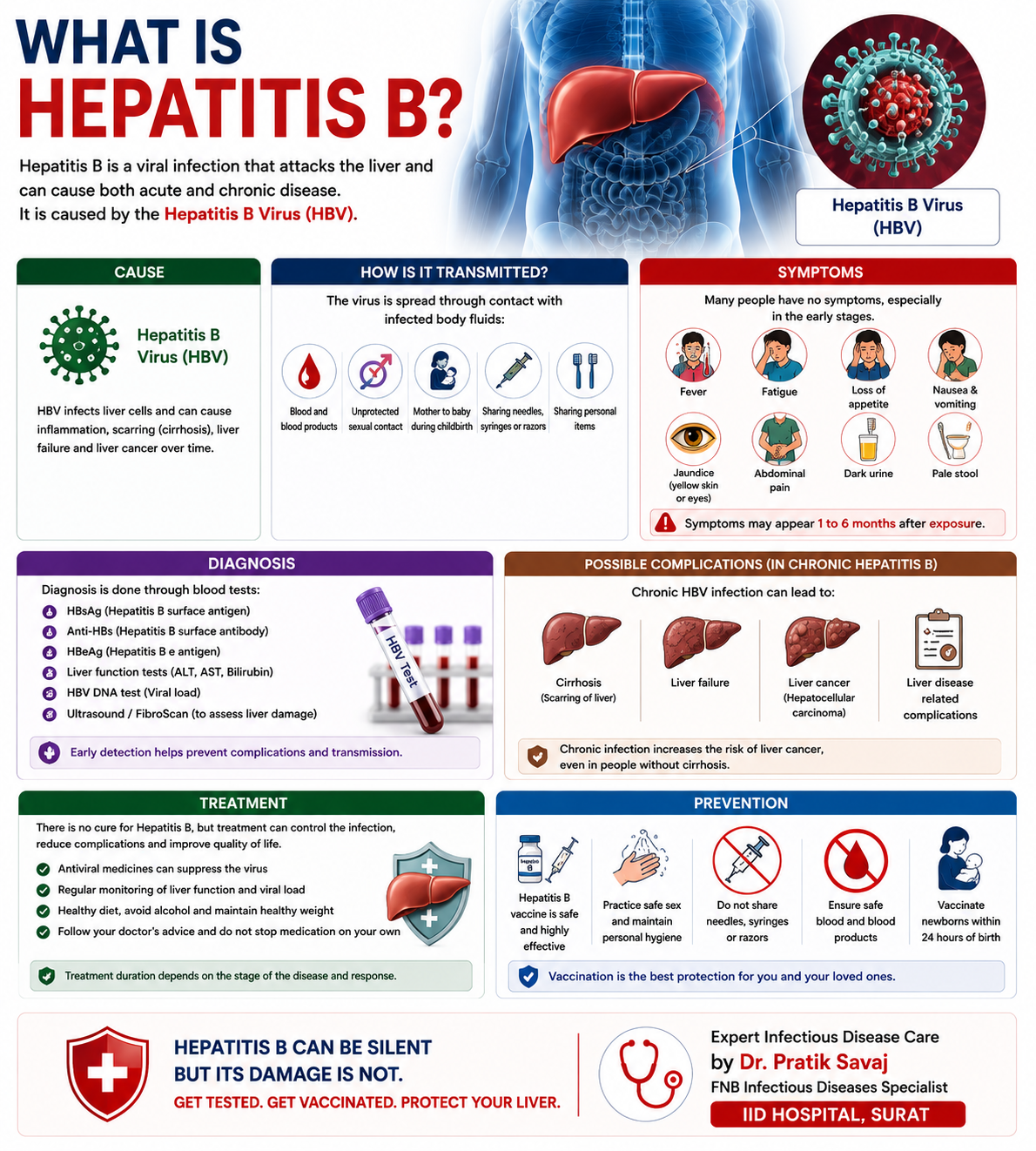
How HBV Is Transmitted — and How It Is Not
Hepatitis B is transmitted through contact with infected blood and certain body fluids. HBV is 50–100 times more transmissible than HIV — it can survive on dried blood on surfaces outside the body for up to 7 days. Understanding transmission routes is essential for prevention and for reducing the severe stigma that prevents people from seeking testing and care.

Mother to Child (Perinatal)
The most common transmission route globally and in India. An HBsAg-positive mother transmits HBV to her newborn during childbirth — through exposure to infected blood and bodily fluids during delivery. If untreated, 90–95% of perinatally infected babies develop chronic HBV. Prevented by: hepatitis B vaccine + HBIG within 24 hours of birth, and maternal tenofovir in the 3rd trimester if viral load is high.
Blood-to-Blood Contact
Direct blood exposure is a highly efficient HBV transmission route: sharing needles or syringes for injection drug use; unscreened blood transfusion (now rare in India with mandatory screening); needle-stick injuries in healthcare workers; sharing personal items with potential blood contact — razors, toothbrushes, nail clippers; unsterilised tattooing or piercing equipment; and dental and medical procedures with inadequate sterilisation.
Sexual Transmission
HBV is present in semen and vaginal secretions and can be transmitted through unprotected sexual intercourse. Sexual transmission is more efficient than for HIV. All sexual partners of HBsAg-positive individuals should be vaccinated and tested. Consistent condom use significantly reduces (but does not eliminate) sexual transmission risk. HBV is an STI and should be included in sexual health screening.
HBV Does NOT Spread Through
Hepatitis B Blood Tests — What Each Marker Means
Hepatitis B serology is uniquely complex — several different blood tests are used, and interpreting the combination of results requires clinical expertise. Understanding what each marker means is the first step to understanding your own hepatitis B status and treatment needs.

HBsAg
Surface Antigen
Positive means
Currently infected with HBV. If positive for more than 6 months = chronic HBV. The primary screening test.
Negative means
Not currently infected. Could be immune (vaccinated) or susceptible.
Anti-HBs
Surface Antibody
Positive means
Protected/Immune — either from successful vaccination or from recovery after past infection. Level above 10 mIU/mL = protective.
Negative means
Not immune. Needs vaccination (if HBsAg also negative) or monitoring (if HBsAg positive).
Anti-HBc
Core Antibody
Positive (IgM) means
Acute HBV infection — current new infection. IgM only in first 6 months.
Positive (IgG) means
Past exposure to HBV — either resolved infection or ongoing chronic infection. Not from vaccination.
HBeAg
e Antigen
Positive means
Active viral replication — high infectivity. Usually correlates with high HBV DNA. Important for treatment decisions.
Negative means
Either low replication or HBeAg-negative chronic hepatitis B (pre-core mutant). HBV DNA still needed.
HBV DNA
Viral Load
Elevated (>2,000 IU/mL)
Active viral replication. Treatment decisions based on level combined with ALT. Guide for treatment monitoring.
Undetectable
Goal of antiviral therapy. Undetectable HBV DNA = minimal liver damage risk and non-infectious.
ALT
Liver Enzyme
Elevated means
Active liver inflammation (hepatitis). Degree of elevation + HBV DNA level = key treatment decision factors.
Normal means
Minimal active inflammation. Can be normal even in significant HBV replication — monitoring still essential.
How to Interpret Common HBV Serology Patterns
| Clinical Scenario | HBsAg | Anti-HBs | Anti-HBc | HBeAg | HBV DNA | ALT |
|---|---|---|---|---|---|---|
| Susceptible (never infected, not vaccinated) | − | − | − | − | Undet. | Normal |
| Successfully vaccinated — immune | − | + | − | − | Undet. | Normal |
| Acute HBV infection | + | − | IgM+ | + | High | Very high |
| Resolved past HBV infection — immune | − | + | IgG+ | − | Undet. | Normal |
| Chronic HBV — immune tolerant (high replication) | + | − | IgG+ | + | Very high | Normal/Low |
| Chronic HBV — active hepatitis | + | − | IgG+ | +/− | High | Elevated |
| Chronic HBV — inactive carrier | + | − | IgG+ | − | Low | Normal |
| On antiviral treatment (successful) | + | − | IgG+ | − | Undet. | Normal |
| Occult HBV infection | − | +/− | IgG+ | − | Low detectable | Normal |
The 4 Phases of Chronic HBV — Why Regular Monitoring Matters
Chronic hepatitis B is not a static condition — it progresses through distinct phases over years, with different levels of viral activity, liver inflammation, and treatment requirements. A patient can shift between phases, which is why 6-monthly monitoring is essential even when they feel well.
Immune Tolerant
Immune Clearance (HBeAg+)
Inactive Carrier
HBeAg-Negative Hepatitis
Why “I Feel Fine” Is Not Enough
Chronic hepatitis B causes no symptoms for most of its course. Patients in the immune tolerant phase feel completely healthy while carrying very high viral loads. Inactive carriers feel well while the liver accumulates damage. Symptoms of cirrhosis (fatigue, ascites, jaundice, variceal bleeding) and liver cancer appear only at late stages. 6-monthly monitoring detects phase changes, liver damage, and early liver cancer when interventions are still effective.
How Hepatitis B Is Treated — Antivirals and Goals
Chronic hepatitis B cannot currently be cured — but it can be completely suppressed with antiviral treatment. The goal of treatment is to reduce HBV DNA to undetectable levels, normalise liver function, prevent cirrhosis, and eliminate the risk of liver cancer.
Treatment is not needed for all patients with chronic HBV. Decision to treat is based on three factors: HBV DNA level, ALT level, and the presence or extent of liver fibrosis. Patients in the inactive carrier phase with low viral load and normal ALT typically do not need treatment — but do need regular monitoring.
When to Start Treatment
First-Line Antiviral Drugs
Tenofovir
TDF or TAF · Nucleotide analogueEntecavir
ETV · Nucleoside analogueTreatment Duration
Most patients with chronic hepatitis B require long-term or lifelong antiviral therapy — stopping treatment usually leads to viral rebound and return of liver inflammation. A small subset (HBeAg-positive patients who achieve HBsAg clearance) can safely discontinue. Treatment duration and stopping criteria are determined by the specialist based on individual response and phase of disease.

Hepatitis B Monitoring — Why 6-Monthly Review Is Non-Negotiable
All patients with chronic hepatitis B — whether on treatment or not — require regular structured monitoring. Chronic HBV can shift between phases without symptoms. Liver fibrosis accumulates silently. Liver cancer can develop in any patient with chronic HBV, including those with low viral loads and normal ALT.
Viral Activity & Liver Function
Liver Cancer Surveillance
Liver Fibrosis Assessment

Hepatitis B & HIV Co-Infection — Critical Management Points
All HIV-positive patients should be screened for HBV (HBsAg) at the time of HIV diagnosis. HBV-HIV co-infection accelerates liver fibrosis progression significantly — patients with both infections develop cirrhosis and liver cancer years earlier than those with HBV alone.
IID Hospital Approach to HBV-HIV Co-Infection
Dr. Savaj manages HBV-HIV co-infection with a single integrated care pathway: HBsAg screening at HIV diagnosis, tenofovir-based ART for all co-infected patients, 6-monthly HBV DNA and LFT monitoring, and 6-monthly liver cancer surveillance. Co-infected patients should never have their HBV treated in isolation from their HIV management.
Vaccine efficacy — the hepatitis B vaccine is one of the most effective vaccines ever developed
The hepatitis B vaccine has been available since 1982. It is safe, highly effective, and provides long-lasting immunity — for at least 20 years and likely lifelong in most vaccinated individuals. Three doses over 6 months provide protection in 95%+ of healthy adults.
Hepatitis B is the only cancer that can be prevented by a vaccine. By preventing chronic HBV infection, the vaccine prevents the progression to cirrhosis and liver cancer — making it one of the most powerful cancer prevention tools in medicine.
Vaccination Schedule
<24 hrs
First dose — given within 24 hours of birth. Also give HBIG (hepatitis B immunoglobulin) if mother is HBsAg positive. This dose is the most critical for preventing mother-to-child transmission.
Second dose — part of the infant immunisation schedule under India’s Universal Immunisation Programme (UIP). Combined with other vaccines as pentavalent vaccine.
Third dose — completes the primary series. Provides long-lasting immunity in 95%+ of recipients. Post-vaccination anti-HBs testing recommended for healthcare workers and immunocompromised patients.
0–1–6 mo
Adults not previously vaccinated: 3-dose schedule at 0, 1, and 6 months. Accelerated schedules available. Double dose (40 mcg) recommended for HIV-positive individuals and patients on haemodialysis.

Who should be vaccinated now?
People with chronic hepatitis B in India — one of the highest national burdens globally
India has an intermediate endemicity for HBV — approximately 3.7–4% of the general population is HBsAg positive, representing approximately 40 million people with chronic hepatitis B. Perinatal transmission (mother to newborn) was historically the dominant route, but blood-borne and sexual transmission remain significant.
India’s National Viral Hepatitis Control Programme (NVHCP) was launched in 2018 with the goal of eliminating viral hepatitis by 2030. The Universal Immunisation Programme has included the hepatitis B vaccine since 2002. However, most people with chronic HBV in India are undiagnosed — they have no symptoms, have never been tested, and are at ongoing risk of liver damage, cirrhosis, and liver cancer.
The Most Important Thing — Get Tested
Most people with chronic hepatitis B in India do not know they have it. A single blood test (HBsAg) can identify chronic HBV infection. This test should be done: at least once in every adult’s lifetime; before any immunosuppressive therapy; for all pregnant women; and for all household and sexual contacts of known HBsAg-positive individuals. Testing is the first step to protection.

What Patients Say About Dr. Pratik Savaj
I was diagnosed incidentally during a routine health check. Dr. Savaj explained the difference between acute and chronic hepatitis B clearly, ordered the complete panel — HBeAg, HBV DNA, liver enzymes — and mapped a monitoring plan. His systematic approach removed all the anxiety from an unexpected diagnosis.
I had chronic hepatitis B for six years without any treatment guidance. Dr. Savaj reviewed my full history, assessed my fibrosis risk, and started tenofovir at the right time. My viral load is now undetectable and liver enzymes have normalised. I finally feel managed, not just observed.
I came to Dr. Savaj with compensated cirrhosis from hepatitis B. He coordinated my antiviral treatment alongside hepatology input, monitored AFP every six months, and helped me understand the importance of HCC surveillance. His multidisciplinary thinking is outstanding.
Managing both HIV and hepatitis B simultaneously was overwhelming. Dr. Savaj chose a regimen that covered both — tenofovir plus emtricitabine — avoiding the need for separate drugs. His expertise in coinfection management is rare and made a dramatic difference to my quality of life.
After my hepatitis B diagnosis, Dr. Savaj screened all five members of my family and vaccinated those who were non-immune. He also explained vertical transmission risk for my pregnant daughter-in-law. This comprehensive family approach was something no other doctor had offered.
I had high HBV DNA during my third trimester. Dr. Savaj started tenofovir to reduce transmission risk, coordinated neonatal HBIG and vaccination at delivery, and confirmed my baby was uninfected at six months. His knowledge of perinatal HBV management was exactly what we needed.
Frequently Asked Questions
About Hepatitis B
Answered by Dr. Pratik Savaj, FNB Infectious Diseases — IID Hospital, Vesu, Surat.