SCID-AI · 405 SNS Axis Business Space, Nanpura, Surat
Mon–Sat: 11–1 PM & 4–6 PM
Mosquito disease prevention Surat SCID-AI Mosquito Disease Prevention · Surat
3 Serious diseases from a single mosquito species
Dengue · Chikungunya · Zika (Aedes aegypti)
 Prevention Guide · SCID-AI, Surat

Mosquito DiseasePrevention in Surat

Not all mosquitoes are the same, and not all prevention methods work against all species. Knowing which mosquito transmits which disease — and where and when it bites and breeds — determines which prevention strategy works. This guide covers the biology, the breeding sites, the repellents, and the specific prevention for dengue, malaria, and chikungunya in Surat.

Dengue Malaria Chikungunya July – November peak
Know Your Mosquito

Two Species, Two Completely Different Prevention Strategies

The most important thing to understand about mosquito prevention in Surat is that the two disease-causing species have completely different behaviour — different biting times, different breeding habitats, and different prevention targets. A strategy that works against one may not work against the other.

Aedes aegypti

The daytime biter — urban indoor-outdoor mosquito

Dengue Chikungunya Zika
Biting timeDawn (6–8 AM) and dusk (4–6 PM) — peak activity. Can bite throughout the day in shaded indoor areas.
BreedingClean stagnant water in and around the home — cooler trays, flower pot saucers, overhead tank lids, tyres, tree holes. Never in drains.
Flight range50–200 metres from breeding site. Your dengue mosquito is almost certainly breeding in your own home or immediate compound.
AppearanceBlack with distinctive white markings on legs and thorax. Smaller than the common house mosquito.
Peak seasonJuly–November in Surat. Populations peak 4–6 weeks after monsoon onset when breeding sites are full.
Key preventionSource reduction (eliminating breeding sites) is the primary intervention. Repellent during dawn/dusk. Long clothing.

Anopheles

The night biter — rural-urban fringe mosquito

Malaria
Biting timeDusk to dawn — peaks in the middle of the night. Bites primarily while people are sleeping.
BreedingLarger, slower-moving water bodies — rice fields, slow streams, marshes, large open drains. Does not breed in small household containers like Aedes.
Flight range1–3 km from breeding site — significantly wider range than Aedes. Can enter homes from surrounding areas.
AppearanceRests with its body at a characteristic angle to the surface (unlike other mosquitoes that rest parallel). Spotted wings in some species.
Peak seasonJuly–October — slightly earlier peak than dengue. Vivax malaria relapses can occur October–November.
Key preventionMosquito nets (ideally insecticide-treated) are the primary protection. Repellent at dusk. Window screening.

Why This Matters for Prevention

Scrubbing cooler water trays every 3 days eliminates Aedes breeding sites — but has no effect on Anopheles, which breeds in outdoor water bodies. Conversely, mosquito nets are highly effective against Anopheles — but Aedes bites during the day when people are not under nets. Comprehensive protection requires strategies targeting both species simultaneously.

Aedes Breeding Sites

Where Dengue Mosquitoes Breed — and What to Do

The Aedes aegypti mosquito breeds exclusively in small, clean, stagnant water in and around the home. It does not breed in drains, rivers, or large open water bodies. This is both a strength and a weakness of dengue prevention: the breeding sites are controllable at the household level, but they are numerous, easy to overlook, and eggs are resistant to drying.

The key technique is emptying AND scrubbing every 3–5 days. Aedes eggs are laid at the waterline of containers — they stick to the container wall and can survive drying for weeks. Emptying water removes adult larvae but leaves eggs behind. Scrubbing removes the eggs. A single cup-sized container can produce 200–300 adult mosquitoes.

 High-Risk Breeding Sites — Check These Weekly

Cooler water trays — most common dengue breeding site in Surat homes
Flower pot saucers — small, easy to overlook, constant water
Overhead tank lids — gaps and accumulated rainwater on top
Discarded tyres — collect rainwater, very productive breeding sites
Blocked roof gutters — pooled water from poor drainage
Construction site containers — buckets, drums left uncovered
Tree holes — natural cavities in larger trees in compounds
Ornamental fountains and bird baths — not changed frequently

 What to Do — Every 3–5 Days

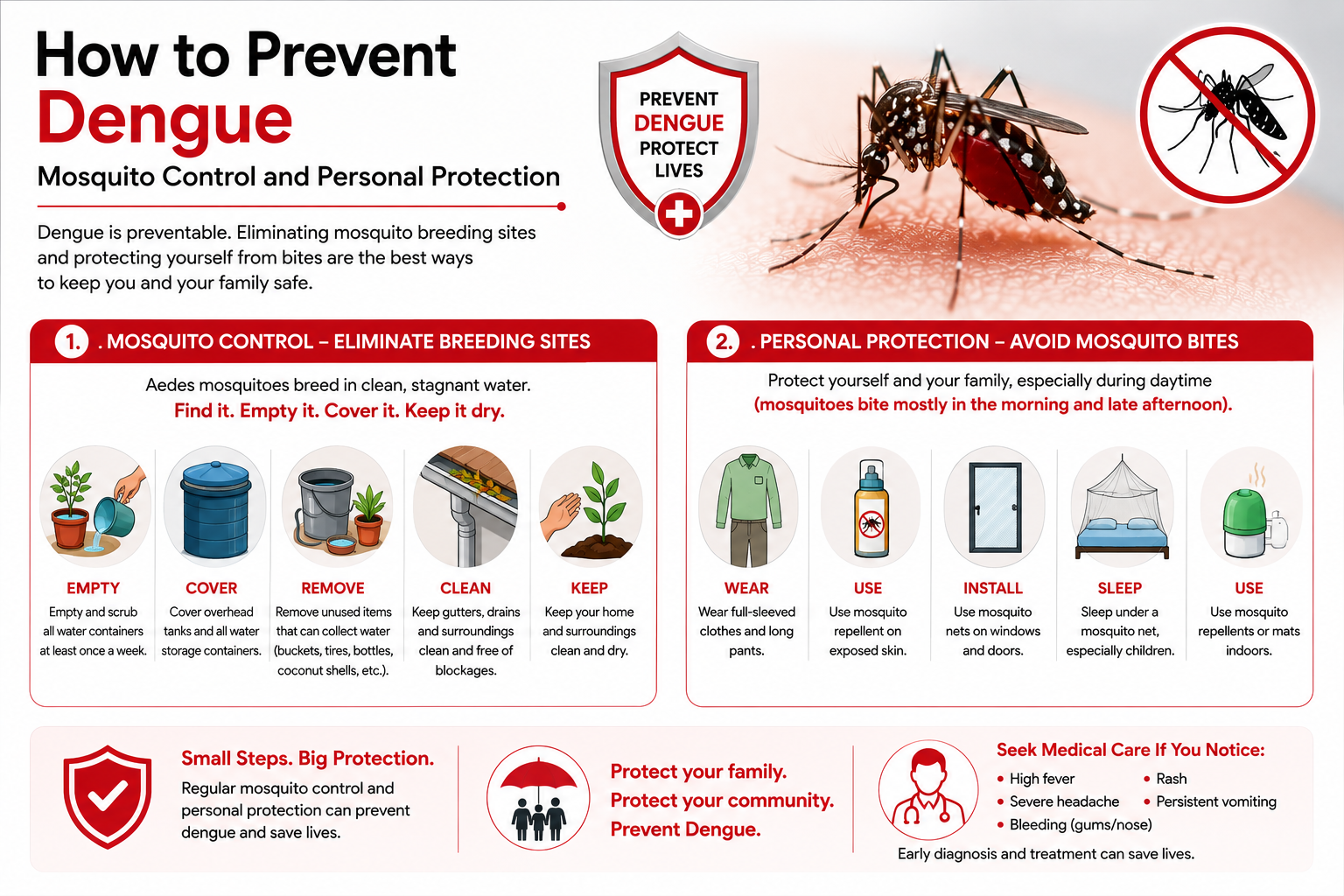
Empty AND scrub cooler trays — scrubbing removes eggs attached to walls
Turn over or remove all unused containers that can hold water
Cover overhead tanks — tight-fitting lid, no gaps for mosquito entry
Add larvicide to containers that cannot be emptied — temephos or BTI
Keep drains clear and free-flowing — stagnant drain water is a secondary site
Remove tyres from compound or fill with sand to prevent water collection

The Aedes Mosquito Flies Only 200 Metres

Your dengue mosquito is almost certainly breeding in your own home or within your immediate building compound. You can control your dengue risk more directly than any other mosquito-borne disease — by eliminating breeding sites within your control. Report uncovered water sources in your building to your housing society.
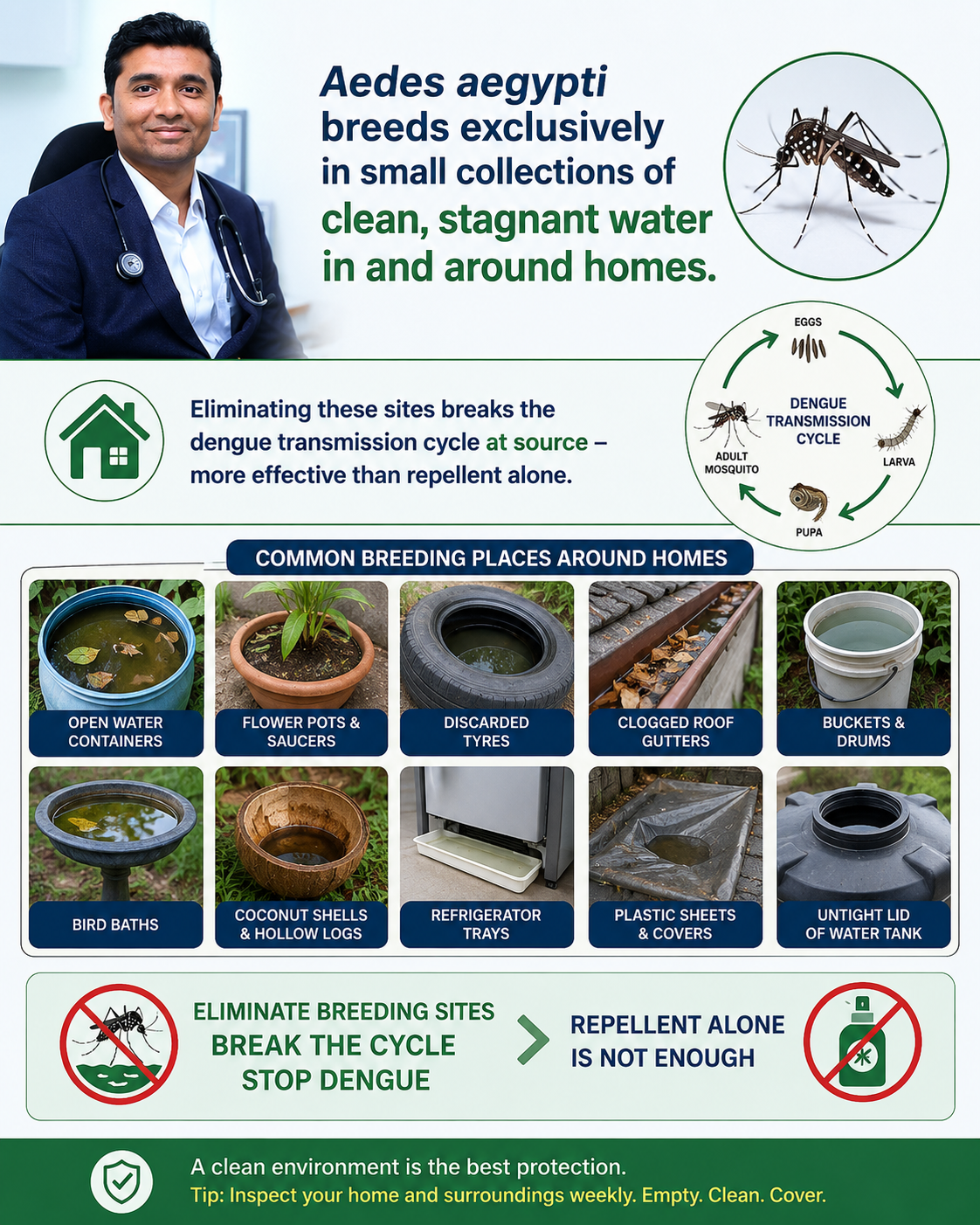
Dengue mosquito breeding sites Surat prevention
Insect Repellents

Which Repellent Works — and How to Use It Correctly

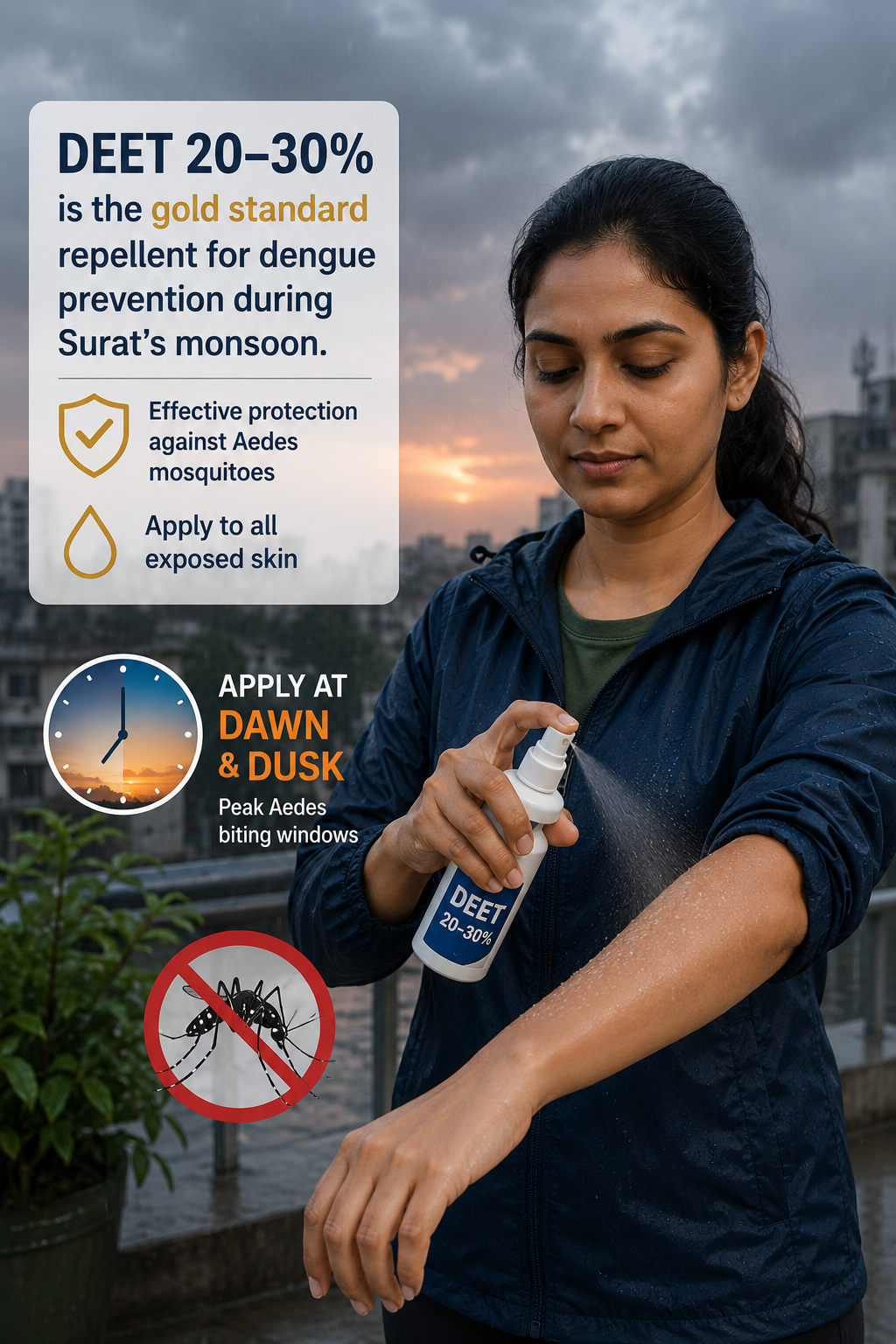
Not all repellents are equally effective. The choice of repellent, its concentration, and correct application technique all determine whether you are protected for 2 hours or 8 hours. During Surat monsoon, repellent is a critical part of daily routine — applied at dawn before morning activities and again at dusk before evening time outdoors.

RepellentConcentrationDurationAge SafetyBest For
DEET 20–30% 4–8 hours 2+ months (≤30%) Best overall — gold standard
Picaridin 20% 4–8 hours 2+ months Equal to DEET; less irritation; no smell
IR3535 20% 2–4 hours 2+ months Children; gentler formula
DEET (low dose) 7–10% 1–2 hours 2+ months Short outdoor activities only
Citronella oil Varies 30–60 min All ages Minimal protection — not recommended
Neem oil Varies 30–60 min All ages Insufficient evidence — not recommended

Correct Application

Apply to all exposed skin — not under clothing
Apply repellent after sunscreen, not before
Reapply after swimming, rain, or heavy sweating
Wash off with soap and water when going indoors
Do not spray directly on face — apply to hands then rub on face

Common Mistakes

Using citronella or neem and thinking you are protected (you are not)
Applying once at sunrise and not reapplying all day
Not applying to ankles — Aedes often bites at ankle level
Using expired repellent — check the date
Applying repellent to children under 2 months
Insect repellent mosquito prevention Surat

 Protection Beyond Repellent

Long sleeves + long trousers at dawn and dusk — physical barrier repellent cannot provide
Light-coloured clothing — mosquitoes prefer dark colours
Permethrin-treated clothing — kills mosquitoes on contact, lasts multiple washes
Window and door screens — fitted, no gaps or holes
Insecticide-treated bed nets — for Anopheles (malaria) night protection
Electric vaporisers indoors overnight — pyrethroids, safe at household concentrations
 Book Consultation
Disease-Specific Prevention

Prevention for Each Mosquito-Borne Disease

Each disease has specific prevention priorities based on the mosquito’s behaviour, the disease’s characteristics, and what is known to work in the Surat context.

 Aedes aegypti · Daytime biter

Dengue Prevention

The most important mosquito-borne disease to prevent in Surat. No vaccine is widely available for adults. No specific antiviral treatment exists. Prevention is the only intervention that actually works. The core strategy is source reduction — eliminating Aedes breeding sites in and around the home.

Prevention Priorities

Empty and scrub all containers every 3–5 days — the #1 action
Apply DEET 20–30% at 6–8 AM and 4–6 PM
Full-coverage clothing during morning and evening activities
Window screens and electric vaporisers indoors during day
Community cooperation — report uncovered water to society

If Fever Occurs

NS1 antigen on day 1 — most sensitive days 1–5
Paracetamol only — never ibuprofen or aspirin
Daily platelet count during critical phase (days 4–6)
See Dr. Savaj for fever >2 days during monsoon
Dengue IgM from day 5 if NS1 was negative
Dengue prevention Surat SCID-AI
Malaria prevention Surat SCID-AI
 Anopheles · Night biter

Malaria Prevention

Less common than dengue in urban Surat, but falciparum malaria can be fatal within 24–48 hours of symptom onset. Night-time protection is the priority because Anopheles bites when people are sleeping. Vivax malaria can relapse from liver dormant forms months after the initial infection.

Prevention Priorities

Insecticide-treated mosquito net (ITN) every night during season
Repellent at dusk — when going out in the evening
Window and door screens — keep closed at night
Long sleeves and trousers after sunset, especially near water bodies
Travellers to endemic areas: consult Dr. Savaj for prophylaxis

If Fever Occurs

Blood smear + RDT on day 1 — both tests together
Species identification mandatory — falciparum vs vivax, different treatment
G6PD test before primaquine (vivax radical cure)
Never delay treatment — falciparum can deteriorate rapidly
Repeat smear if first is negative but suspicion remains high
 Aedes aegypti · Same mosquito as dengue

Chikungunya Prevention

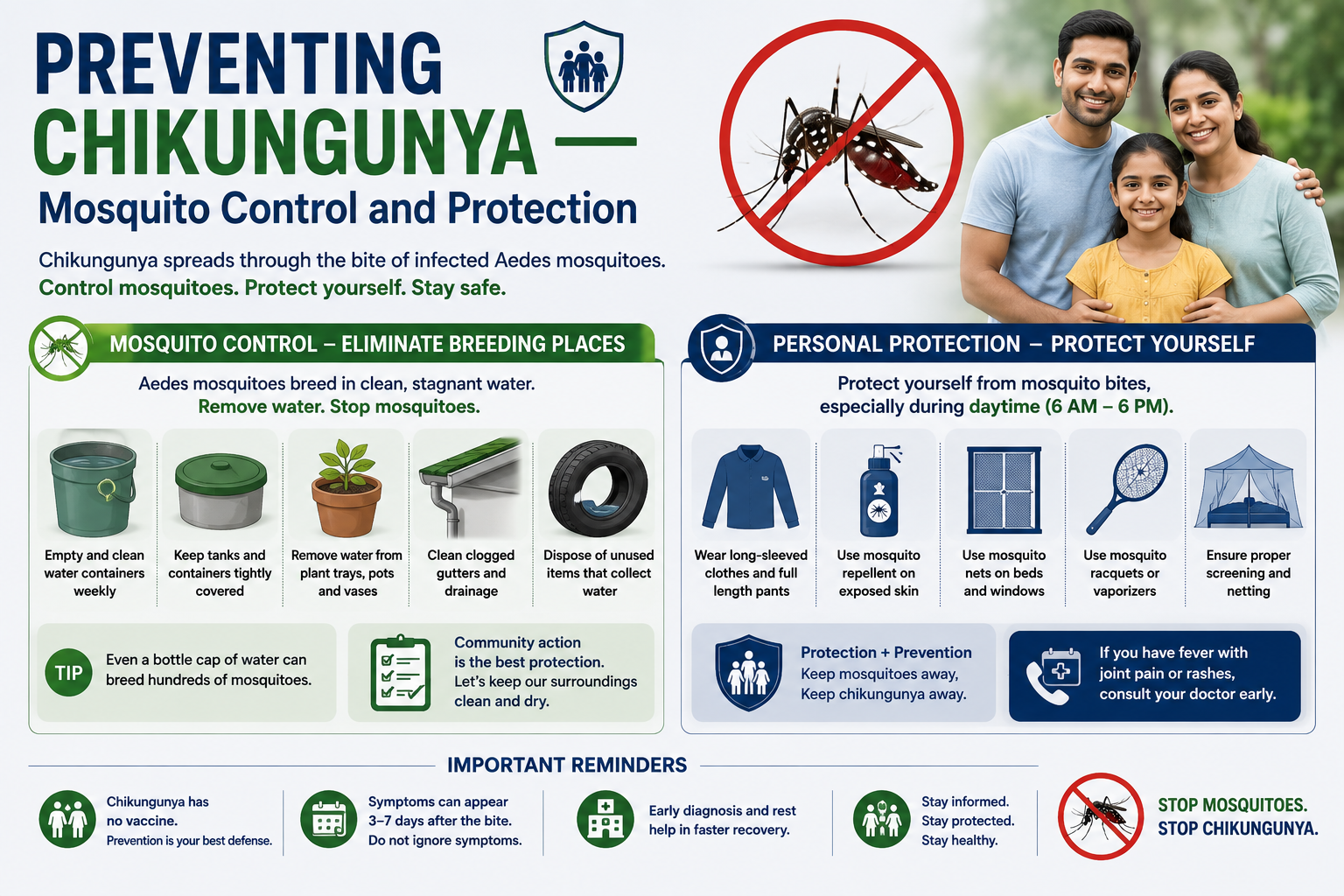
Chikungunya is transmitted by the same Aedes aegypti mosquito as dengue — so all dengue source reduction measures also prevent chikungunya. The distinction matters clinically: chikungunya’s severe bilateral joint pain can persist for months as post-chikungunya arthritis, which requires hydroxychloroquine — not just paracetamol.

Prevention — Same as Dengue

Eliminate Aedes breeding sites — protects against both diseases
Repellent at dawn and dusk — same biting time as dengue mosquito
Test for both simultaneously — NS1 (dengue) + Chikungunya PCR on day 1–5
Chikungunya IgM from day 5 onwards

Post-Chikungunya Arthritis

Fever resolves in 2–4 days but joint pain may persist months
Bilateral joint pain — ankles, wrists, fingers, morning stiffness
Hydroxychloroquine — not paracetamol alone — for PCA treatment
Physiotherapy referral for persistent joint disease
See Dr. Savaj if joint pain persists >4 weeks after fever
Chikungunya prevention Surat SCID-AI
Mosquito Season in Surat

When to Be Most Vigilant — Month by Month

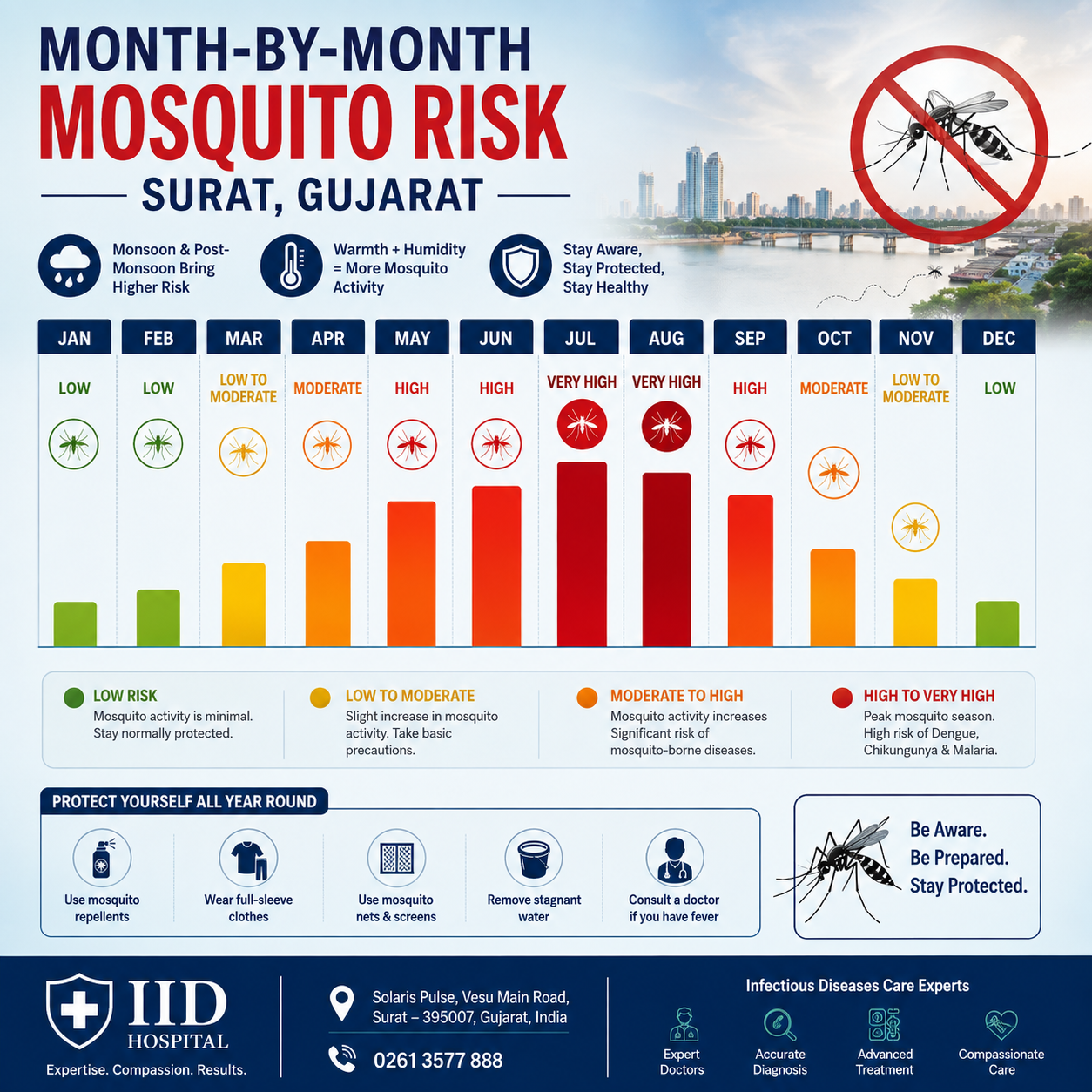
Mosquito populations in Surat follow a predictable annual pattern tied to the monsoon. Knowing when each disease peaks helps you time your prevention efforts correctly.

Dec – May

Low Season

Mosquito populations low. Some residual risk from vivax malaria relapses (hypnozoite reactivation). Dengue and chikungunya very uncommon. Continue basic source reduction but high-intensity prevention not required.

Jun – Jul

Building Season

First rains fill containers. Aedes and Anopheles populations begin building rapidly. Start intensive prevention NOW — before populations peak. Scrub all containers, buy DEET, check window screens, get typhoid vaccine.

Aug – Oct

Peak Season

Highest risk. Dengue, malaria, and chikungunya all at peak transmission. Any fever: NS1 + blood smear on day 1. Paracetamol only. Daily container scrubbing. Repellent every morning and evening. See Dr. Savaj for any fever >2 days.

Nov

Post-Monsoon

Dengue and malaria declining but still present. Post-chikungunya arthritis cases presenting 6–8 weeks after infection. Vivax malaria relapse cases. Maintain vigilance until December. Patients with joint pain after monsoon fever need hydroxychloroquine assessment.
Patient Feedback

What Patients Say About Mosquito Disease Care at SCID-AI

I had chikungunya in September and joint pain lasted 5 months. I was taking paracetamol every day with no improvement. Dr. Savaj diagnosed post-chikungunya arthritis and started hydroxychloroquine. Within 6 weeks the pain was 80% better. I did not know this was a treatable condition — I thought I just had to live with it.

PM
Priya M.Post-chikungunya arthritis · Surat

My father had malaria and the first doctor gave him chloroquine. He did not improve. Dr. Savaj repeated the smear — it was falciparum malaria, not vivax, and chloroquine does not work for falciparum. He changed treatment to ACT. My father recovered within 3 days. Species identification before treatment — something the first doctor did not do — saved his life.

RK
Rahul K.Falciparum malaria — correct treatment · Surat
Common Questions

Frequently Asked Questions About Mosquito Diseases

Answered by Dr. Pratik Savaj, FNB Infectious Diseases, SCID-AI, Surat.

Can a single mosquito net protect the whole family?
A single mosquito net only protects the person sleeping under it — it does not create a protective zone for the whole room. Each person sleeping needs their own net or shared net that is large enough to tuck under the mattress on all sides without gaps. For Aedes mosquitoes (dengue/chikungunya), nets are less critical because Aedes bites during the day — daytime protection with repellent and clothing is more important. For Anopheles (malaria), which bites at night, nets are a primary protection measure. Insecticide-treated nets (ITNs) add a chemical barrier that kills mosquitoes on contact, making them significantly more effective than untreated nets.
Which insect repellent is most effective against dengue mosquitoes?
DEET (N,N-Diethyl-meta-toluamide) at 20–30% is the gold standard repellent — most extensively tested, most effective, longest duration (4–8 hours). It is safe for children over 2 months old at concentrations up to 30%. Picaridin at 20% is equally effective, less skin irritation, less smell, safe from infancy. IR3535 is gentler and effective for 2–4 hours — good for children. Plant-based repellents (citronella, neem oil): significantly shorter protection (30 minutes to 2 hours), much less effective, require frequent reapplication. Apply repellent after sunscreen, not before. Do not use DEET under clothing — apply to exposed skin only.
Is dengue or malaria more dangerous in Surat?
Both are serious but in different ways. Dengue is far more common in Surat — it peaks every monsoon season with thousands of cases across the city. Dengue is usually self-limiting but severe dengue (dengue haemorrhagic fever, dengue shock syndrome) can be fatal if not recognised and managed correctly. The critical phase (days 4–6) requires monitoring even if the patient appears better. Malaria is less common in urban Surat than dengue but remains present. Falciparum malaria can cause cerebral malaria and organ failure within 24–48 hours of symptom onset — it is potentially more rapidly fatal. Both require same-day testing on day 1 of fever during monsoon: NS1 for dengue, blood smear + RDT for malaria.
Can dengue occur outside the monsoon season in Surat?
Yes — though it is far less common. Aedes mosquito populations are lowest during the cooler, drier months (December–February). However, dengue cases can occur year-round in Surat because: the city’s urban density maintains small mosquito populations even outside peak season; international travel can introduce virus; and domestic coolers, construction sites, and overhead tanks maintain breeding sites throughout the year. The risk is dramatically higher during July–November, but fever with severe body pain and falling platelets should raise dengue suspicion in any month. NS1 antigen testing is appropriate for any suspected dengue presentation regardless of season.
Does indoor spraying by the municipality prevent dengue?
Municipal fogging provides temporary knockdown of adult mosquitoes but does not address breeding sites. Adult mosquitoes are typically killed within 50–100 metres of the spray. However, because Aedes aegypti breeds in small household water containers, larvae are not affected by outdoor fogging. Within days, new adult mosquitoes emerge from indoor breeding sites that fogging never reached. The evidence is clear: source reduction (eliminating breeding sites) is far more effective than adult mosquito spraying. Fogging is a supplement to source reduction, not a substitute. The responsibility for source reduction lies with individual households — not just the municipality.
How long does protection from a single application of DEET repellent last?
Protection duration depends on the concentration: DEET 7%: approximately 2 hours. DEET 20%: approximately 4–5 hours. DEET 30%: approximately 6–8 hours. Above 30%, duration does not increase significantly but skin irritation risk rises. Reapply after: swimming or wading in water; heavy sweating (outdoor exercise, physical labour in heat); towelling the skin. Do not reapply more frequently than the product instructions specify. For children, apply once and reapply only if protection duration has elapsed. Wash repellent off with soap and water when returning indoors and protection is no longer needed.
Are mosquito coils and electric repellents effective?
Both provide indoor protection but with important limitations. Mosquito coils: effective at repelling and killing mosquitoes in a confined space. However, burning coils produce particulate matter and volatile organic compounds — equivalent to smoking several cigarettes. Use outdoors or in well-ventilated spaces only. Not recommended for use in closed bedrooms, especially with children or people with respiratory conditions. Electric liquid vaporisers (All Out, Good Knight): effective in small enclosed rooms overnight. The active ingredient (pyrethroids) is relatively safe at the concentrations used in vaporisers. More appropriate for indoor overnight use than coils. Combine with a mosquito net for maximum protection. Window-plug repellents are less effective in large or poorly sealed rooms.
What should I do if I develop fever during dengue or malaria season?
In Surat between July and November: Do not wait to see if the fever improves on its own. On day 1–3 of fever: get NS1 antigen test (dengue — most sensitive days 1–5) and blood smear + RDT (malaria). Take paracetamol only for fever — never ibuprofen or aspirin until dengue is excluded (both increase bleeding risk in dengue). Do not take antibiotics empirically. If NS1 is negative but fever persists beyond day 5, test for dengue IgM + malaria repeat + blood culture (typhoid). See Dr. Savaj at SCID-AI for any monsoon fever lasting more than 2 days — correct diagnosis on day 1 changes the entire management trajectory.
Consult Dr. Pratik Savaj

Monsoon Fever or Joint Pain After Chikungunya? See Dr. Savaj.

No referral needed. Any fever during Surat monsoon needs NS1 + blood smear on day 1. Post-chikungunya joint pain needs hydroxychloroquine — not just paracetamol. Falciparum malaria needs species-specific ACT. Dr. Pratik Savaj, FNB Infectious Diseases, SCID-AI, Nanpura, Surat gets the diagnosis right before starting treatment.

SCID-AI, Nanpura, Surat — 405 SNS Axis Business Space, Besides Mahavir Hospital, Surat 395001
Mon–Sat: 11 AM–1 PM & 4–6 PM · Sunday: Closed
+91 72839 34807 — Call or WhatsApp
Dr. Pratik Savaj
Dr. Pratik Savaj FNB Infectious Diseases
MBBS · DNB Medicine · Fellowship ID
P.D. Hinduja Hospital, Mumbai
Morning11:00 AM – 1:00 PM, Mon–Sat
Evening4:00 PM – 6:00 PM, Mon–Sat
Phone+91 72839 34807
 WhatsApp to Book