
Travel Infection PreventionBefore, During & After Travel
Every journey carries infectious risks that depend on where you are going, how you are travelling, how long you are staying, and your own health conditions. A pre-travel consultation at IID Hospital identifies your specific risks and provides vaccines, prophylaxis, and practical guidance tailored to your itinerary — not a generic pamphlet.
Pre-Travel Preparation
Vaccines, malaria prophylaxis, medical kit, destination-specific risk briefing
Protection While Travelling
Food and water safety, repellent use, medication adherence, when to seek care
Post-Travel Evaluation
Post-travel fever assessment, malaria exclusion, parasite screening
What to Do Before You Travel — A Timeline
6–8 weeks before
Book Pre-Travel Consultation at IID Hospital
The earlier the better — some vaccines require multiple doses with spacing (hepatitis A: 2 doses 6–12 months apart; hepatitis B: 3 doses; Japanese encephalitis: 2 doses 28 days apart). A consultation this far in advance allows complete vaccine schedules and gives immunity time to develop before departure.
4–6 weeks before
Vaccines and Prophylaxis
Vaccines: typhoid (2–4 weeks for immunity); hepatitis A (single dose provides immediate partial protection); yellow fever (required for entry to many countries — must be given at least 10 days before travel); Japanese encephalitis (2 doses); rabies pre-exposure (3 doses). Malaria prophylaxis: start doxycycline 1–2 days before; start mefloquine 2–3 weeks before (to assess tolerance); start atovaquone-proguanil 1–2 days before.
2–4 weeks before
Medical Kit and Standby Medications
Dr. Savaj prescribes a destination-specific medical kit: oral rehydration salts (traveller’s diarrhoea); azithromycin standby emergency treatment (antibiotic to self-treat diarrhoea if needed; preferred over ciprofloxacin given widespread resistance); loperamide (symptom relief for diarrhoea); DEET repellent 20–30%; basic wound care. For altitude travel: acetazolamide (Diamox) for altitude sickness prevention.
1–2 weeks before
Chronic Condition Management Review
Diabetics: ensure adequate insulin/medication supply + 30 days extra; adjust timing for time zone changes; carry glucose monitor and test strips in hand luggage. HIV-positive travellers: sufficient ART supply; check destination’s drug import regulations; carry doctor’s letter. Patients on immunosuppressants: review infection risk; consider dose timing adjustment.
Day before departure
Final Checklist
All medications in hand luggage (never checked baggage — luggage can be lost or delayed). International Certificate of Vaccination (yellow fever) if required. Medical kit packed. IID Hospital phone number saved. Travel insurance with medical evacuation cover confirmed. Emergency contacts for destination established.

What to Tell Dr. Savaj
Your Risk Depends on Where You Are Going
Infection risk in travel is highly destination-specific. The interventions that a traveller to rural Odisha needs are completely different from those needed for travel to London or Dubai. Dr. Savaj assesses risk based on your specific itinerary.
High risk
Sub-Saharan Africa, South & Southeast Asia Rural, Amazon
Uganda, Kenya, Tanzania, rural Thailand, rural Indonesia, rural Northeast India, Amazon basin
Moderate risk
South & Southeast Asia Urban, Middle East, North Africa
Bangkok, Bali, Cairo, Dubai, Nepal, Sri Lanka, Vietnam cities, rural domestic India
Lower risk
Western Europe, North America, Australia, Japan
UK, USA, France, Germany, Australia, Japan, Singapore, UAE cities
Domestic Travel Within India Is Not Risk-Free
Travellers from urban Surat visiting rural areas of Odisha, Chhattisgarh, Northeast India, or tribal belt regions face significant malaria risk — including falciparum malaria. Pilgrimages to mountain areas (Char Dham, Kedarnath) carry altitude sickness risk at elevations above 2,500 metres. A pre-travel consultation is relevant for domestic high-risk travel, not only international travel.
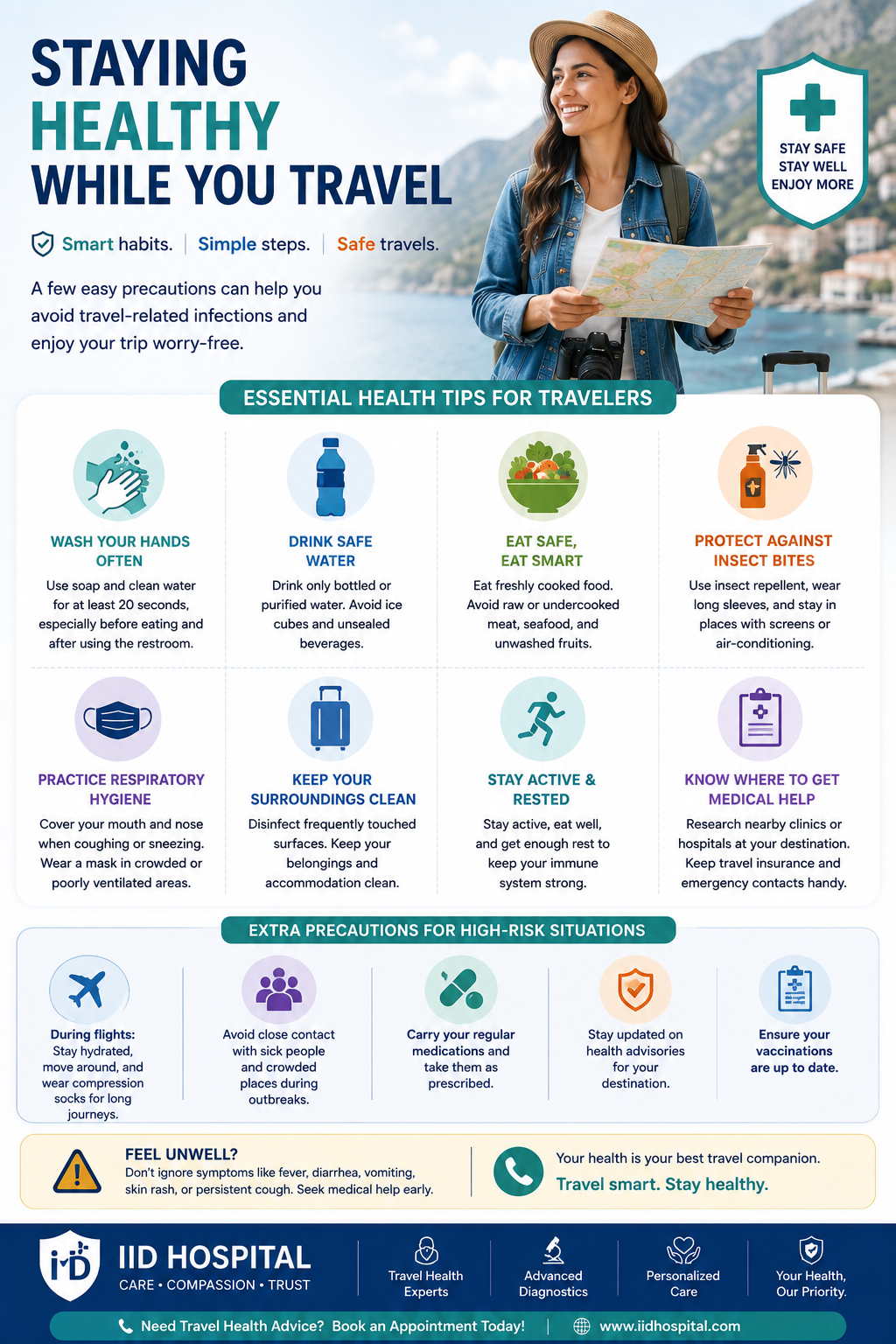
Staying Healthy While You Travel
Food and Water Safety
Mosquito Protection
Managing Traveller’s Diarrhoea
Sun, Heat, and Animal Safety

Returning travellers with fever present a specific diagnostic challenge: the differential diagnosis is determined not just by symptoms, but by what they were exposed to at their destination. The same fever presentation means something completely different in a person returning from rural Odisha versus London. Always tell your doctor exactly where you travelled, when you returned, and what prophylaxis you took.
The most time-critical diagnosis is falciparum malaria — it can deteriorate to cerebral malaria or organ failure within 24–48 hours of symptom onset. Any fever within 3 months of return from a malaria-endemic area requires a blood smear and RDT on the same day — not the next morning, not after waiting to see if it improves.
| Disease | Window After Return | Key Test | Urgency |
|---|---|---|---|
| Falciparum malaria | Days to 3 months | Blood smear + RDT | SAME DAY EMERGENCY |
| Vivax malaria | Days to 1 year (relapses) | Blood smear + RDT | Same day |
| Dengue | Days to 2 weeks | NS1 antigen (days 1–5) | Same day |
| Typhoid | 1–3 weeks | Blood culture | Within 24 hours |
| Hepatitis A | 2–6 weeks | Anti-HAV IgM | Within 1 week |
| Hepatitis E | 2–9 weeks | Anti-HEV IgM | Within 1 week |
| Chikungunya | Days to 2 weeks | Chikungunya PCR/IgM | Within 1 week |
| Rickettsial disease (scrub typhus) | Days to 3 weeks | Weil-Felix / scrub typhus IgM | Within 48 hours |
See Dr. Savaj at IID Hospital for Any Post-Travel Fever
Post-travel fever is a specialist evaluation. General physicians without travel medicine training may not order the correct tests or may miss that the patient was recently in a malaria-endemic area. At IID Hospital, Dr. Savaj takes a systematic travel history and orders destination-specific tests based on your exact itinerary. Call +91 92747 93759 and mention you have returned from travel — you will be prioritised.
Special Considerations by Health Condition
Certain health conditions require specific preparation beyond the standard pre-travel advice. These groups should consult Dr. Savaj at least 6 weeks before travel.
Diabetic Travellers
HIV-Positive Travellers
Pregnant Travellers
Elderly Travellers (65+) and Immunosuppressed
What Patients Say About Dr. Pratik Savaj
I was travelling to Kenya and needed yellow fever vaccination, malaria prophylaxis, and hepatitis A advice — all in one visit. Dr. Savaj gave a destination-specific risk assessment and got me travel-ready within days. No other doctor had offered this level of pre-travel planning.
I returned from Rajasthan with a fever and joint pain. Three doctors had called it viral. Dr. Savaj diagnosed chikungunya with dengue co-infection, explained the dual presentation, and gave a clear recovery plan. Specialist-level thinking that saved weeks of wrong treatment.
Dr. Savaj assessed my malaria risk for a trip to Odisha and chose the right prophylaxis for the P. vivax-dominant region I was visiting. He also explained when to start, when to stop, and what symptoms to watch for. This level of detail is impossible to find elsewhere in Surat.
Our family needed typhoid, hepatitis A, and meningococcal vaccination before the Hajj pilgrimage. Dr. Savaj reviewed each family member individually, administered the mandatory meningococcal vaccine, and issued the required health documentation. Efficient and completely professional.
I came back from Bangladesh with three weeks of intermittent fever. Dr. Savaj tested for both P. falciparum and P. vivax malaria simultaneously and confirmed mixed-species infection — something that is very easy to miss. Treatment was tailored to both species and I recovered fully.
I needed PrEP guidance before an extended stay in a high-prevalence country. Dr. Savaj assessed my risk honestly, prescribed PrEP, and arranged monitoring. He also vaccinated me for hepatitis B and A, typhoid, and flu in the same visit. Comprehensive travel health in one appointment.
Frequently Asked Questions
About Travel Infection Prevention
Answered by Dr. Pratik Savaj, FNB Infectious Diseases — IID Hospital, Vesu, Surat.