
How Infections SpreadThe 5 Transmission Routes
The most important insight in infection prevention: the prevention strategy is entirely determined by the transmission route. Hand hygiene stops typhoid but not dengue. Mosquito nets stop malaria but not hepatitis B. Understanding how each disease spreads tells you exactly what to do — and what not to bother with.
Transmission Route = Prevention Strategy
Every infection follows a chain: source → transmission route → susceptible host. Breaking any link in this chain stops the infection. But you can only break the right link if you know which route is being used. This is not academic — it determines what you actually do to protect yourself and your family.
A person who understands that typhoid spreads via contaminated food and water will boil their water, wash their hands before eating, and get the typhoid vaccine. These actions directly interrupt the faecal-oral chain. The same person using mosquito repellent to prevent typhoid is wasting effort — because typhoid does not spread via mosquitoes. Right prevention requires right understanding of transmission.
The five transmission routes in this guide account for virtually all infections of clinical importance in India: faecal-oral (typhoid, hepatitis A), airborne (TB, COVID-19, influenza), vector-borne (dengue, malaria, chikungunya), bloodborne (HBV, HIV), and direct contact (tinea, scabies, leptospirosis). Each route has a specific mechanism, specific diseases, and specific preventive actions.
One Symptom, Five Possible Causes
A patient presents with fever. The cause could be typhoid (faecal-oral), TB (airborne), dengue (mosquito-borne), or typhus (flea-borne). Each needs a completely different test and treatment. This is why at IID Hospital, Dr. Savaj always asks about travel history, food and water sources, animal and mosquito exposure, and blood exposures — to identify which transmission route was involved.
5 Routes — Quick Reference
Why This Matters Clinically
When Dr. Savaj asks “Did you eat outside?” or “Were you near someone with TB?” or “Did you have any needle exposure?” — he is systematically checking each transmission route. The history is the diagnosis.
The 5 Routes — How Each Works and How to Stop It
Each route has a specific entry point into the body, a specific mechanism, and therefore a specific set of preventive actions. Understanding one route at a time makes prevention rational rather than overwhelming.
Faecal–Oral Transmission
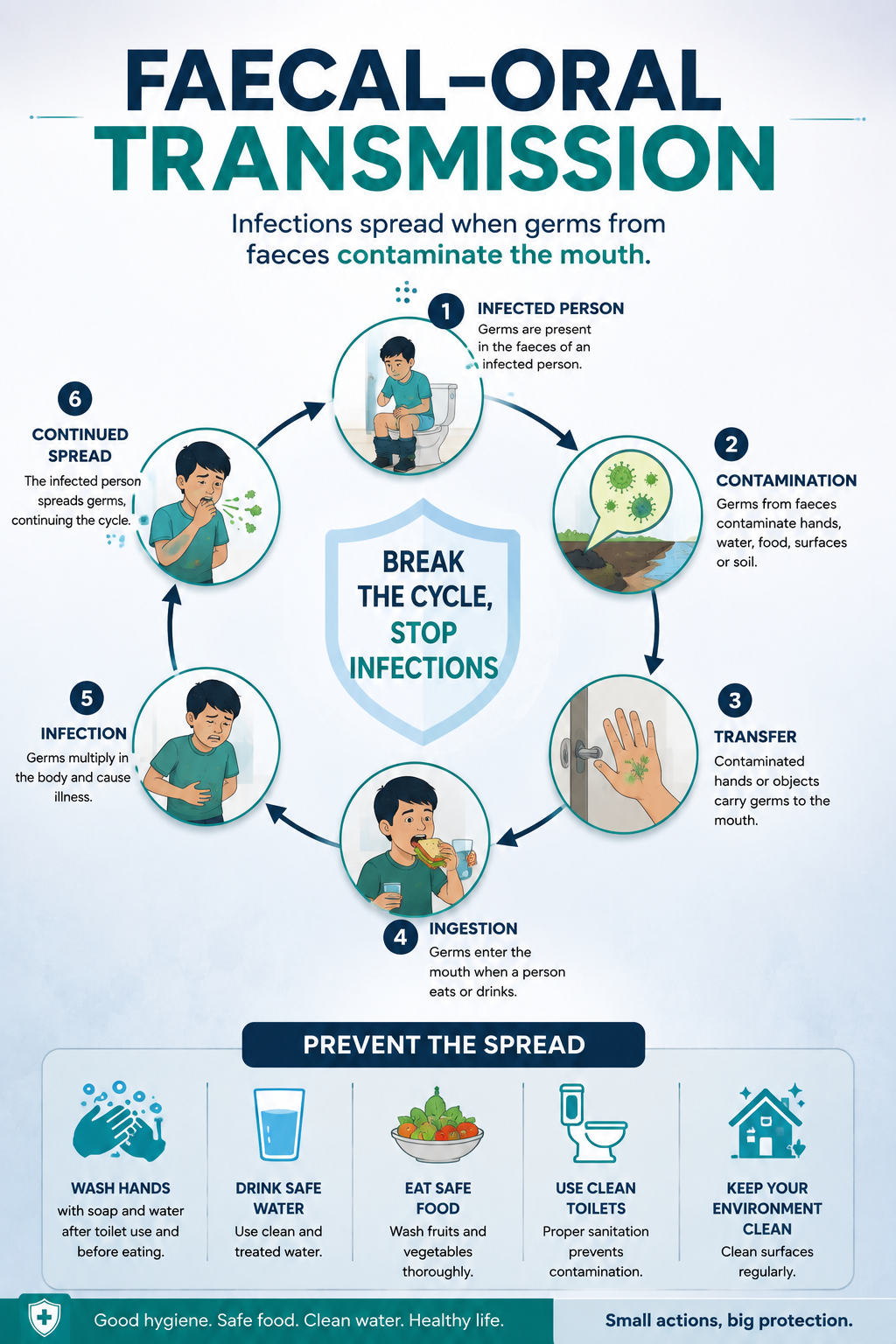
An infected person sheds pathogens in their stool. These contaminate food, water, or surfaces. A new host ingests them by eating contaminated food, drinking contaminated water, or touching a contaminated surface and then touching their mouth. The critical moment is the mouth.
How It Spreads
How to Prevent It
Most Common Route in India
Faecal-oral transmission is responsible for typhoid, hepatitis A, and hepatitis E — all of which circulate in Surat every monsoon season. The single most effective intervention: washing hands with soap before eating. No other measure has a higher impact per unit effort.

Airborne Transmission
Infected persons expel respiratory particles when breathing, talking, coughing, or sneezing. Large droplets (influenza, COVID-19) fall within 1–2 metres. Droplet nuclei <5 microns (TB, measles) remain suspended for hours, travel across rooms, and accumulate in poorly ventilated spaces. These are fundamentally different risks requiring different precautions.
How It Spreads
How to Prevent It
TB vs Flu — Not the Same Risk
TB spreads via droplet nuclei that remain airborne for hours in a closed room — a fundamentally different risk from influenza droplets that fall within 2 metres. Open windows prevent TB. Avoiding a coughing colleague prevents flu. The right precaution depends on which disease you are trying to prevent.
Vector-Borne Transmission
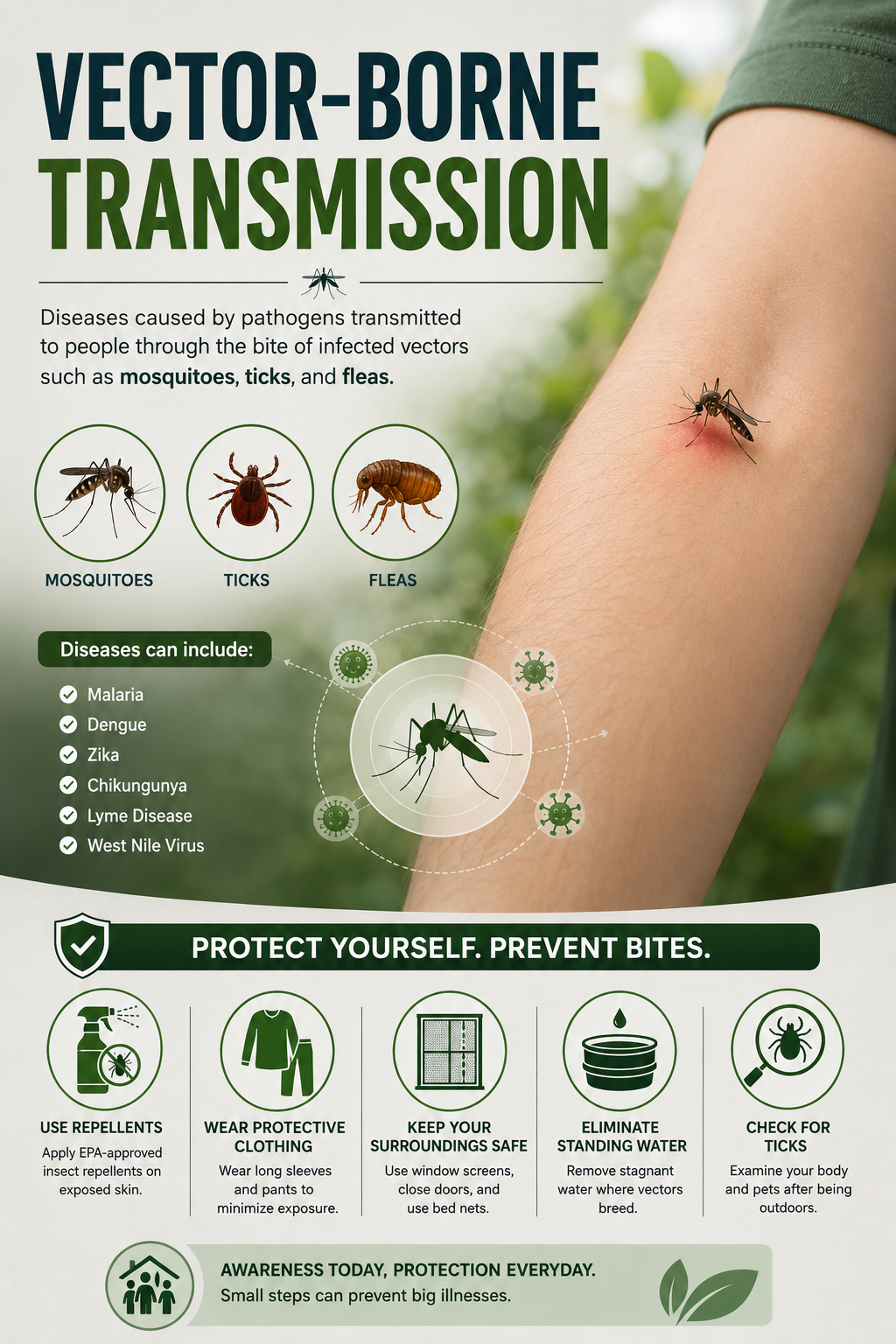
A vector — most commonly a mosquito — ingests a pathogen while feeding on an infected host. The pathogen replicates within the mosquito. When the infected mosquito feeds again, it injects the pathogen into a new host. Person-to-person contact plays no role — the vector is an essential intermediary. Prevention therefore targets the mosquito, not people-to-people interactions.
How It Spreads
How to Prevent It
Hand Hygiene Prevents Nothing Here
Vector-borne diseases are not transmitted by person-to-person contact. Washing hands after touching a dengue patient changes nothing. The only interventions that work are those that target the mosquito: eliminating breeding sites, applying repellent, using nets. Prevention strategy must match transmission route.
Bloodborne Transmission
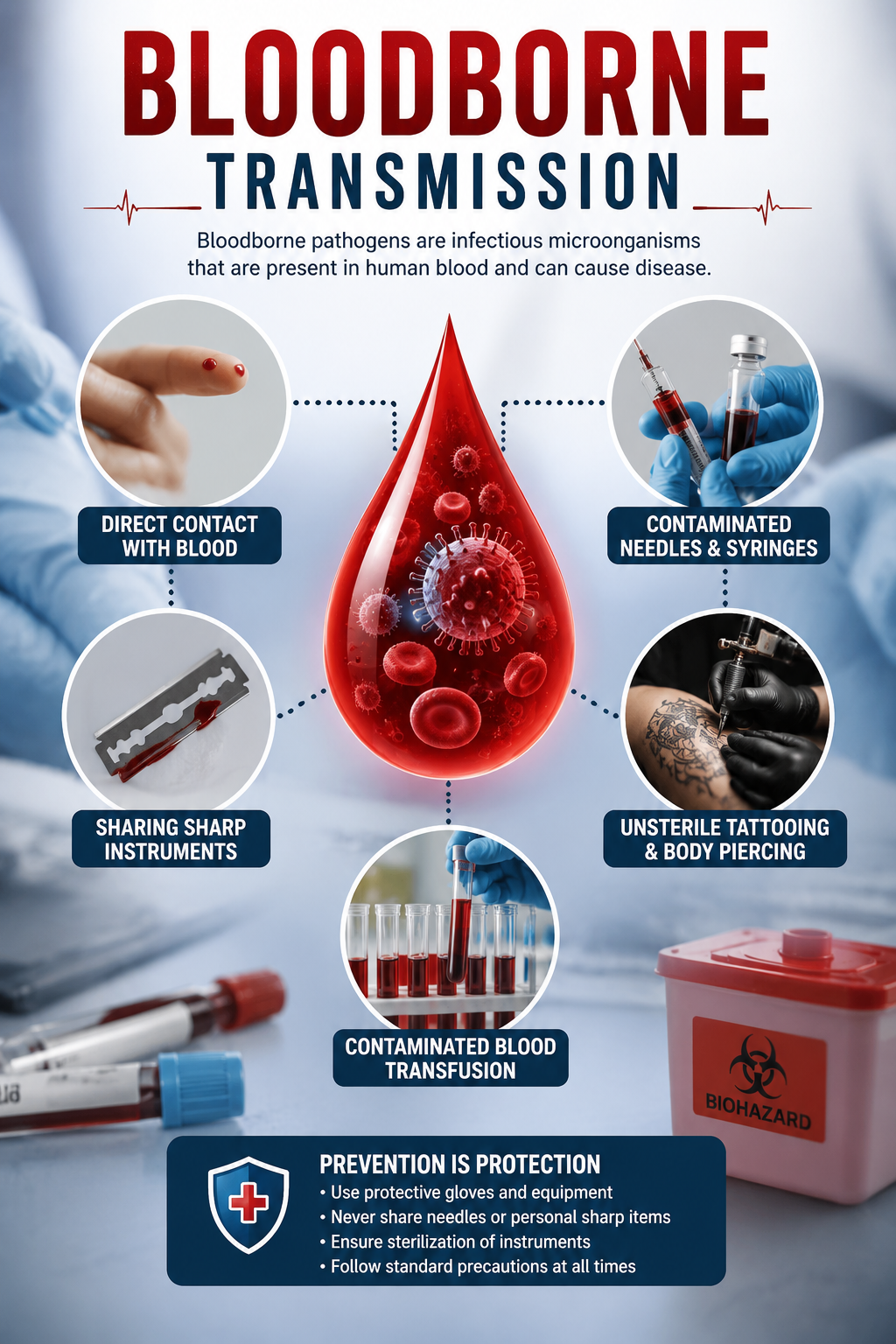
Bloodborne pathogens are present in blood (and for HIV/HBV, in semen and vaginal secretions). Transmission requires direct contact between infected blood/body fluid and a susceptible host's bloodstream or mucous membranes. Casual contact — meals, handshaking, hugging, coughing — cannot transmit bloodborne pathogens. This distinction matters enormously for preventing discrimination.
How It Spreads
How to Prevent It
HBV Cannot Spread Through Shared Meals
Hepatitis B is NOT transmitted through sharing food, utensils, hugging, or casual contact. This is the basis for the harmful social discrimination against HBV-positive individuals in India. HBV-positive people can work, share meals, and live normally — only blood and sexual contact carry risk. Hepatitis B vaccine prevents infection.
Direct Contact Transmission
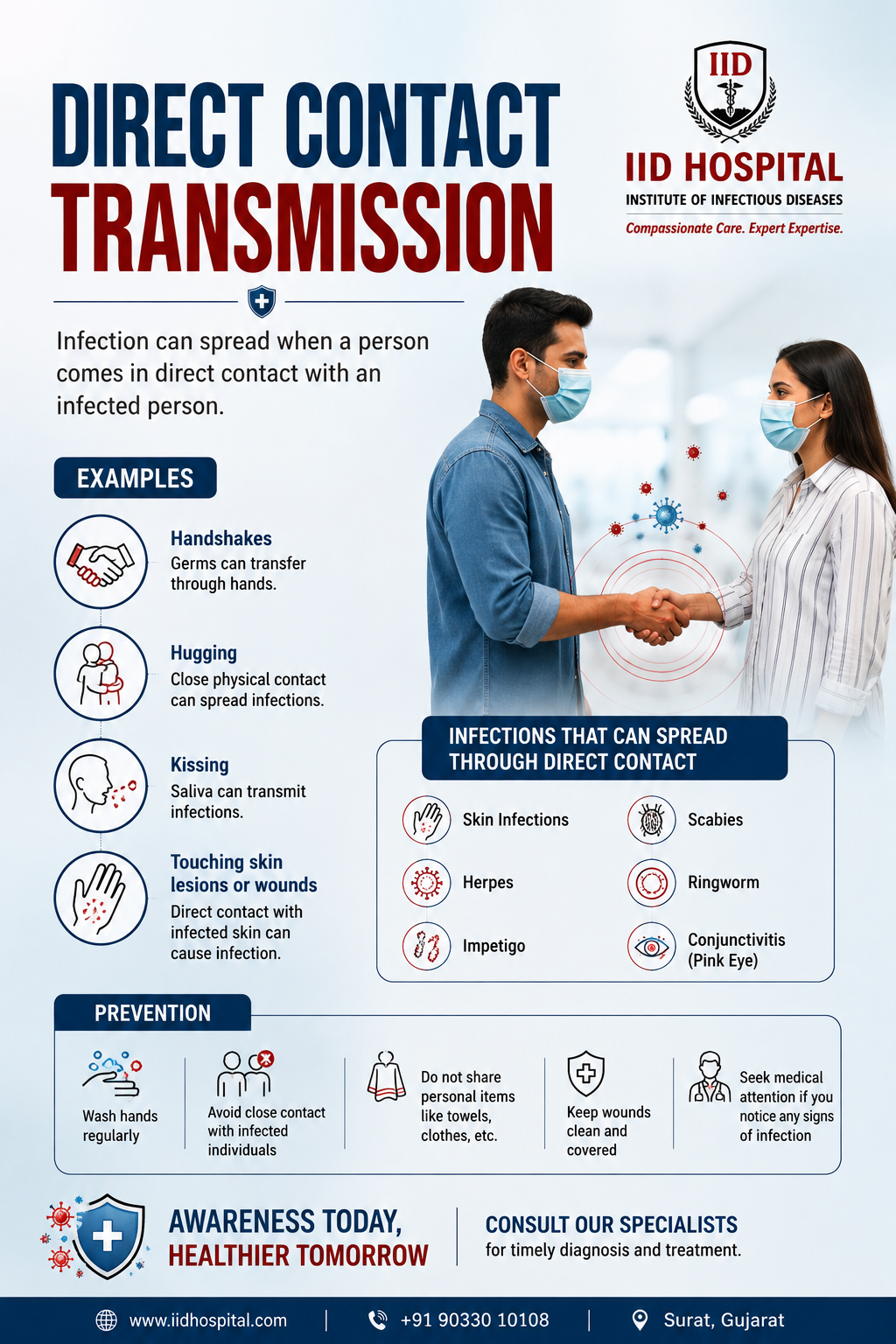
Direct contact transmission occurs when a pathogen passes directly from an infected source to a new host through skin-to-skin contact, contact with infected bodily secretions, or contact with contaminated environmental surfaces (indirect contact). A critical variant is percutaneous infection — where pathogens penetrate intact or broken skin from the environment (leptospirosis from flood water; hookworm from soil).
How It Spreads
How to Prevent It
Leptospirosis During Surat Floods
Leptospirosis — a bacterial infection from rat urine in flood water — is a significant risk during Surat monsoon flooding. The bacteria penetrate intact skin as well as cuts. Waterproof footwear in flood water is mandatory. Fever within 1–2 weeks of flood water exposure: see Dr. Savaj and specifically mention the exposure.
How Long Pathogens Survive Outside the Body
Understanding how long a pathogen survives in the environment explains why some infections spread through contaminated surfaces and others do not. HIV dies within minutes outside the body — which is why it cannot spread through handshakes or shared utensils. Hepatitis B survives on surfaces for up to 7 days — which is why healthcare workers need to handle blood-contaminated equipment with strict precautions.
| Pathogen | Route | On Surfaces | In Water | In Air |
|---|---|---|---|---|
| M. tuberculosis | Airborne | Hours–days in dried sputum | Weeks in water (rare route) | Hours as droplet nuclei |
| SARS-CoV-2 | Airborne | Up to 72 hrs (plastic/steel) | Brief in water | Hours as aerosol |
| Influenza | Airborne | 24–48 hrs on hard surfaces | Brief | Minutes–hours |
| Measles virus | Airborne | Up to 2 hours | Not a route | Up to 2 hours in room air |
| Hepatitis B | Bloodborne | Up to 7 days (most stable) | Days in water | Not a route |
| HIV | Bloodborne | Minutes–hours (very fragile) | Minutes | Not a route |
| Salmonella typhi | Faecal-oral | Hours on surfaces | Weeks in water | Not a route |
| Hepatitis A | Faecal-oral | Hours–days | Months in water | Not a route |
| Norovirus | Faecal-oral | Up to 2 weeks | Months in shellfish | Not a route |
| Leptospira | Direct contact | Hours (moisture needed) | Weeks in moist soil/water | Not a route |

High-Risk Situations in Surat
When in Doubt: See Dr. Savaj
Fever after any of these exposures in Surat: tell Dr. Savaj your exact exposure. The history determines the test. The test determines the treatment.
Which Prevention Works for Which Route
The table below shows which preventive measures are effective against which transmission routes. A tick means the measure directly interrupts this route. A cross means it has no effect — applying it is wasted effort for that disease.
How to Read This Table
Mosquito repellent (✓ for vector-borne) prevents dengue and malaria. The same repellent has zero effect on typhoid (faecal-oral) or TB (airborne). This is not a weakness of repellent — it is simply not the right tool for those diseases. Using the right prevention for the right route is more effective than doing everything randomly. This table helps you apply effort where it actually works.
What Patients Say About Dr. Pratik Savaj
I was confused about how I got typhoid when I was careful about what I ate. Dr. Savaj explained faecal-oral transmission in detail — including indirect contamination from ice and salad washing. Understanding the route helped me prevent a second infection.
My colleague was diagnosed with TB and I needed to know my own risk. Dr. Savaj explained droplet vs airborne transmission, assessed my exposure, arranged a tuberculin test, and gave me a clear action plan. His systematic thinking removed weeks of unnecessary anxiety.
I was diagnosed with hepatitis B and needed to understand how I had contracted it and the risk to my family. Dr. Savaj explained blood-borne transmission clearly, screened my family, vaccinated the non-immune members, and arranged monitoring for me.
Two family members got dengue in the same week. Dr. Savaj explained Aedes vector biology — including the daytime-biting pattern and the indoor breeding sites we had missed. The practical prevention advice stopped a third family case.
I developed fever and jaundice after wading through floodwater. Dr. Savaj diagnosed leptospirosis, explained how Leptospira enters through skin abrasions in contaminated water, and treated me with the correct antibiotic course. Without the right diagnosis I would have been treated for viral hepatitis.
I asked Dr. Savaj why hand hygiene works for some infections but not others. He explained that surface contact, droplet, airborne, and vector-borne routes each require different interventions. His systematic explanation of transmission routes changed how my whole family approaches infection prevention.
Frequently Asked Questions
About How Infections Spread
Answered by Dr. Pratik Savaj, FNB Infectious Diseases — IID Hospital, Vesu, Surat.