SCID-AI · 405 SNS Axis Business Space, Nanpura, Surat
Mon–Sat: 11–1 PM & 4–6 PM
Viral vs bacterial infection guide SCID-AI Surat
 Educational Guide · SCID-AI, Surat

Viral vs BacterialDo You Actually Need Antibiotics?

The most consequential clinical question in everyday medicine: is this infection viral or bacterial? Antibiotics cure bacterial infections and do nothing for viral infections — while causing real harm through side effects and resistance. The distinction matters every time you or a family member falls ill.

 Viral Infections

No Antibiotic Needed

Self-limiting — resolve on their own
Antibiotics have zero effect
Supportive care: rest, fluids, paracetamol
Common cold, flu, dengue, viral gastroenteritis
Antivirals exist for HIV, HBV, HCV, influenza
 Bacterial Infections

Antibiotics Can Be Life-Saving

May not resolve without antibiotics
Correct antibiotic — guided by culture
Typhoid, TB, bacterial pneumonia, UTI
Delay in treatment can cause organ damage
Wrong antibiotic breeds resistance
The Clinical Distinction

Viral vs Bacterial — How They Differ in Every Way That Matters

The two types of infection differ in structure, mechanism, clinical features, and treatment. Understanding these differences is what allows a physician to decide whether antibiotics are needed — and which one.

Viral Infection

Caused by a virus — obligate intracellular parasite

Bacterial Infection

Caused by bacteria — independent living organisms

Size & Structure
Nanometres (20–300 nm). Not a cell — a protein coat (capsid) around genetic material. No cell wall, no ribosome of its own, no metabolism independently.
Micrometres (1–10 μm). Single-celled living organism with cell wall, ribosome, DNA, metabolism. Can reproduce independently.
How It Replicates
Cannot reproduce alone. Must enter a host cell and hijack its machinery to make copies. Bursts the cell on exit (lytic) or integrates into host DNA (lysogenic).
Reproduces independently by binary fission — one cell divides into two. Doubling time can be as fast as 20 minutes in ideal conditions.
How It Makes You Ill
Direct cell destruction; immune activation (fever, fatigue); sometimes the immune response itself causes most symptoms (dengue haemorrhagic fever).
Direct tissue invasion and destruction; toxin production (cholera toxin, tetanus toxin, botulinum toxin); triggering systemic inflammatory response (sepsis).
Typical Clinical Features
Gradual onset. Prominent systemic symptoms (myalgia, malaise, headache). Runny nose. Normal or low WBC. Lymphocytosis. Low CRP.
More localising signs — painful swollen lymph nodes, productive purulent cough, dysuria. Elevated WBC with neutrophilia. High CRP (>100 mg/L often).
Response to Antibiotics
No response. Antibiotics have no mechanism of action against viruses. Taking antibiotics for a viral infection does not shorten duration, reduce severity, or prevent complications.
Critical response. Correct antibiotic guided by culture eliminates the organism. Delay in treatment of serious bacterial infection can cause irreversible organ damage or death.
Treatment Approach
Supportive care: paracetamol for fever, rest, fluids, symptomatic relief. Specific antivirals exist for HIV, HBV, HCV, influenza (oseltamivir), HSV (acyclovir).
Culture before antibiotics where possible. Choose antibiotic based on culture sensitivity. Complete the full course. Never stop early because you feel better.
Immune Response
Cellular immunity (T cells) is primary. Antibodies produced — basis of vaccination and long-term immunity. Some viruses (HIV, CMV) evade immune clearance and persist lifelong.
Antibodies (B cells) + neutrophils are primary. Complement activation. Most bacterial infections are cleared after appropriate treatment and do not persist.
Common Infections Classified

Which Common Infections Are Viral and Which Are Bacterial

Misclassifying these is the primary driver of unnecessary antibiotic use in India. Every viral infection treated with antibiotics is a missed opportunity to let the immune system work — and a contribution to resistance.

Viral — No Antibiotics

Resolve with supportive care

Common Cold

Rhinovirus, coronavirus. Runny nose, sore throat, mild fever. 7–14 days. No antibiotic effective.

No antibiotics

Seasonal Influenza

Influenza A/B. High fever, severe myalgia, headache, dry cough. Oseltamivir within 48 hrs if high-risk. No antibiotics.

Antiviral only

Dengue Fever

Flavivirus. Biphasic fever, severe body pain (“breakbone”), rash, low platelets. Paracetamol + fluids. No antibiotics.

Supportive only

COVID–19

SARS-CoV-2. Fever, cough, breathlessness. Antivirals (nirmatrelvir) for high-risk. Antibiotics have no effect.

No antibiotics

Viral Gastroenteritis

Norovirus, rotavirus. Vomiting + diarrhoea, no blood. ORS + fluids. Antibiotics worsen norovirus illness.

No antibiotics

Viral Hepatitis A & E

HAV/HEV. Jaundice, dark urine, fatigue. Supportive care only. No antivirals. No antibiotics.

Supportive only

Chickenpox (Varicella)

VZV. Vesicular rash + fever. Acyclovir for severe/immunocompromised. Otherwise supportive. No antibiotics.

Antiviral if severe

HIV Infection

HIV. Not self-limiting. Lifelong ART (antiretroviral therapy). Antibiotics only for bacterial opportunistic infections.

ART lifelong

Bacterial — Antibiotics May Be Needed

Culture before treating where possible

Typhoid Fever

Salmonella typhi. Step-ladder fever + abdominal pain + rose spots. Blood culture. Azithromycin or cefixime (ciprofloxacin resistance high).

Culture + antibiotic

Tuberculosis

M. tuberculosis. Cough >3 weeks + night sweats + weight loss. 6-month RNTCP regimen. Culture + DST for drug resistance.

DOTS regimen

Bacterial Pneumonia

Strep pneumoniae, Klebsiella. Productive cough + high fever + breathlessness + consolidation on CXR. Antibiotic guided by severity.

Antibiotic essential

Urinary Tract Infection

E. coli (most common). Dysuria + frequency + pyuria. Urine C&S before antibiotic. Never empirical repeat treatment.

Urine C&S first

Streptococcal Pharyngitis

Group A Strep. Severe sore throat + exudate + no cough + high fever. Rapid strep test / throat swab. Penicillin or amoxicillin.

Culture + penicillin

Bacterial Meningitis

Strep pneumoniae, Neisseria. Fever + neck stiffness + photophobia — EMERGENCY. IV antibiotics within the hour. LP for CSF culture.

Emergency IV ABX

Leptospirosis

Leptospira. Fever + myalgia + jaundice + flood water exposure. Doxycycline (mild) or IV penicillin (severe). Must know the exposure.

Penicillin/Doxy

Hepatitis B (Chronic Active)

HBV (DNA virus). Not a classic “bacterium” but antivirals, not antibiotics, treat it. Tenofovir or entecavir. Culture not needed.

Antiviral (HBV)
Should You Take Antibiotics?

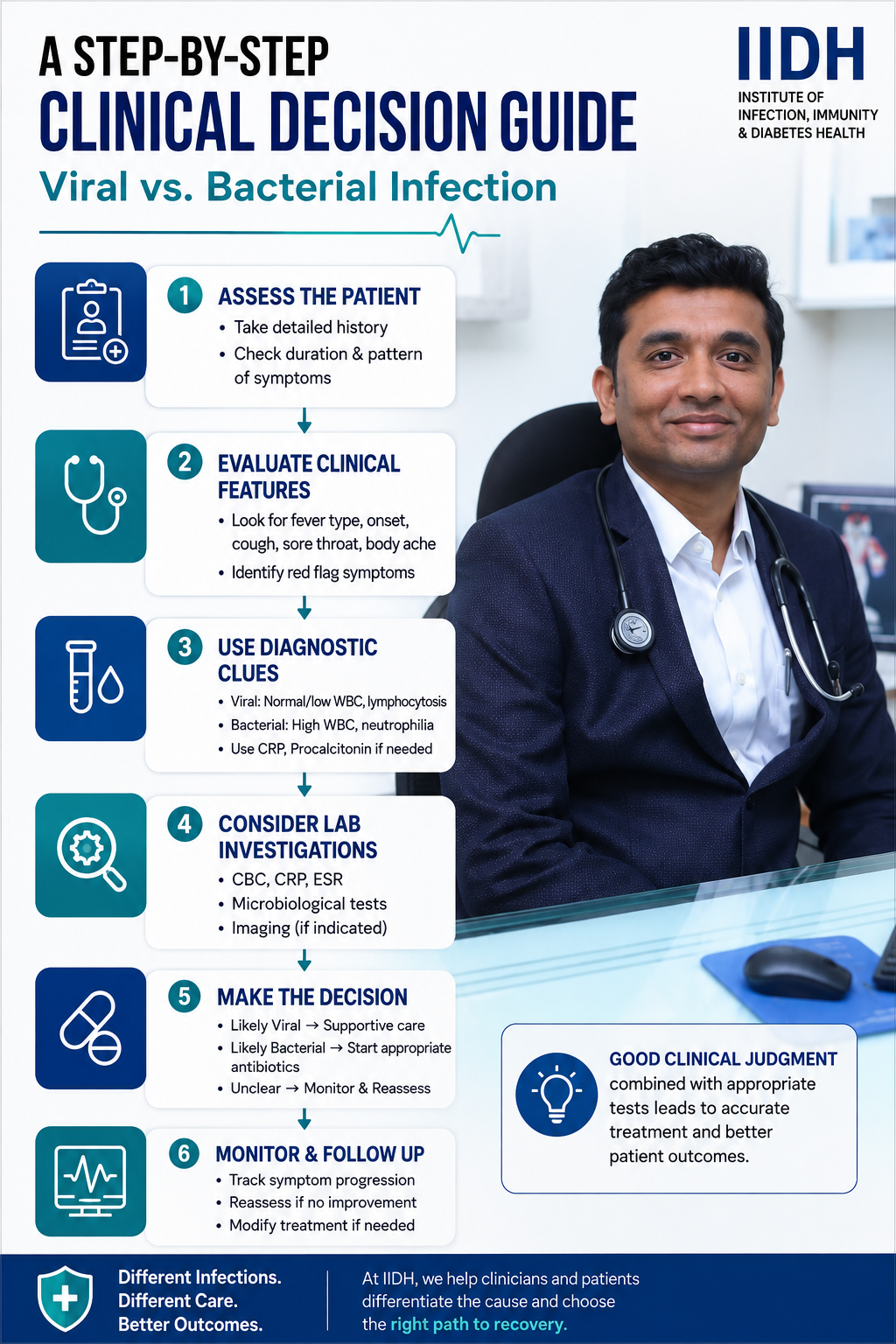
A Step-by-Step Clinical Decision Guide

1

Is this a known viral illness?

Common cold, influenza, dengue, COVID-19, viral gastroenteritis (vomiting + loose stools, no blood), chickenpox, viral hepatitis A/E — these are always viral. No antibiotics are indicated.

 Yes — do not take antibiotics Not sure — proceed to step 2
2

Are there localising signs of bacterial infection?

Painful swollen ear with discharge (otitis media). Purulent (green/yellow thick) productive cough with high fever (bacterial pneumonia). Painful urination + cloudy urine (UTI). Severe sore throat + white exudate + no runny nose (strep pharyngitis). Neck stiffness + photophobia (MENINGITIS — emergency).

 Yes — specific localising signs → see Dr. Savaj for culture No specific signs → likely viral, supportive care
3

Has a culture been sent before starting antibiotics?

Culture before antibiotics is the most important step — it identifies the organism, determines which antibiotic will actually work, and detects resistance. Starting antibiotics before culture makes subsequent cultures negative and removes the ability to know if the right antibiotic was chosen.

 Yes — wait for sensitivity, then use the right antibiotic No — send culture first if condition allows; if emergency, start empirically
4

If you have been prescribed antibiotics — complete the full course.

Stopping antibiotics when you feel better is one of the primary drivers of antibiotic resistance. You feel better because the antibiotic has reduced the bacterial load — but the remaining bacteria are the ones that survived exposure to the drug. Completing the full course eliminates them.

 Complete all doses Never stop early even if feeling better
5

Was fever not improving after 48–72 hours of antibiotics?

If fever and symptoms are not improving 48–72 hours after starting an antibiotic that should work, the organism may be resistant to that antibiotic, the diagnosis may be wrong, or there may be a complication. Return to Dr. Savaj — do not add more antibiotics empirically.
 Improving — continue full course Not improving → return to Dr. Savaj for reassessment
Antibiotic decision SCID-AI Surat
The Resistance Crisis

Antibiotic Resistance in India — A Crisis Driven by Misuse

India has among the highest rates of antibiotic resistance globally — and the primary driver is the use of antibiotics for viral infections and without culture guidance. Every unnecessary antibiotic course kills sensitive bacteria and creates selection pressure for resistant strains. These resistant strains spread through the community, hospitals, and food chain.

The consequence in Surat today: UTIs that were once cured with 3 days of oral ciprofloxacin now require 7–14 days of IV antibiotics because E. coli is resistant to fluoroquinolones in more than 50% of isolates. XDR typhoid (resistant to fluoroquinolones, ampicillin, chloramphenicol, and trimethoprim) now circulates in Surat — treatable only with azithromycin or carbapenems. This is a direct, measurable consequence of decades of antibiotic misuse.

At SCID-AI — Culture Before Every Antibiotic

Dr. Savaj’s practice: culture is sent before every antibiotic prescription where the clinical condition allows. This identifies the organism, detects resistance, selects the right drug, and contributes to the local resistance surveillance data. Empirical antibiotics without culture — never repeated if the same infection recurs without a new culture.

50%+E. coli fluoroquinolone resistanceIndia — ciprofloxacin now failing for UTIs
XDRTyphoid now in SuratResistant to all first and second-line drugs
80%Sore throats are viralYet most receive antibiotics empirically
2 yrsGut microbiome disruptionFrom a single amoxicillin-clavulanate course
Antibiotic resistance SCID-AI Surat

 Never Do These

Take leftover antibiotics from a previous course for a new illness
Take a friend's or family member's antibiotic without prescription
Take antibiotics for every fever without diagnosis
Stop antibiotics when you feel better before completing the course
Self-prescribe azithromycin for every respiratory infection
Take antibiotics for dengue, influenza, or viral gastroenteritis
Demand antibiotics from a doctor who has not done a culture for a recurring infection
Patient Feedback

What Patients Say About Diagnosis at SCID-AI

My 8-year-old had a fever for 4 days. The first doctor gave antibiotics on day 1 without any test. Dr. Savaj sent a dengue NS1 on day 1 of our visit — positive. He explained why antibiotics are harmful in dengue, not just useless. He managed the platelets and fluid balance. We avoided hospitalisation. Knowing the difference between viral and bacterial changed everything for our family.

MP
Meena P.Child with dengue — antibiotics avoided · Surat

I had a UTI six times in one year. Every doctor gave ciprofloxacin — each course helped temporarily but it came back. Dr. Savaj sent a urine culture every time. By the fourth culture, E. coli was resistant to ciprofloxacin. He switched to nitrofurantoin based on sensitivity, treated the underlying bladder anatomy issue, and I have had one UTI in 18 months. Culture before antibiotics made the difference.

LN
Lata N.Recurrent UTI — culture-guided treatment · Surat
Common Questions

Frequently Asked Questions About Viral vs Bacterial Infections

Answered by Dr. Pratik Savaj, FNB Infectious Diseases, SCID-AI, Surat.

How do doctors distinguish viral from bacterial infections?
Clinicians use a combination of: History: duration, onset pattern, associated symptoms, contacts. Gradual onset with prominent runny nose, mild sore throat, body ache without localising signs suggests viral. Sudden onset with high fever, localising signs (painful ear, productive cough with purulent sputum, dysuria), and no runny nose suggests bacterial. Examination: inflamed tympanic membrane with pus suggests bacterial otitis media; clear otitis media fluid suggests viral. Tonsillar exudate with fever and no cough — bacterial (streptococcal) pharyngitis. Investigations: elevated WBC with neutrophilia (high neutrophil count) suggests bacterial; lymphocytosis (high lymphocyte count) or normal WBC suggests viral. CRP above 100 mg/L is more consistent with bacterial infection. Blood culture is definitive for bacteraemia. Throat swab / rapid strep test confirms streptococcal pharyngitis. No test is 100% discriminating — clinical judgement integrates all findings.
Why do antibiotics not work against viruses?
Antibiotics target structures and processes that exist in bacteria but not in viruses. The most common antibiotic mechanisms: Beta-lactams (amoxicillin, cephalosporins): inhibit bacterial cell wall synthesis. Viruses have no cell wall — this mechanism has nothing to attack. Fluoroquinolones (ciprofloxacin): inhibit bacterial DNA gyrase. Viruses use completely different replication machinery — this enzyme does not exist in viral particles. Macrolides (azithromycin): inhibit bacterial ribosome (50S subunit). Viral ribosomes (where they use the host cell’s) are structurally different — azithromycin has no antiviral effect. Viruses replicate by hijacking the host cell’s own machinery — targeting them without harming the host’s cells is the fundamental challenge of antiviral development, and why there are far fewer antivirals than antibiotics.
What is antibiotic resistance and why does it matter in India?
Antibiotic resistance occurs when bacteria evolve mechanisms to survive exposure to antibiotics that would previously kill them. When antibiotics are taken unnecessarily (for viral infections) or incompletely, sensitive bacteria are killed but naturally resistant variants survive and reproduce — a process of selection pressure. India has among the highest antibiotic resistance rates globally: over 50% of E. coli isolates in India are resistant to fluoroquinolones (ciprofloxacin, levofloxacin) — now the most common antibiotic class used empirically for UTIs and GI infections. XDR (extensively drug-resistant) typhoid is now common in Surat. The primary driver is over-the-counter antibiotic use without prescription and without culture. The consequence: infections that were once easily treated with oral antibiotics now require IV hospitalization. This is a direct, measurable harm from taking antibiotics for viral illness.
Can a viral infection become a bacterial infection?
Yes — this is called a secondary bacterial infection, and it is the most important reason why viral illnesses sometimes do require antibiotics — but only after the secondary infection occurs, not prophylactically. The mechanisms: Viral damage to epithelial barriers allows bacteria normally present on mucosal surfaces to invade deeper tissues. Viral suppression of immune responses reduces the ability to clear colonising bacteria. Classic examples: influenza followed by Staphylococcal or Streptococcal pneumonia (historically the main cause of death in influenza pandemics). Viral URTI followed by bacterial sinusitis (persistent purulent nasal discharge beyond 10 days with worsening fever). Viral lower respiratory infection followed by bacterial pneumonia (new spike of fever after initial improvement, productive purulent cough). Signs of secondary bacterial infection require reassessment and possible antibiotic therapy — but this is different from giving antibiotics at the start of every viral illness “to prevent infection.”
Is azithromycin (Z-pack) effective for respiratory infections?
Azithromycin is effective for specific bacterial respiratory infections: Community-acquired pneumonia caused by atypical organisms (Mycoplasma pneumoniae, Chlamydophila pneumoniae, Legionella) — these lack cell walls and azithromycin's macrolide mechanism works against their ribosomes. Whooping cough (Bordetella pertussis). Traveller's diarrhoea (azithromycin is now preferred over ciprofloxacin due to widespread E. coli fluoroquinolone resistance). It does NOT work for: common cold (rhinovirus, coronavirus — viral); standard seasonal influenza; COVID-19 (no antiviral activity demonstrated in robust trials despite widespread use). The practice of prescribing azithromycin for every fever or cough — extremely common in India — is clinically unjustified and drives macrolide resistance. In Surat, azithromycin should be culture-guided for bacterial infections or reserved for specific clinical indications.
When should I specifically NOT take antibiotics?
Antibiotics are specifically not indicated for: Common cold (rhinovirus, coronavirus) — always viral, always resolves without antibiotics in 7–14 days. Antibiotics do not shorten duration or reduce severity. Seasonal influenza: viral. Antivirals (oseltamivir) exist but antibiotics are not indicated unless secondary bacterial pneumonia develops. Viral gastroenteritis (stomach flu): most acute gastroenteritis is viral (norovirus, rotavirus); antibiotics worsen norovirus illness. COVID-19: viral; antibiotics have no effect on the virus. Dengue fever: viral; antibiotics are actively harmful (alter gut flora, increase bleeding risk in severe dengue). Sore throat without strep: 80% of sore throats are viral; only confirmed streptococcal pharyngitis (rapid strep test positive) requires antibiotics. The rule: never take an antibiotic without knowing whether the infection is bacterial — if uncertain, culture before treating.
What are the side effects of taking antibiotics unnecessarily?
Unnecessary antibiotic use causes measurable harm beyond just resistance: Gut microbiome disruption: antibiotics kill beneficial gut bacteria alongside pathogens. A single course of amoxicillin-clavulanate can alter gut microbiome composition for up to 2 years. This increases vulnerability to Clostridioides difficile (C. diff) colitis — a severe, sometimes fatal diarrhoeal illness. Antibiotic-associated diarrhoea: occurs in 5–35% of antibiotic courses. Clindamycin and amoxicillin-clavulanate are highest risk. Allergic reactions: ranging from mild rash to anaphylaxis. Penicillin allergy is the most common drug allergy. Tendon damage: fluoroquinolones (ciprofloxacin, levofloxacin) cause tendinopathy — particularly Achilles tendon rupture — especially in the elderly. QT prolongation: azithromycin causes cardiac rhythm changes at standard doses — dangerous in patients with underlying heart disease. Drug interactions: multiple interactions with common medications.
How do antiviral medications work differently from antibiotics?
Antiviral medications work by targeting virus-specific steps in viral replication — processes that exist in viruses but not in normal human cells. Key mechanisms: Entry inhibitors: block viral attachment to host cell receptors (e.g., some HIV antiretrovirals). Protease inhibitors: block viral enzymes that process precursor viral proteins — HIV protease inhibitors (lopinavir, ritonavir). Polymerase inhibitors: block viral RNA or DNA polymerase (oseltamivir/Tamiflu blocks influenza neuraminidase; tenofovir blocks HBV/HIV reverse transcriptase). Integration inhibitors: block HIV integrase which inserts viral DNA into host chromosome (raltegravir, dolutegravir). Developing antivirals is harder than antibiotics because viruses use the host cell’s own machinery extensively — blocking viral replication without harming normal cells requires identifying the few truly virus-specific steps. This is why effective antivirals exist for relatively few viruses (HIV, HBV, HCV, influenza, HSV) compared to the broad spectrum of available antibiotics.
Consult Dr. Pratik Savaj

Unsure If You Need Antibiotics? Ask Dr. Savaj.

No referral needed. Dr. Pratik Savaj, FNB Infectious Diseases, SCID-AI, Nanpura, Surat cultures before treating, identifies whether the infection is viral or bacterial, and prescribes the right antibiotic — or explains why none is needed. Culture before antibiotics. Every time.

SCID-AI, Nanpura, Surat — 405 SNS Axis Business Space, Besides Mahavir Hospital, Surat 395001
Mon–Sat: 11 AM–1 PM & 4–6 PM · Sunday: Closed
+91 72839 34807 — Call or WhatsApp
Dr. Pratik Savaj
Dr. Pratik Savaj FNB Infectious Diseases
MBBS · DNB Medicine · Fellowship ID
P.D. Hinduja Hospital, Mumbai
Morning11:00 AM – 1:00 PM, Mon–Sat
Evening4:00 PM – 6:00 PM, Mon–Sat
Phone+91 72839 34807
 WhatsApp to Book